Portuguese
  Spanish



Mechanical Technician Creates Solar Heater with PET Bottles That Has Been Working for Over 20 Years and Has Benefited 7,000 Families in Brazil
Unhappy with the improper disposal of waste, retired mechanical technician José Alcino Alano, from Tubarão (SC), developed in 2002 a homemade solar heater with PET bottles and long-life cartons that still works today. The system arose from the difficulty of properly discarding recyclable waste accumulated at home and the lack of recycling infrastructure in the municipality.
Not wanting to throw away the PET bottles and packages consumed by the family, Alano and his wife Elizete created a prototype using 100 PET bottles, 100 one-liter Tetra Pak cartons, and PVC tubes. The equipment has been in operation for over two decades, proving the durability of the social technology that received the Super Ecology Award 2004 from the magazine Superinteressante.
Thermo-Siphon System Replaces Conventional Solar Panels for Just R$ 83
The solar heater with PET bottles operates on the principle of thermo-siphon, the same used in commercial solar systems that cost thousands of reais. The difference lies in the materials used.
-
A fossil kept for years in a small museum in Montreal concealed 450-million-year-old soft tissue, a discovery that has only happened once before in history.

-
Three teenagers transform cut cardboard into Japanese origami-style packaging that promises to retire styrofoam and bubble wrap, win a $12,500 prize, and target giants like Amazon, FedEx, and Home Depot after a robot motor arrived broken.

-
The large jar blender has a rival: Oster Ultra Power bets on 1,000 W, six stainless steel blades, and two portable cups with leak-proof lids.

-
Tesla injected an additional $250 million into the German factory, doubled the battery cell target, and opened its own production line for startups.


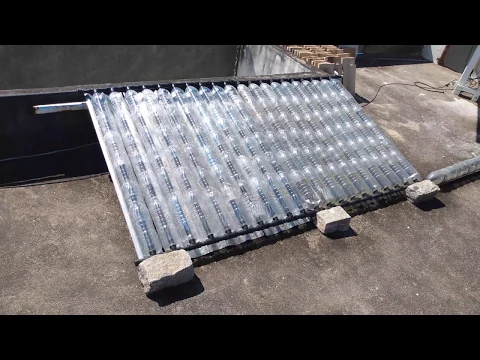

While industrial collectors use copper tubes, metal structures, and tempered glass, Alano’s model employs transparent PET bottles, long-life cartons painted matte black, and PVC tubes. The bottles create a simplified greenhouse effect, retaining heat. The painted cartons absorb solar radiation and transfer the heat to the water circulating through the PVC columns.
The cost of the first installation in 2002 was only R$ 83, making the solar heater accessible for low-income families.
System Heats Up to 250 Liters of Water and Reaches 52°C in Summer
The standard model developed by Alano uses 240 two-liter PET bottles and 200 long-life cartons, forming a thermal absorption area of approximately 1.80 m².

With about six hours of sunlight, the water stored in a 250-liter tank can reach up to 52°C in summer, requiring mixing with cold water for use. In winter, even with initial temperatures between 13°C and 16°C, the system can heat up to 38°C on sunny days.
The equipment comfortably serves a family of four, providing hot water throughout the day. The average lifespan of the system is six years, and even on cloudy days, it still maintains partial heating, losing about one degree per hour without direct sunlight.
National Recognition Boosts Partnerships with State Governments
In 2004, the project won the Super Ecology Award, opening doors for partnerships with public agencies. Celesc (Santa Catarina Power Company) signed a technical cooperation agreement to expand the dissemination of the technology.
The government of Santa Catarina adopted the program “Hot Water Combines with Economy and Environmental Preservation.” In Paraná, the initiative was named “Hot Water for All,” coordinated by the State Department of the Environment.
By 2011, over 6,000 solar heaters with PET bottles had been installed in low-income communities in Paraná. Training workshops were created to train technology multipliers in five Brazilian states.
Free Manual Prevents Undue Commercial Exploitation
Alano registered the invention with the INPI for a strategic purpose: to prevent political use, avoid undue commercial industrialization, and ensure that the system remained available for free for self-construction.
In 2004, 500,000 free manuals were distributed, teaching step by step how to assemble the solar heater. Today, there are technical publications prepared by Celesc and the government of Paraná with detailed guidance on sizing, solar positioning, and proper installation.
Anyone can learn to build the system without paying royalties, maintaining the philanthropic nature of the project.
Savings of Up to 40% on Electricity Bill
In homes where the electric shower represents a large part of energy consumption, installing the solar heater can reduce electricity bills by up to 40%, saving about 120 kWh per month.
According to data from the electricity sector, the electric shower accounts for approximately 25% of household consumption. The reduction directly impacts the family budget and also decreases the overload on the electrical system during peak hours, between 5 PM and 8:30 PM.
Environmental Impact: Millions of Reused Packages
With the 6,000 systems installed in Paraná, it is estimated that 1.2 million PET bottles and nearly 1.5 million long-life packages were reused, avoiding disposal in landfills.
The largest system built was installed at the lodging of the 15th Combat Engineer Company of the Army in Paraná, heating 8,000 liters of water per day and reusing approximately 1,700 bottles just in that unit.
Youth Training Expands Social Technology
In 2021, the Department of the Environment of Paraná partnered with the Brazilian Scout Association to train 4,800 youths in assembling the solar heater with PET bottles.
The initiative created a network of multipliers who teach the technology in communities, strengthening environmental education and energy efficiency.
Energy Bath Project Serves Cold Regions
In 2011, a partnership between Celesc, Epagri, and the Rural Development Fund created the Energy Bath project, aimed at the mountainous regions of Santa Catarina.

200 systems were installed in 34 municipalities, with 80% of the cost subsidized by Celesc and the remainder financed by the FDR. In 2014, a new phase invested R$ 7.2 million to install 1,000 complementary systems for recovering heat from wood stoves.
The technology was implemented in Santa Catarina, Paraná, Minas Gerais, São Paulo, and Rio de Janeiro. It has also been adopted by universities, preschools, community associations, and even vocational training centers.
The project has become a reference for low-cost social technology, integrating energy efficiency, waste reuse, and income generation for recycling cooperatives.