Portuguese
  Spanish


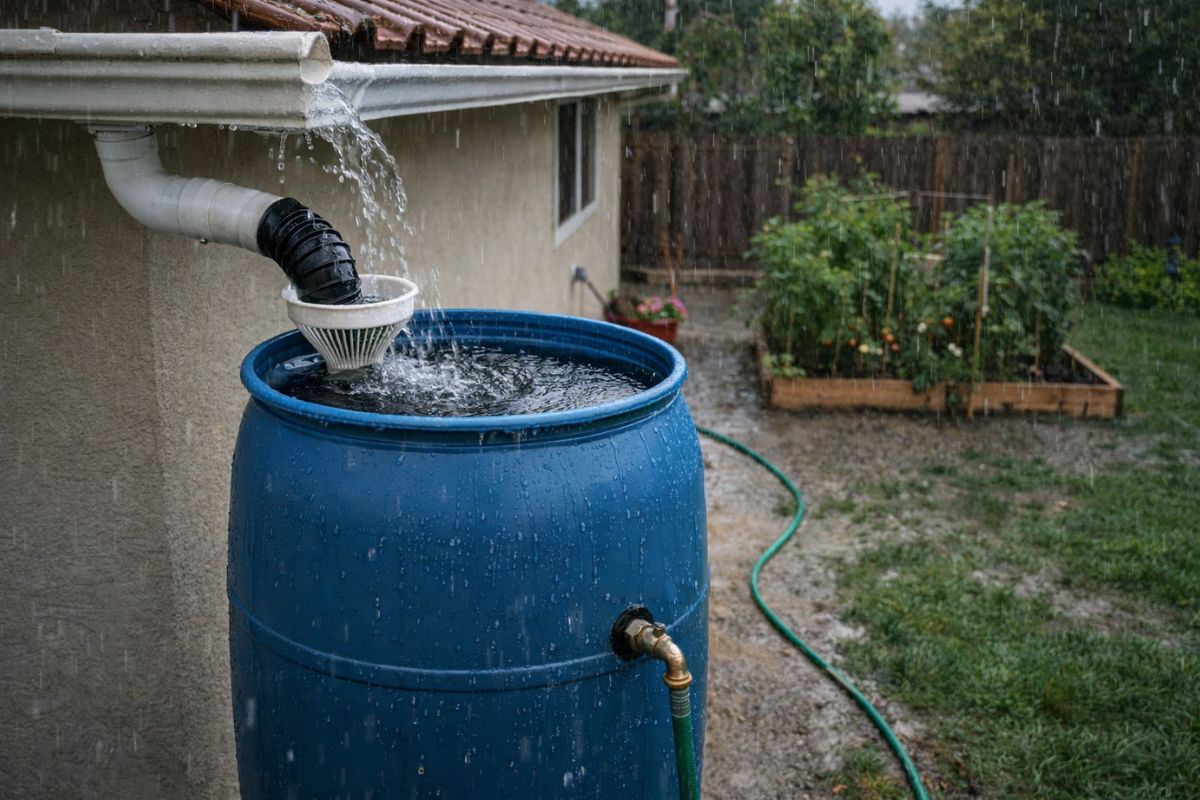


Rainwater Harvesting On A Small Scale Can Be Set Up In The Yard With A Reused Barrel, Simple Connection To The Roof And Secure Base, According To A University Manual Targeted At Residents Who Want To Reduce Drinking Water Use In Irrigation, Take Advantage Of The Rain Between Events And Disregard Heavy Intervention On The Entire Structure Of The House.
The rainwater harvesting that makes the most sense for a common yard does not start with large construction or an underground system. It starts with a straightforward logic: collect the water that falls on the roof, direct it through a gutter, a downspout, or even a rain chain, and store that volume in a barrel for later use in irrigation and other outdoor tasks. The university manual used here as a basis describes exactly this domestic and accessible model.
The most interesting point is that the proposal does not treat rainwater harvesting as an eco-gadget, but as a management tool for the house. The guide states that, with the right tools, a barrel can be assembled for less than 100 reais, which shifts the conversation from expensive construction to a feasible project. The central idea is simple: capture from the roof, store near the point of use, and empty between rain events.
What This System Really Needs To Function

In practice, rainwater harvesting on a small scale has three essential components. The first is the catchment area, usually the roof.
-
Furong: The 2,000-Year-Old Chinese City Built on a 60-Meter Waterfall Becomes a Global Tourist Phenomenon

-
YouTube Inventor Dubbed “Real-Life Tony Stark” Builds Robotic Legs for Father’s Day, Creating a Wheelchair That Conquers Stairs and Rough Terrain

-
Brazilian Scrap Dealer Processes 3,000 Tons of Ferrous Scrap Monthly, Paying $0.09 to $0.70 per Pound, Reveals Why a Hidden Cylinder Costs 1,500 kg Discount

-
Alabama Family Converts Giant Grain Silos into a 1,750 sq ft Rustic Home, Spending $100,000 to Prove the Impossible





The second is the conduction system, which can be made by gutters, downspouts, rain chains, or directed flow.
The third is storage, which in the simplest case is a barrel. The manual also provides an important warning: this water should only be made potable if specific treatment is applied and it complies with local regulations.
Without this, its use should remain in non-potable functions.
This aspect explains why the guide focuses on barrels, and not on larger cisterns.
Barrels are treated as a small-scale solution, typically under 100 gallons, cheaper and much more viable for those who want to start in the yard without renovating the entire house.
Larger cisterns fall into a different category of complexity, cost, and installation.
For a resident who wants to reuse water from the roof without heavily modifying the structure, a barrel appears as the most realistic entry point.
From The Roof To The Barrel Without Damage
The manual dismantles a common idea that rainwater harvesting necessarily depends on a pre-existing and perfect gutter.
With a gutter, transport is easier. Without a gutter, it is still possible to concentrate the collection at the corners of the eaves or use a rain chain to direct the water to the barrel.
The crucial detail lies less in sophisticated equipment and more in observing the water’s path during a real rain.
Those who do not understand where the water flows on their own roof already begin the project in the dark.
After that, comes the most overlooked and at the same time most sensitive part: the installation site.
The guide recommends choosing the capture point, planning where the water will be used, and positioning the barrel near the plants or the area that will actually receive irrigation.
It also insists that the terrain or platform should be level and strong enough to support the total weight of the system.
A full 55-gallon barrel exceeds 450 pounds, and this completely changes the responsibility of the base. Improvising support can turn water savings into risks of falling, damage, and accidents.
Where The Savings Appear For Real
The strength of rainwater harvesting becomes evident when calculating the volume. The manual states that one inch of rain on a 1,000 square foot roof can generate over 600 gallons of runoff.
To visualize, that’s too much water to flow directly through the downspout without serving the house in any way.
The same material notes that Alabama records an average of 56 inches of annual precipitation, although this does not eliminate dry spells and dry periods. In other words, there is significant water availability, but it needs to be captured when it arrives.
This helps understand why the home system can alleviate the use of drinking water in the garden.
The guide also reminds that outdoor consumption takes up a significant portion of residential water, and irrigation weighs heavily on that total.
Storing rain for outdoor use is, first of all, a source exchange, and not a magical promise of total independence.
The barrel does not replace the entire house supply but can specifically target a recurring and silent expense: treated water used for tasks that do not require human consumption standards.
What A Small Barrel Can Deliver In Routine
There is a physical limit that the guide addresses honestly.
Rainwater harvesting with a small barrel works well for watering cans, buckets, short hoses, and localized irrigation, but it does not generate enough pressure for underground sprinklers or misting devices.
The document explains that raising the barrel improves pressure and offers a useful equivalence: a column of water 2.31 feet above the outlet produces 1 psi. Height, in this case, is not an aesthetic detail; it’s performance.
For this reason, the elevated base appears as a practical recommendation, not a decorative one.
The material cites examples such as concrete blocks, stacked stones, or treated wood platforms, always emphasizing stability and load capacity.
If the resident wants to go beyond watering cans, an infiltration or drip hose close to the barrel can work, as long as the system is adjusted for low pressure. It’s a domestic, controlled, and localized use. It is not a mini hydraulic station.
The Mistakes That Most Ruin A Simple Project
The most serious part of the guide is the one that tries to prevent rainwater harvesting from becoming a dirty, open, and poorly directed reservoir.
The recommendation is clear: use a food-grade barrel, never reuse a container that transported chemicals, keep the entrance always screened, and never treat the collected water as suitable for drinking, cooking, or direct human contact without additional treatment.
The document also notes that mosquitoes can go from egg to annoyance in about seven days in containers filled with water, which explains the insistence on sealing and screening.
Another recurring mistake lies in overflow.
The guide advises that the excess outlet should be properly sized and direct the water at least 10 feet away from the house, preferably towards a permeable area, such as a planter or rain garden.
It also warns that flow should never be directed over a septic system’s absorption field.
In a small project, the biggest loss usually comes not from the rain that gets in but from improperly addressed excess water.
Maintenance Is What Separates Reuse From Make-Do
The manual treats maintenance as a minimum routine, not as perfectionism.
The guidance is to avoid letting water sit for more than a week, clean gutters at least twice a year, empty and rinse the barrel at least once a year, check for leaks, monitor screens, and observe where the excess is going after heavy rains.
If runoff is eroding the soil, the guide suggests using plants or stones to contain the problem and maintain slow infiltration on permeable surfaces.
There is also a visual point with practical function.
Clear barrels promote more algae growth, so the document recommends a dark color or, if the barrel is too exposed to sunlight, relocation to a shadier spot or using vegetation around it. It’s not just about appearance.
Maintenance, shade, and sealing are part of the quality of stored water and the system’s lifespan.
When this is neglected, the project ceases to be a domestic solution and becomes a poorly disguised problem.
The rainwater harvesting taught by this university guide does not promise miracles or total autonomy.
It promises something more credible and useful: to reduce the use of treated water in the yard, make use of what already falls on the roof, avoid waste between rain events, and assemble all of this on a domestic scale, as long as the resident respects weight, sealing, overflow, and maintenance.
If you were to start this system in your home this semester, what would be the biggest factor holding back your decision: space in the yard, base safety, adaptation of the gutter, or discipline to keep the barrel clean and empty between rains?