






 Portuguese
  Spanish


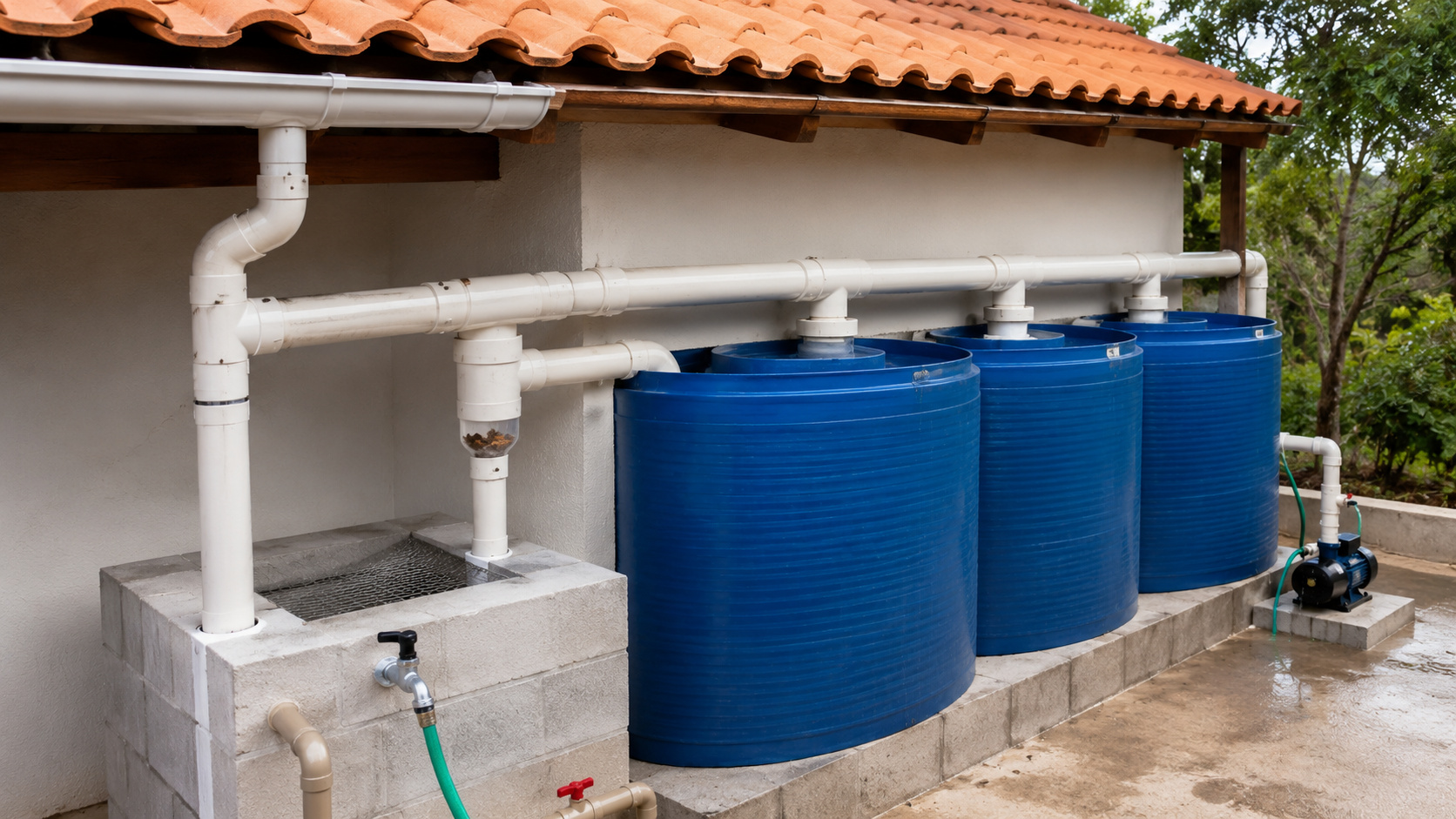
Rainwater harvesting with 100 mm PVC pipe, filter, and reservoir can utilize thousands of liters per year for non-potable uses.
A simple rainwater harvesting system with a 100 mm PVC pipe, basic filtration, and a small reservoir can function as an economical alternative for storing water for non-potable uses, provided the sizing considers roof area, rainfall volume, and runoff coefficient. The technical booklet from FEAM/FIEMG notes that 1 mm of rain over 1 m² equals 1 liter, making it possible to achieve something like 5,000 liters over the year in small or partially utilized structures.
In the retail market consulted via Buscape on June 23, 2026, a 3-meter 100 mm PVC pipe was priced at R$ 71.90 and a 500-liter water tank at R$ 289.90, indicating that a basic setup can cost significantly less than more complete commercial systems, although the final price depends on the filter, connections, and shipping.
How rainwater harvesting works in a simple residential system
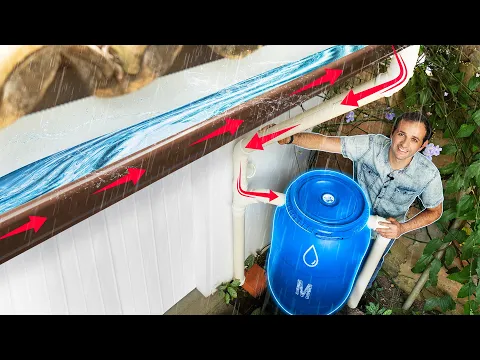
The most basic setup consists of four parts. The first is the catchment surface, usually the roof. The second is the water conveyance, done by gutters and vertical pipes. The third is the filter, which reduces the entry of leaves and debris. The fourth is the reservoir, where the water is stored for later use.
-
Brazilian Government Invests $48 Million to Upgrade Highway in Southern Brazil, Elevates Sections to Mitigate Flood Impact

-
Architect Uses 7,000 Clay Tea Cups to Create Natural Air Conditioning, Cooling House by 5°C and Reducing Energy Bills

-
New Trend in Home Renovations: Painting Concrete Floors Enhances Durability, Cuts Maintenance Costs, and Modernizes Spaces Quickly

-
Denver’s “Housing First” Approach Reduces Homeless Population by 64% in Three Years: 2026 Census Finds Only 518 People on Streets, 7,700 Moved to Permanent Housing




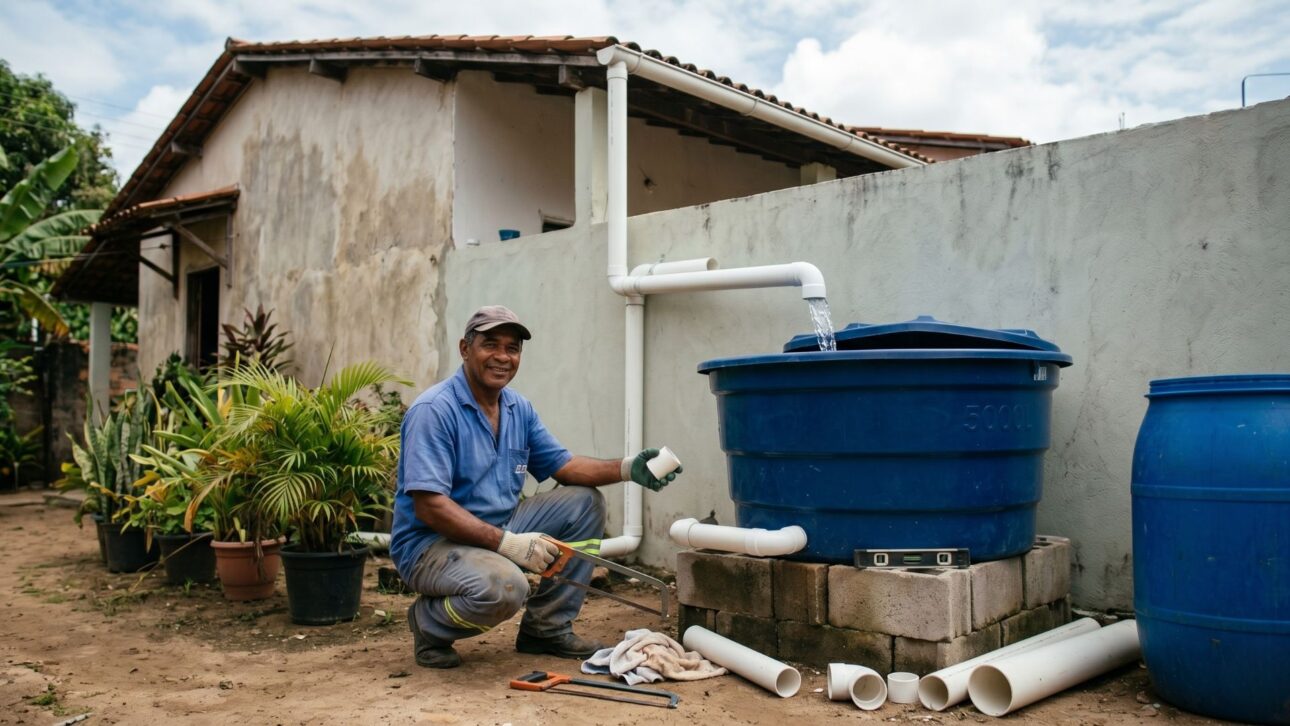
In practice, the rain falls on the roof, flows into the gutter, and follows the downpipe to the filtration point.
After that, the water passes through the initial discard system and enters the reservoir. The IPT and the FIEMG/FEAM booklet emphasize that separating the first rain is important because it carries the dirtiest part washed from the roof.
In the model described in the article, using a 100 mm PVC pipe can be a functional solution for the water downpipe, especially in homemade setups with good flow. Still, the pipe sizing should match the catchment area and rainfall intensity, as the system’s performance depends on the hydraulic set, not just the isolated diameter.
Roof area, annual rainfall, and losses define the collection potential
According to the FIEMG/FEAM guide, the estimate of utilization depends on the catchment area, the local rainfall indices, and the runoff coefficient of the roof material.
The publication itself shows, for example, that ceramic tiles usually work with coefficients between 0.60 and 0.90, while smoother coverings can have higher utilization.

Using the simplified calculation from the example, a roof of 50 m² in a region with 1,200 mm of rain per year, with a coefficient of 0.8, would have a theoretical potential of 48,000 liters annually. Since 1 mm of rain over 1 m² equals 1 liter, the calculation is straightforward: 50 × 1,200 × 0.8 = 48,000 liters per year. In this logic, achieving something like 5,000 liters annually in small structures or with partial utilization is entirely plausible.
This shows why the collection potential varies so much from one house to another. A larger roof, in a rainier city and with better runoff material, naturally delivers higher volumes. Meanwhile, small roofs or regions with prolonged drought significantly reduce the final result.
100 mm PVC pipe helps with flow, but filter and initial discard are decisive
The 100 mm PVC pipe is often chosen in simple systems because it offers a wide flow section and reduces the risk of bottlenecks during heavier rains.
In residential setups, this helps to channel the water from the gutter to the filtration point and the reservoir with a lower chance of overflow or clogging, provided there is correct inclination and well-made connections.

But the system’s performance does not depend solely on the piping. The IPT advises installing a fine mesh screen on the pipe descending from the gutter to retain leaves and larger debris, while the FIEMG/FEAM guide includes the self-cleaning filter and the first rainwater discard reservoir among the basic elements of the setup.
This point is crucial because the first precipitated volume is precisely the one most loaded with dust, animal feces, leaves, and particles accumulated on the roof. Without this step, the stored water reaches the reservoir with much worse quality and requires more frequent maintenance.
Service budget platforms in Brazil like Getninjas indicate that the professional installation or replacement of a water tank can range from a few hundred reais to more than R$ 1,000, depending on the reservoir’s capacity, the need to remove the old piece, the reinforcement of the base, and the complexity of the installation.
Well-sealed reservoir defines the safety of storage
After filtering and initial disposal, the water needs to be directed to a suitable and covered reservoir. The IPT advises that this storage be protected against the entry of dirt and, especially, mosquitoes, in addition to emphasizing the importance of keeping the water in an appropriate reservoir.
Plastic water tanks and cisterns are common solutions because they simplify installation and sealing. The choice of size depends on the roof area, rainfall pattern, and the volume the residence intends to replace in non-potable uses.
The most common mistake is installing a reservoir without foreseeing the overflow, which needs to exist to release excess during heavy rains.
The water accumulated in this system should not be intended for human consumption without proper treatment. The IPT manual is direct in stating: “Can I drink rainwater? No!”, precisely because the water can carry contaminants and its quality is not automatically guaranteed for drinking or cooking.
Rainwater can replace treated water in various domestic uses
The ABNT NBR 15527, cited by Adasa, lists non-potable uses such as toilet flushing, irrigation, vehicle washing, floor cleaning, and other uses compatible with this type of water. This means that even simple systems can alleviate the demand for treated water in daily activities that do not require potable standards.
In practice, this includes irrigating gardens and vegetable patches, washing patios, cleaning external areas, and supplying the toilet flush when the installation is adapted for this.
The FIEMG/FEAM guide also highlights that the use of rainwater can contribute to the reduction of costs associated with water tariffs, in addition to reducing surface runoff.
This saving, however, varies according to the household’s consumption habits and the regularity of rainfall. The system does not fully replace conventional supply in any property, but it can significantly reduce the use of treated water in the most repetitive tasks.

Simplified installation and regular maintenance keep the system functional
The basic assembly usually follows a simple sequence. First, the gutter is connected to the vertical conductor. Then, the filtration and first rain disposal are installed. Next, the piping is led to the reservoir, which needs to have a lid, insect protection, and an overflow outlet.
Maintenance is what prevents a simple system from becoming a sanitary problem. This includes cleaning the filter and gutters, checking for obstructions, verifying loose connections, maintaining the proper slope of the pipe, and inspecting the interior of the reservoir.
The IPT also recommends ongoing care for the quality of stored water and protection against mosquitoes.
In the end, the rainwater harvesting system with a 100 mm PVC pipe, filter, and reservoir shows how a relatively simple structural solution can enhance the use of a frequently wasted resource.
When the project adheres to basic principles of sizing, initial disposal, sealing, and maintenance, the residence gains a complementary source for non-potable uses and reduces the pressure on treated water.








Be the first to react!