






 Portuguese
  Spanish


In India, architect Gokul Goyal used about 7,000 clay tea cups, the kulhads, as thermal insulation on the roof. The air trapped inside them and the reflective mosaic create a natural air conditioner that makes the house 5 °C cooler and cuts 25% off the electricity bill.
It sounds like a joke, but it’s good engineering. An Indian architect bought thousands of clay cups like those used to serve tea on the streets of India, turned them all upside down, and buried them in the roof of his own house. On top, he applied cement and a colorful mosaic. The result is a roof that functions as a natural air conditioner, without a motor, without gas, and without adding to the electricity bill, using only clay, air, and physics.
The feat belongs to Gokul Goyal, an architect from the city of Hisar, in the state of Haryana, and was detailed by Business Today in June 2026. Approximately 7,000 kulhads, the disposable clay cups used for drinking tea, were transformed into roof thermal insulation. In a country that boils in the summer and where the electricity bill is increasingly burdensome, Goyal’s idea shows that it’s possible to beat the heat with material that costs almost nothing.
How 7,000 tea cups became a cooling roof

Goyal spread about 7,000 clay cups across the roof slab, using the cups as a filler that occupies space and creates voids. The key piece is precisely the hollow of each cup, which traps air instead of allowing solid concrete to conduct heat directly into the house.
-
New Trend in Home Renovations: Painting Concrete Floors Enhances Durability, Cuts Maintenance Costs, and Modernizes Spaces Quickly

-
Denver’s “Housing First” Approach Reduces Homeless Population by 64% in Three Years: 2026 Census Finds Only 518 People on Streets, 7,700 Moved to Permanent Housing

-
Couple Transforms Abandoned Fire Station into Dream Home After a Decade of DIY Renovations
-
Bolivian Female Construction Workers Form Association to Combat Discrimination and 38% Pay Gap in the Industry




On top of the kulhads came the finishing touch. The architect covered everything with a layer of cement and finished with mosaic tiles, using a special mixture of white cement and waterproofing compounds to seal the joints and prevent infiltration. The clay is hidden, and the house gains a beautiful terrace, with the added advantage of the mosaic being a non-slip surface.
The charm of the solution is that it hides high ingenuity in a common material. The kulhad is a very cheap clay cup, sold in large quantities in India, and no one would imagine it could become a piece of thermal insulation. Goyal took a disposable item and transformed it into roofing technology, without sacrificing aesthetics or durability.
The simple physics behind the trick
The whole secret is in the air. Still air is one of the best insulators that exist, and that’s exactly what the clay cups do: each kulhad becomes a small sealed air pocket, and thousands of them together form an insulating layer under the floor. This air cushion slows down the passage of heat from the sun to the rooms below, which is the principle of any good thermal insulation.
There is also a second line of defense, up top. According to the architect, the vitrified mosaic reflects up to 70% of the sun’s heat right on the surface, and the remaining 30% that still passes is absorbed by the air pockets inside the clay cups. It’s reflection and insulation working together, one blocking the heat at the entrance and the other preventing the little that remains from reaching the internal ceiling.
None of this depends on electricity, and that’s where the beauty lies. While a conventional air conditioner spends energy to push the heat out, Goyal’s natural air conditioner just rearranges the physics in its favor. The heat is blocked for free, all day long, without any device turned on and without any noise.
5 °C less and up to 25% on the electricity bill
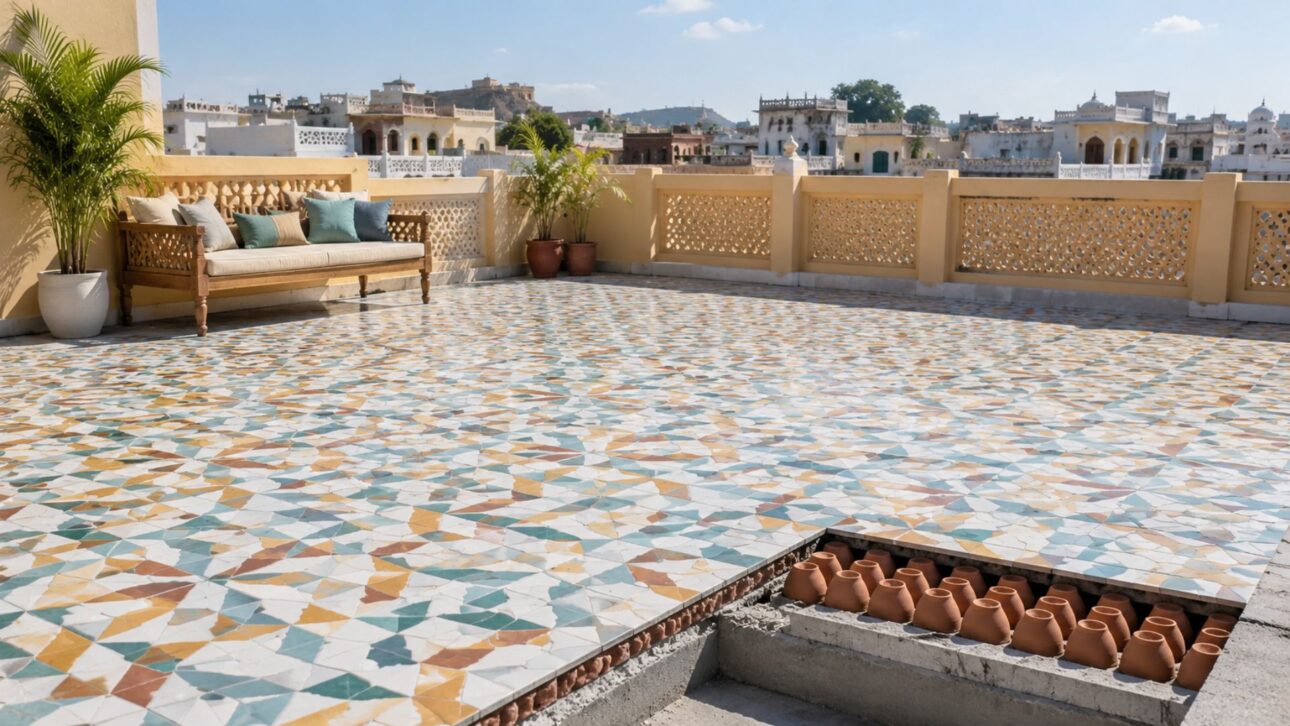
According to the report, the clay cup roof lowers the internal temperature by 4 to 5 degrees Celsius on hot days. In an Indian summer, or a Brazilian summer, this difference is what separates a stuffy environment from one where you can live without suffering.
The economy is directly felt in the wallet. Goyal states that the system reduces energy consumption by 20 to 25%, precisely because fans and cooling devices need to work much less when the house is already naturally cool. Cutting a quarter of the electricity bill with a roof that costs nothing is the kind of math that wins anyone over.
Add the two effects together and natural air conditioning stops being a curiosity and becomes a solution. Less heat inside the house and less money going out on the electricity bill, without relying on a single extra watt. For those living in hot regions, it’s solving two problems with one project.
What is a kulhad and why it is perfect for this
For the Brazilian reader, it is worth explaining the character of this story. The kulhad is a small, handleless clay cup used for centuries in India to serve tea and drinks on the streets, and then discarded. It is cheap, biodegradable, and found everywhere there, making it an abundant and almost free material for those who want to experiment.
The shape greatly aids in thermal insulation. Being hollow, slightly conical, and made of clay, the kulhad combines three useful qualities at once: it creates an air pocket, fits well side by side, and is made of a material that naturally retains heat. Turned upside down on the slab, it is practically already a ready-made insulating brick, as detailed by The Better India.
There is also a beautiful cultural layer to this. Goyal did not import any expensive technology; he looked at a typical object from his own land and saw an engineering solution. The clay tea cups, a symbol of Indian daily life, became the heart of an intelligent roof, combining tradition and technique in a single gesture.
Costs Rs 250 per square foot: cheaper than air conditioning
The price is an essential part of the message. According to the report, the roof made with kulhads costs about 250 rupees per square foot, a value much lower than buying, installing, and maintaining an air conditioner, which also charges a bill every month on the electricity bill. The project is paid once and cools forever.
Besides being cheap, the system is durable and low maintenance. With the joints well sealed by waterproof cement, the set of clay cups withstands time and still delivers a usable, beautiful, and non-slip terrace. It is not a fragile improvisation; it is real finishing, which enhances the house instead of decorating it.
Finally, there is the environmental appeal, which resonates with the moment. It is a natural air conditioner that emits no gases, consumes no electricity, and reuses a simple and biodegradable material. It is sustainability that costs less, not more, the opposite of the reputation that living green weighs on the budget.
Why this matters to Brazil
It’s hard to read this story in Brazil without thinking about our own roof. The country is hot most of the year, heat waves are more frequent, and the electricity bill skyrockets precisely in the months when everyone turns on the air conditioning at the same time. A cheap and passive thermal insulation solution fits like a glove in this scenario.
Of course, copying requires adaptation. The kulhad is typical of India, but the principle works with any material that creates air pockets under a reflective finish, and Brazil has plenty of clay, ceramics, and creativity. Goyal’s lesson is not to use a tea cup, but to understand that still air and a light surface beat the heat. This reasoning fits any Brazilian slab.
In the end, the case proves that not all innovation needs to be expensive or high-tech. Sometimes it’s clay, air, and common sense solving what an expensive device would do while consuming energy. A natural air conditioner made of clay cups is the kind of simple idea that hot and budget-tight Brazil should get to know better.
Gokul Goyal’s contraption shows that it’s possible to tackle the heat with intelligence instead of brute force. Seven thousand clay tea cups, a bit of cement and mosaic, and the roof became a natural air conditioner that lowers the temperature by 5 °C and cuts a quarter of the electricity bill, without plugging anything in. It’s the kind of solution that makes us rethink what we throw away and what we build.
And you, would you consider turning your slab into a roof of clay cups to escape the heat and ease the electricity bill, or do you still prefer the old trust in the air conditioner running at full blast? Tell us in the comments if you would try this idea at home.






Be the first to react!