






 Portuguese
  Spanish


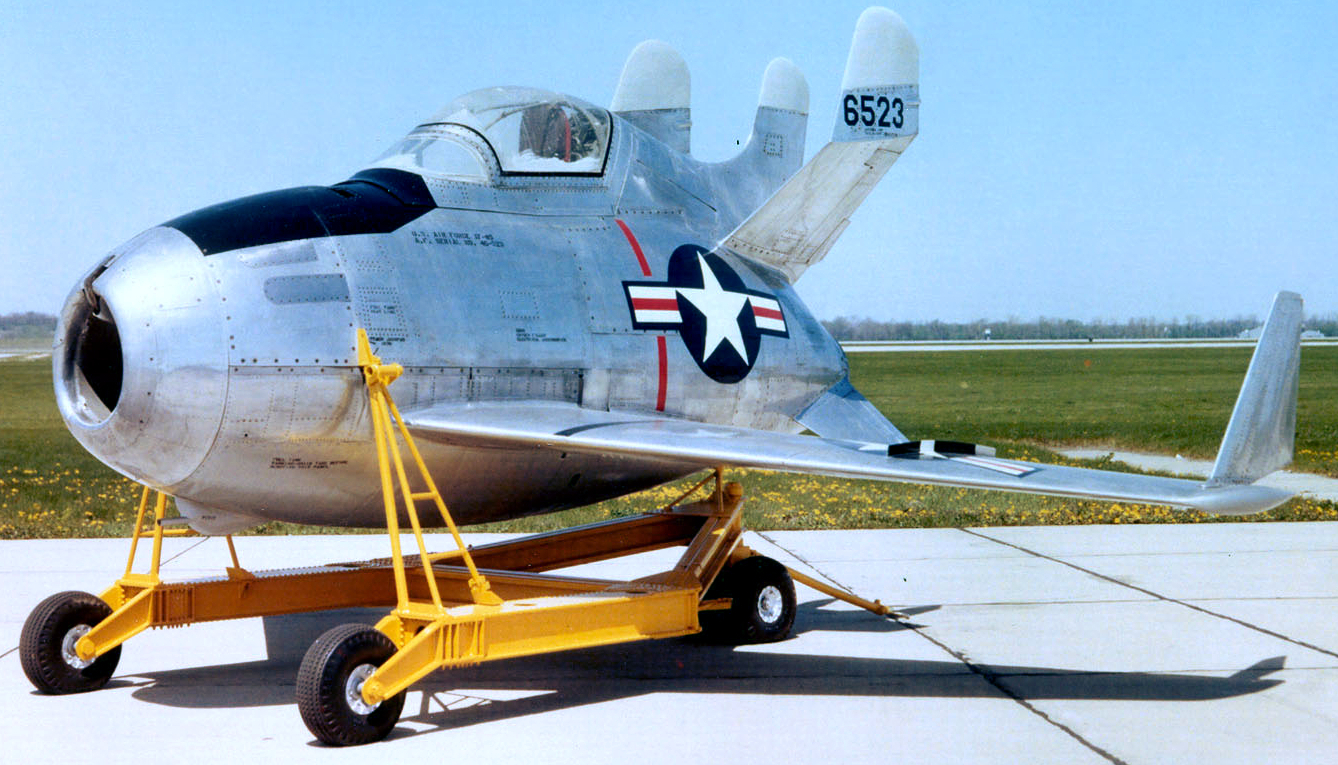

McDonnell XF-85 Goblin was an experimental jet fighter created to fit in the bomb bay of a B-36 bomber, but failed after seven flights and only 2h19 in the air.
In August 1948, a modified B-29 bomber took off from Muroc Air Test Center, California, with an aircraft hidden in its bomb bay. It wasn’t a bomb. It was a jet fighter smaller than a modern passenger car, with folding wings, an egg-shaped fuselage, and four .50 caliber machine guns fitted in the nose. When the bomber reached 6,000 meters altitude, a hatch opened, a mechanical trapeze arm descended through the air, and the small aircraft was released to fly on its own for the first time. The pilot, Major Edwin Schoch, kept the XF-85 Goblin in the air for a few minutes before attempting the program’s most difficult maneuver.
He needed to approach a moving bomber at about 400 km/h, face the turbulence created by the larger aircraft’s propellers and tail, and hook a steel hook onto the trapeze arm. According to the National Museum of the United States Air Force, the Goblin hit the trapeze, broke the pilot’s helmet, lost the cockpit canopy, and ended up landing in the desert.
XF-85 Goblin was created to solve the problem of nuclear bomber escort
To understand why the United States spent US$3.2 million on a car-sized fighter, one must go back to the end of World War II. At that time, the strategic bomber was a central piece of American nuclear doctrine.
-
China Unveils Laser Weapon Capable of Instantly Neutralizing Military Drones, Marking a Significant Advancement in Air Defense Technology

-
U.S. Navy’s Ticonderoga-class Cruiser Becomes a 9,800-Ton Missile Fortress with Advanced Aegis System Capable of Tracking Hundreds of Targets

-
France’s Charles de Gaulle: The Sole Nuclear-Powered Aircraft Carrier Outside the US, Weighing 42,500 Tons and Equipped with Two Atomic Reactors

-
The military spaceplane that almost took the Cold War into orbit: Boeing X-20 Dyna-Soar was designed to re-enter above Mach 20, fly for up to 40 hours, land like a plane, and transform Titan rockets into a gateway to a new era of orbital warfare.




The logic was to send bombers with nuclear weapons from the United States to targets in the Soviet Union. The problem was that these aircraft would need to cross thousands of kilometers at risk of interception by enemy fighters.
Jet fighters of the time had a range of only a few hundred kilometers, while bombers like the Convair B-36 could fly over 10,000 km without refueling. The solution proposed by McDonnell Aircraft in 1945 was radical: have the bomber itself carry its escort fighter in the bomb bay.
Parasite fighter XF-85 Goblin needed to fit in the B-36’s bomb bay and combat Soviet interceptors
The American Air Force requirement was precise and almost absurd: to create a jet fighter that could fit in the B-36’s bomb bay, be launched and recovered in flight, and still have the capability to face Soviet fighters.

McDonnell designed an egg-shaped fuselage, without an elongated nose, without a conventional tail, and without wasted space. The total length was 4.52 meters, shorter than many modern sedans.
The wingspan was 6.44 meters with the wings open, but dropped to just over 1.5 meters with the wings folded. The XF-85 Goblin was literally a fighter designed to fit inside a box.
Westinghouse Engine took the small fighter to over 1,000 km/h
Despite its reduced size, the Goblin was not an experimental toy without performance. The Westinghouse XJ34 turbojet engine delivered 1,360 kgf of thrust, enough to propel the 2,064 kg aircraft to a maximum speed of 1,069 km/h.
The planned armament consisted of four .50 caliber machine guns installed in the nose. The total endurance was 1 hour and 20 minutes, a time considered sufficient to intercept enemies, protect the bomber, and attempt to return to the mother aircraft.
The critical point was the return. In the Goblin’s nose was a steel hook that needed to latch onto the trapeze hanging below the bomber, in full flight, hundreds of meters high and within an intense turbulence zone.
B-29 Superfortress became a test platform for launching the Goblin
The B-36, the aircraft for which the Goblin had been created, was still in production when testing began. To avoid delaying the program, the Air Force modified a B-29 Superfortress, the same model that had dropped atomic bombs on Hiroshima and Nagasaki three years earlier.
The modified B-29 was named EB-29B and nicknamed “Monster” among the base mechanics. In the bomb bay, a mechanical trapeze arm was installed, capable of extending during flight and serving as an anchoring point for the small fighter.

The first trials were capture tests, with the Goblin attached to the trapeze without being released. The initial phase worked well, and on July 23, 1948, the aircraft was deemed ready for its first independent flight.
Seven flights and only 2 hours and 19 minutes showed the failure of the XF-85
The first free flight took place on August 5, 1948, with Edwin Schoch at the controls. The launch worked: the trapeze descended, the Goblin was released, and the fighter flew normally for a few minutes.
The problem began with the recovery attempt. The turbulence below the B-29 was violent and unpredictable, pushing the small fighter sideways in fractions of a second.
On the first attempt, the Goblin hit the trapeze hard enough to break Schoch’s helmet and tear off the cockpit visor. With his face exposed to the wind, the pilot aborted the maneuver and made an emergency landing on the dry bed of the Mojave Desert.
Recovering the fighter in mid-flight was more difficult than launching it
Over seven test flights, conducted between August 1948 and April 1949, the Goblin was successfully launched in all of them. The problem was never releasing the fighter from the bomber, but bringing it back.
Recovery worked on only three occasions. In the other four, Schoch was forced to land in the desert, using the small skid under the fuselage, as the XF-85 had no conventional landing gear.
In total, the program accumulated only 2 hours and 19 minutes of effective flight. For a project designed to escort nuclear bombers on strategic missions, this was an insufficient operational margin.
Bomber turbulence made the Goblin practically unrecoverable
The failure was not due to the pilot’s courage. Schoch was an experienced test pilot, and recovery attempts were made with extreme control.
The problem was physical. The B-29 displaced enormous volumes of air, and the interaction between propellers, fuselage, wings, and tail created intense eddies below the bomber.
For a fighter weighing just over 2 tons, with short wings and limited stability, this environment was almost uncontrollable. If recovery failed in controlled tests, the chance of it working in real combat would be minimal.
In-flight refueling made the parasite fighter obsolete
While McDonnell tried to solve the Goblin’s problems, another solution was rapidly advancing: in-flight refueling. The technique allowed conventional fighters to extend their range without requiring them to enter a bomber’s bomb bay.
The comparison was unfavorable to the XF-85 in all respects. In-flight refueling was simpler, safer, more versatile, and could be applied to various fighter models, not just a tiny aircraft designed for a specific bomber.
In 1949, the Air Force demonstrated that fighters could be refueled in flight by tanker aircraft. In October of the same year, the XF-85 Goblin program was formally canceled.
XF-85 Goblin prototypes ended up in museums in the United States
Two Goblin prototypes were built. The first, serial number 46-0523, was primarily used in static and wind tunnel tests.
During ground tests, this example accidentally fell from a height of 12 meters and suffered structural damage that prevented its use in flight. The second prototype, serial number 46-0524, accumulated most of the program’s 2 hours and 19 minutes.
After cancellation, the second Goblin was transferred to the National Museum of the United States Air Force in Dayton, Ohio. Another example or test cell is at the Strategic Aerospace Museum in Ashland, Nebraska.
XF-85 Goblin cost US$3.2 million and became an expensive engineering lesson
The XF-85 program lasted from 1945 to 1949 and cost US$3.2 million. By today’s standards, it’s less than the price of a modern fighter, but at the time it represented a significant investment in an experimental gamble.

The two prototypes never saw combat, never escorted a real bomber, and never flew from the B-36, the aircraft for which they had been designed.
The legacy was different: technical documentation on turbulence, aerial coupling, and practical limits of the flying aircraft carrier concept. The main conclusion was simple and brutal: launching one aircraft from another is feasible; recovering it in operational flight is almost impossible.
Goblin name matched the small, strange, and difficult-to-control aircraft
The XF-85 was named “Goblin,” a creature from European folklore described as small, mischievous, and capable of appearing and disappearing without warning. The name ended up suiting the aircraft.
It was too small to look like a conventional fighter, but too ambitious to be treated as a curiosity. It promised to combat Soviet interceptors, but could barely return to the aircraft that launched it.
The gap between promise and reality was not born of bad faith on the part of the engineers. It arose from the attempt to solve, with extreme design, a problem that physics and available technology did not yet allow to be solved.
The fighter that the Cold War rendered unnecessary before maturing
There’s a final irony in the case of the XF-85. The problem it was trying to solve, the vulnerability of strategic bombers on long-distance flights, was being reduced by other technologies.
First came in-flight refueling, which extended the range of conventional fighters. Then, intercontinental ballistic missiles changed the logic of nuclear deterrence and reduced the exclusive reliance on bombers.
The Goblin arrived too late for World War II, too early for reliable aerial coupling technology, and before the Cold War changed direction. It flew for only 2 hours and 19 minutes, but left one of military aviation’s most curious lessons: not every ingenious idea survives its encounter with real turbulence.


