Portuguese
  Spanish


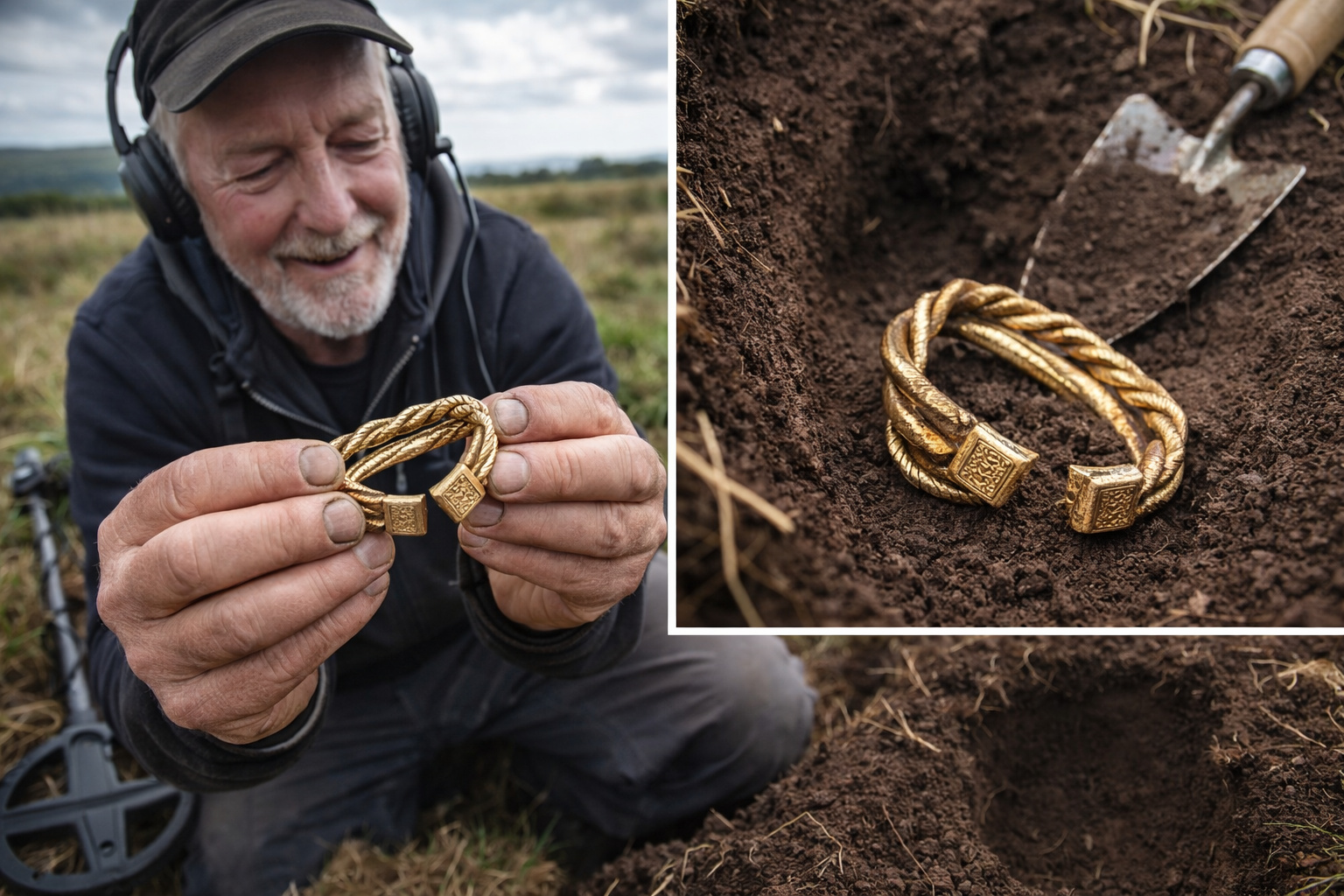

Discovery on the Isle of Man reveals Viking gold bracelet weighing 27.26 g and advanced technique that served as money and symbol of power.
In 2025, veteran metal detectorist Ronald Clucas, a resident of the Isle of Man, a territory located between Great Britain and Ireland, made a discovery that caught the attention of archaeologists and European historical institutions. After five decades of using a metal detector, Clucas found a buried gold object that, after analysis by the Manx National Heritage, was identified as a Viking bracelet dated between the years 1000 and 1100 AD.
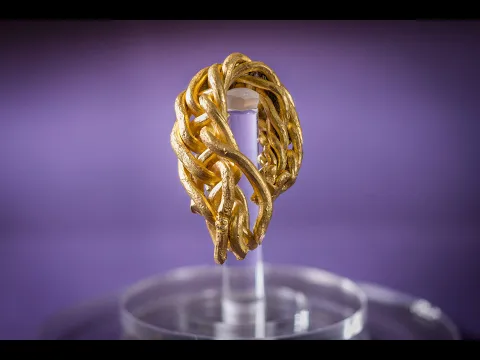
The piece weighs 27.26 grams, measures approximately 7.7 centimeters in its original form, and was produced from eight carefully braided gold wires, a technique that requires precise control of twisting and advanced metallurgical mastery for the time. The object was folded, which initially might have seemed like damage, but actually turned out to be one of the most important elements of the discovery.
According to the experts who analyzed the find, the bracelet was not just an ornament. It represents a type of multifunctional artifact typical of the Viking economy, where precious metals were used as a form of payment, store of value, and symbol of social alliances.
-
Man Disguises as His Own Mother to Collect €3,000 Monthly Pension, but Makeup and Beard Stubble Raise Suspicions at Registry Office

-
Brazilian Airport to Receive $2.8 Million Investment, Completion Expected Within a Year

-
UN Warns of AI’s Environmental Impact and Calls for Greater Corporate Transparency

-
Former Atacadão Employee Turns Online Cake-Baking Lessons into a Confectionery Brand with Factory, Store, Delivery, and Nearly $400,000 in Revenue




What is a Viking bracelet and why was it so important
The so-called arm rings, or Viking bracelets, were objects widely used during the Viking Age, which extends approximately from 793 to 1066 AD. Contrary to what may seem at first glance, these pieces did not have an exclusively aesthetic function.
In the medieval Scandinavian context, where the circulation of standardized coins was limited in various regions, gold and silver took on the role of economic base. In this scenario, the bracelet functioned as a form of portable wealth, able to be carried on the body itself.

The piece found on the Isle of Man perfectly illustrates this logic. The fact that it is folded indicates that it may have been prepared for division or transport, a common characteristic in objects known as hack metal, which were fragmented to facilitate commercial transactions.
This functionality completely transforms the interpretation of the object. It is not just a piece of jewelry, but an economic instrument integrated into the daily lives of Viking societies.
The bracelet as currency in the Nordic world
One of the most relevant aspects of this discovery lies in its relation to the Viking economic system. Unlike centralized monetary models, the Nordic peoples used precious metals flexibly, based on the weight and purity of the material. In this context, objects like the arm ring could be:
- Stored as a reserve of value, functioning as a kind of “savings” in gold;
- Cut or fragmented, allowing for fractional payments in negotiations;
- Weighed on scales, ensuring more precise transactions.
The practice of bending or cutting pieces of precious metal was not uncommon. On the contrary, it is part of an archaeological pattern observed in various Viking treasures found in Europe and the British Isles.

The arm ring from the Isle of Man fits exactly into this pattern. Its deformation does not represent wear or accidental damage, but rather functional use within a physical metal-based economic system.
Advanced engineering in the manufacture of the piece
Another point that elevates the importance of this discovery is the technical level involved in the production of the arm ring. The piece was made from eight braided gold wires, forming a uniform and highly symmetrical pattern. This type of construction requires advanced knowledge of metal twisting control, uniform tension distribution, and manipulation of gold in a malleable state without rupture.
Modern studies show that patterns of this type follow well-defined geometric principles. The twisting of the wires creates a stable and visually consistent structure, indicating that Viking artisans mastered techniques that are now analyzed through the lens of physics and applied mathematics.
This level of sophistication reinforces the idea that these pieces were not produced in an improvised manner. They were the result of accumulated knowledge passed down through generations of specialized artisans.
Symbol of power and oath of loyalty
In addition to its economic role, the Viking arm ring also had an extremely relevant social and political function. In many regions of Scandinavia, these objects were used as symbols of authority and commitment.
Chiefs and leaders distributed arm rings to warriors as a way to establish bonds of loyalty. Receiving a piece of this kind meant more than wealth: it was a sign of belonging to a group or leadership. In some traditions, oaths were made while holding or touching these objects, which led historians to classify them as “oath rings”.

This completely transforms the interpretation of the found piece. It may have been a form of payment, a status symbol, or an object linked to alliances or commitments. This multiplicity of functions is one of the factors that makes the discovery especially relevant for understanding Viking society.
Why the piece was buried
The presence of the buried armlet raises a recurring question in archaeology: why were valuable objects hidden in the ground? There are some main hypotheses that help explain this pattern:
- One is linked to periods of instability. In contexts of conflict, invasions, or territorial disputes, hiding wealth was a common strategy to avoid losses.
- Another possibility involves deliberate storage. Burying precious metals could serve as a way to “store” wealth in a safe location, especially in societies without structured financial institutions.
- There is also the hypothesis of ritual deposits. In some cases, objects were buried as offerings or part of symbolic practices.
In the specific case of the armlet from the Isle of Man, the fact that it is isolated and folded strongly suggests a context of storage or concealment, possibly associated with a moment of risk or transition.
The strategic importance of the Isle of Man in the Viking Era
The location of the discovery is not a secondary detail. The Isle of Man occupied a strategic position in the Irish Sea, serving as a connection point between trade and maritime routes during the Viking Era. Between the 9th and 11th centuries, the region was influenced by Nordic populations and became a space of intense circulation of people, goods, and ideas.

This geographical position explains why Viking objects are found on the island. It was part of a larger network connecting: Scandinavia, the British Isles, and continental Europe. The presence of a gold armlet in this context reinforces the economic and cultural importance of the region during this period.
What this discovery reveals about the Viking world
The analysis of the armlet found by Ronald Clucas allows access to different dimensions of Viking society in a concrete and documented way. First, it highlights an economic system based on precious metals, where objects functioned as currency and store of value.
Second, it reveals an advanced technical level in metallurgy, with twisting and construction techniques that required specialized knowledge. Third, it shows the importance of material symbols in social relations, especially regarding loyalty and hierarchy. Finally, it reinforces the archaeological pattern of wealth concealment, indicating recurring practices of storage or protection of goods.
Now I want to know your opinion: do you think these pieces functioned more as money, as a symbol of power, or as both at the same time?