






 Portuguese
  Spanish


The case of Dadarao Bilhore stopped being just a family tragedy and became a portrait of an urban problem that appears in India’s statistics. Since 2015, he has used cement, sand, stones, and volunteer support to fix potholes in the streets of Mumbai and nearby cities, while official data shows an increase in accidents, deaths, and injuries linked to road craters.
Dadarao Bilhore, a vegetable vendor in Mumbai, lost his 16-year-old son in July 2015 after an accident caused by a pothole on the road.
The teenager was riding a motorcycle with his cousin when the vehicle hit a crater on a flooded road. The cousin survived. Bilhore’s son, Prakash, died.
Since then, Bilhore has taken it upon himself to fill potholes in the streets of Mumbai and nearby regions. According to Anadolu Agency, he stated in 2021 that he had already filled about 1,500 craters, with the help of friends and volunteers, mainly on Sundays.
-
Dinosaurs Spark Children’s Curiosity, Boost Cognitive and Emotional Development, and Build Essential Future Skills

-
From Orphan to Leader: Geraldo Now Runs One of Latin America’s Largest Truck Recycling Companies

-
She Wasn’t the Chief Engineer, But She Led Key Decisions for One of New York’s Largest Bridges When Her Husband Fell Ill
-
Japanese Fan’s Emotional Reaction to Brazil Loss Goes Viral, But Behind-the-Scenes Reveal the Truth



The story draws attention because it exposes a problem larger than the individual initiative. In India, potholes, dangerous curves, bridges, manholes, construction sections, and maintenance failures appear in official reports as risk factors for traffic accidents.
The accident happened on a flooded road and exposed a common failure in cities during the rains
The accident occurred on the Jogeshwari-Vikhroli Link Road, known as JVLR, an important link in Mumbai. As reported by NDTV in 2018, Prakash died on July 28, 2015, after the motorcycle fell into a deep pothole covered by rainwater.
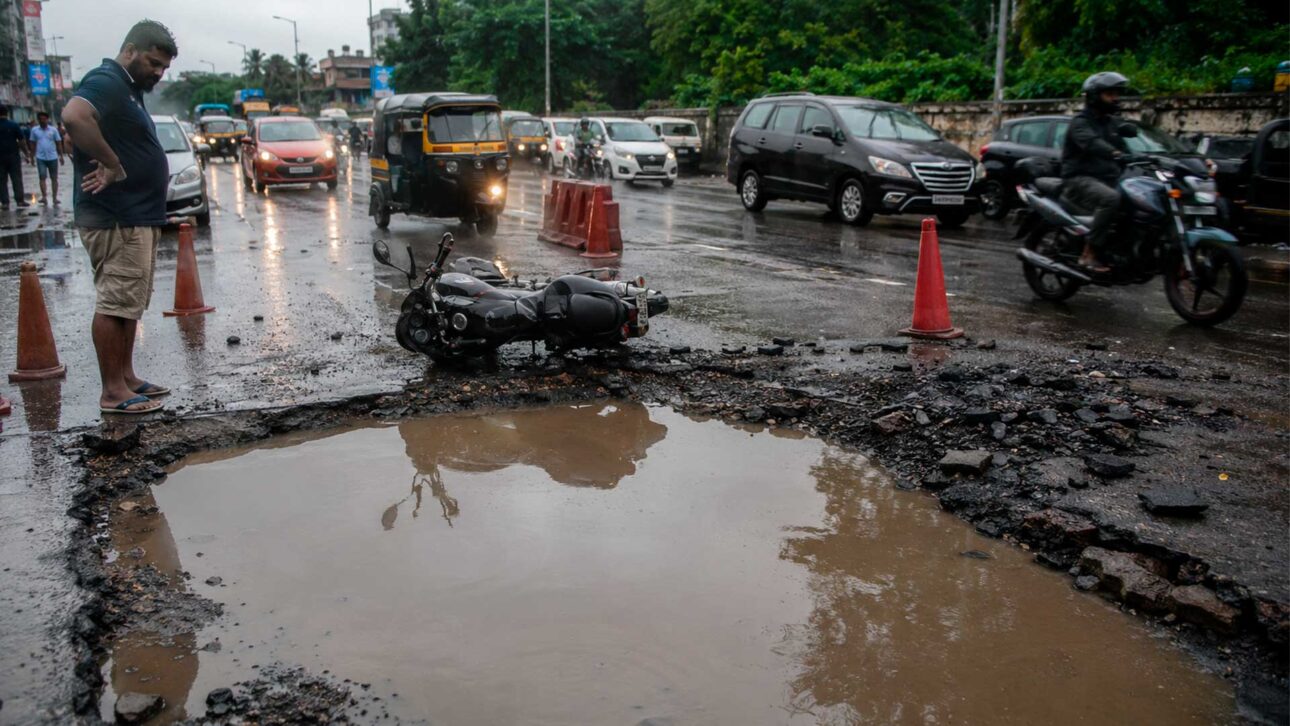
This detail changes the reading of the case. Potholes on dry roads already pose a risk, but during monsoon periods, the water hides the depth of the crater and reduces the reaction time for motorcyclists, cyclists, and drivers.
In dense cities like Mumbai, where motorcycles share space with buses, cars, trucks, and pedestrians, a small pavement failure can turn into a serious collision in seconds.
Bilhore did not create a formal public work nor does he replace the responsibility of the city council. What he does is an emergency response. He receives locations indicated by residents, goes to the spot, and tries to prevent the same crater from remaining open for days or weeks.
Official numbers show that potholes are not a small problem in India
The report “Road Accidents in India 2023” by the Ministry of Road Transport and Highways of India recorded 480,583 traffic accidents, 172,890 deaths, and 462,825 injuries in the country in 2023. Within the category of road characteristics, potholes caused 5,840 accidents, 2,161 deaths, and 5,309 injuries that year. Compared to 2022, accidents related to potholes increased by 31.4%, deaths grew by 16.4%, and injuries rose by 42.2%.
The document itself points out that potholes, curves, manholes, bridges, and construction sections require attention from engineers responsible for maintenance at national, state, and local levels. In other words, the issue is not just “distracted driver.” There is a clear component of infrastructure, supervision, drainage, and quick response to complaints.
Data released by the Press Information Bureau, the official body of the Indian government, shows that the country was already at a high level before this. In 2022, there were 461,312 accidents, 168,491 deaths, and 443,366 injuries on Indian roads, with statistics gathered from information from state and territory police departments.
Bilhore’s action works as an emergency repair but does not solve the bottleneck of urban maintenance
Bilhore started alone. Later, he began receiving help from friends and volunteers. The work usually takes place on Sundays, when there is less traffic and more time to locate the craters indicated by residents.
The method is simple. He uses construction materials such as sand, gravel, and cement to fill the most dangerous failures. In some cases, the material comes from leftover construction works. The immediate goal is not to rebuild the street but to reduce the risk of falling, losing control, and collision.
This difference is important. Filling a crater with improvised material can prevent an accident in the short term but does not replace milling, resurfacing, drainage, proper base, and pavement quality control. When the origin of the pothole is linked to infiltration, heavy traffic, or poorly executed service, the problem tends to return.
Therefore, the initiative has gained strength as a symbol of demand. It shows the gap between the citizen’s complaint and the execution of public service. This gap, on a busy and flooded avenue, can cost lives.
App, volunteers, and lectures brought the case to the road safety debate
Bilhore also tried to organize reports through an app so that residents could report the location of potholes. According to what he told Anadolu, the tool had technical problems, but the idea was to facilitate the mapping of the faults and reduce the reliance on informal notices.
With the repercussion, he began to participate in events on road safety and received support from local groups and well-known figures in India. Still, the central point remains the same since 2015: an open pothole on a busy street is not just an inconvenience for drivers, it is a risk of death.
The World Health Organization estimates that 1.19 million people die each year in traffic worldwide. The entity also relates road safety to urban design, enforcement, speed, infrastructure, and protection of vulnerable users, such as pedestrians, cyclists, and motorcyclists.
The case of Mumbai shows a bill that appears before the new asphalt
Dadarao Bilhore’s actions gained attention because they stem from a family loss, but the public relevance lies in what it reveals about urban maintenance. A city can invest in large projects, overpasses, and corridors, but remain vulnerable if it fails in the basics: drainage, pavement, signage, inspection, and quick response to complaints.
The case also shows a practical limitation. Voluntary action can reduce specific risks, but it does not create a permanent prevention system. For that, budget, technical team, inspection after rains, efficient complaint channel, response time, and transparency about who is responsible for each road are needed.
Bilhore said he intends to continue as long as he can. The phrase carries weight, but it should not hide the main question: how many craters does a city need to accumulate before treating potholes as an indicator of public safety?
Do you think potholes on streets and highways should result in direct punishment for those responsible for maintenance when they cause serious accidents? Leave your opinion in the comments and tell us if this problem also happens frequently in your city.


