






 Portuguese
  Spanish


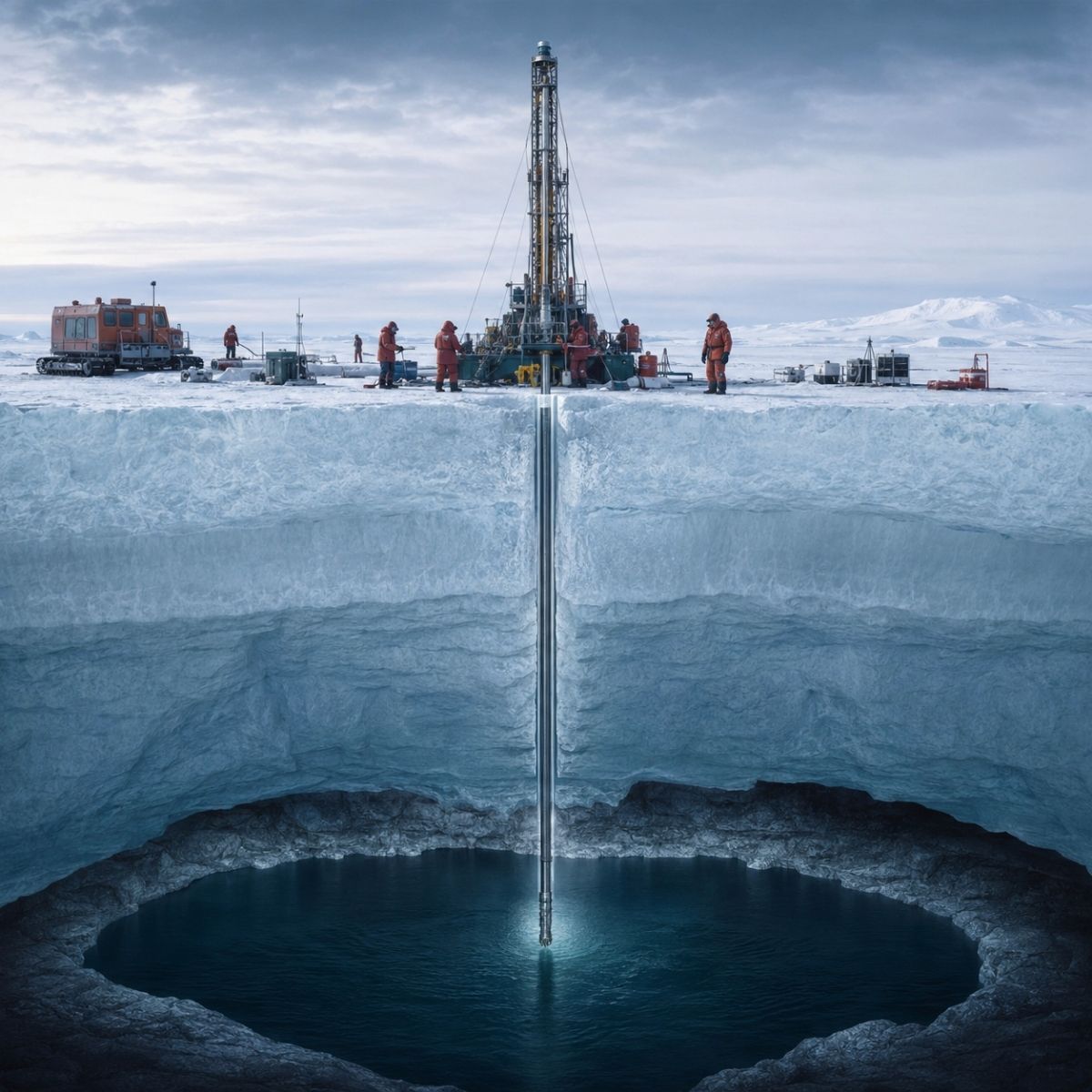


The 22-year drilling by Russia’s AARI reached Lake Vostok on February 5, 2012, 3,769 meters under the Antarctic ice, the planet’s largest subglacial lake isolated for 15 to 25 million years, but biological findings were contested due to suspected contamination.
On February 5, 2012, a team from Russia’s Arctic and Antarctic Research Institute (AARI) completed one of the longest and most difficult drilling operations in the history of science by reaching the surface of Lake Vostok, a liquid water reservoir located under 3,769 meters of ice in East Antarctica. Drilling began in 1990, was suspended in 1998 130 meters from the water due to concerns about biological contamination, resumed in 2003 with new protocols, and was completed 22 years after its start, under temperatures that at Vostok Station had already reached the world record of minus 89.2 degrees Celsius recorded in 1983. The lake that scientists reached has been isolated from the Earth’s atmosphere for an estimated 15 to 25 million years, a period prior to the evolution of modern primates, making Vostok a geological time capsule unparalleled on the planet.
The importance of the drilling goes beyond the technical achievement: Lake Vostok is considered the closest terrestrial analogue to the subsurface oceans that space missions seek to explore on the icy moons of Jupiter and Saturn. If the lake harbors life forms that have survived isolated for millions of years in total darkness, under pressure equivalent to 4 km of ocean depth and a temperature of minus 2.5 degrees Celsius kept liquid by the pressure of the ice above and by possible geothermal heat below, the discovery would reinforce the hypothesis that life could exist on Europa (Jupiter’s moon) and Enceladus (Saturn’s moon), where similar conditions have been identified by space probes. However, the biological findings of the Russian expedition remain disputed by the scientific community, and the definitive answer about what lives in the waters of Vostok has not yet been given with the certainty that science demands.
How Lake Vostok was discovered decades before drilling began

The history of Lake Vostok begins long before the drilling that reached it in 2012. Vostok Station was established by the Soviet Union in 1956 in East Antarctica, and between 1959 and 1964, Russian scientist Andrey Kapitsa first proposed, based on seismic measurements, that a body of liquid water could exist under the kilometers of ice beneath the station, a hypothesis that took decades to confirm. Radar penetration measurements in the 1970s and 1980s reinforced the possibility, but definitive confirmation only came in 1996, when a joint study by British and Russian researchers published in the journal Nature proved the existence of the planet’s largest known subglacial lake.
-
Billionaire says the most valuable skill will help overcome job elimination caused by AI, following Bill Gates’ fears

-
A Dutchman created a ‘box’ that makes trees grow in the desert almost without water and without irrigation: the invention has already brought seedlings to dozens of countries and achieves up to 90% survival where common planting did not exceed 10%.

-
Abandoned warehouse hid a giant collection of rare computers, with over 2,000 artifacts from the 1930s to the 1980s.
-
Scientists warn that melting ice is triggering an alarming chemical transformation in preserved areas, and the first signs are already concerning researchers worldwide.




The lake revealed by the measurements has surprising dimensions for being hidden under ancient ice. With an area of about 12,500 square kilometers (comparable to the state of Sergipe), 250 kilometers in length, and a depth reaching 800 meters at some points, Lake Vostok contains an estimated volume of 5,400 cubic kilometers of water, kept in a liquid state despite surface temperatures that make Vostok Station the coldest point ever recorded on Earth. The drilling that would begin in 1990 would face not only the thickness of the ice and extreme cold, but also a scientific and ethical dilemma: how to access an ecosystem isolated for millions of years without destroying it with contamination in the process.
Why drilling was interrupted and what changed when it resumed

The suspension of drilling in 1998 occurred due to pressure from the international scientific community itself. The Scientific Committee on Antarctic Research (SCAR) recommended the halt when the drill was only 130 meters from the lake’s surface, arguing that the kerosene-based drilling fluid used by the Russians could contaminate the lake ecosystem and destroy exactly what the expedition sought to find. Drilling was paused for five years while the Russian team developed new protocols that promised to prevent the drilling fluid from coming into direct contact with the lake water, a solution that involved creating negative pressure in the borehole so that the lake water would rise naturally through the hole instead of the fluid descending.
The resumption in 2003 marked the beginning of the final drilling phase, which would last another nine years until contact with the water. Scientists worked only during the austral summer, between December and January, when temperatures at Vostok Station rise from minus 89 degrees in winter to “only” minus 30 degrees, and each season advanced meters or tens of meters into the ice layer separating the drill from the lake’s surface. On February 5, 2012, drilling reached 3,769.3 meters, and Lake Vostok water rose through the hole, freezing upon contact with the colder environment of the borehole and forming an ice cylinder that scientists extracted in subsequent seasons as a sample of the lacustrine material.
What scientists found in the samples and why the debate continues


The analysis of the material extracted from Lake Vostok produced an announcement that generated similar measures of enthusiasm and controversy. In 2013, scientists from the St. Petersburg Nuclear Physics Institute led by Sergei Bulat announced they had identified a bacterium in the samples with only 86% correspondence to known species in international databases, a percentage that would suggest a potentially new life form, a discovery that, if confirmed, would make Lake Vostok the first isolated ecosystem on Earth where unknown life has been documented. In subsequent analyses of the same material, researchers identified genetic signs of up to 3,507 potential species, including bacteria, fungi, and eukaryotes.
The challenge came from within the Russian team itself. Vladimir Korolyov, head of one of the laboratories involved in the analysis, publicly disagreed with the results in March 2013, pointing out that the identified bacterium could use kerosene as an energy source, a material identical to the drilling fluid, raising suspicion that the organism was a contaminant, not a resident of the lake. Studies conducted in 2014, 2015, and 2018 identified 255 species as contaminants, and the most recent paper, from 2022, with samples collected in 2018, suggests that most of the genetic material found in the initial analyses is due to contamination. The most solid finding so far is the bacterium Methylobacterium sp. strain V23, isolated from accretion ice (not directly from the lake water), whose genome was sequenced and published, but which is also not free from doubts about contamination.
What Lake Vostok has to do with Europa and the search for extraterrestrial life
The connection between drilling in Antarctica and space exploration is what gives Lake Vostok relevance that transcends terrestrial geology. Europa, Jupiter’s moon, has evidence of a liquid water ocean beneath an ice crust estimated between 15 and 25 kilometers thick, and Enceladus, Saturn’s moon, ejects water jets into space from a subsurface ocean, environments that share with Lake Vostok the basic conditions of total darkness, extreme pressure, sub-zero temperatures, and isolation from the atmosphere. The drilling techniques developed by the Russians and the contamination protection protocols tested in Vostok are considered a rehearsal for future missions that will attempt to drill through Europa’s ice, a challenge that NASA’s Europa Clipper, launched in October 2024, will begin to prepare for by studying the moon between 2030 and 2034.
The contamination debates surrounding the Vostok findings also serve as a warning for space missions. If science cannot guarantee that samples extracted from a lake on Earth are free from contamination by the extraction process itself, the challenge of doing the same on Europa or Enceladus, where costs and complexity are incomparably greater, requires solutions that do not yet exist. The 22-year drilling in Antarctic ice may therefore be less an isolated achievement and more the prologue to a story that the coming decades of space exploration will continue to write on icy worlds hundreds of millions of kilometers from Antarctica.
And you, do you think Lake Vostok harbors unknown life or are the findings contamination? Leave your opinion in the comments.





