Portuguese
  Spanish


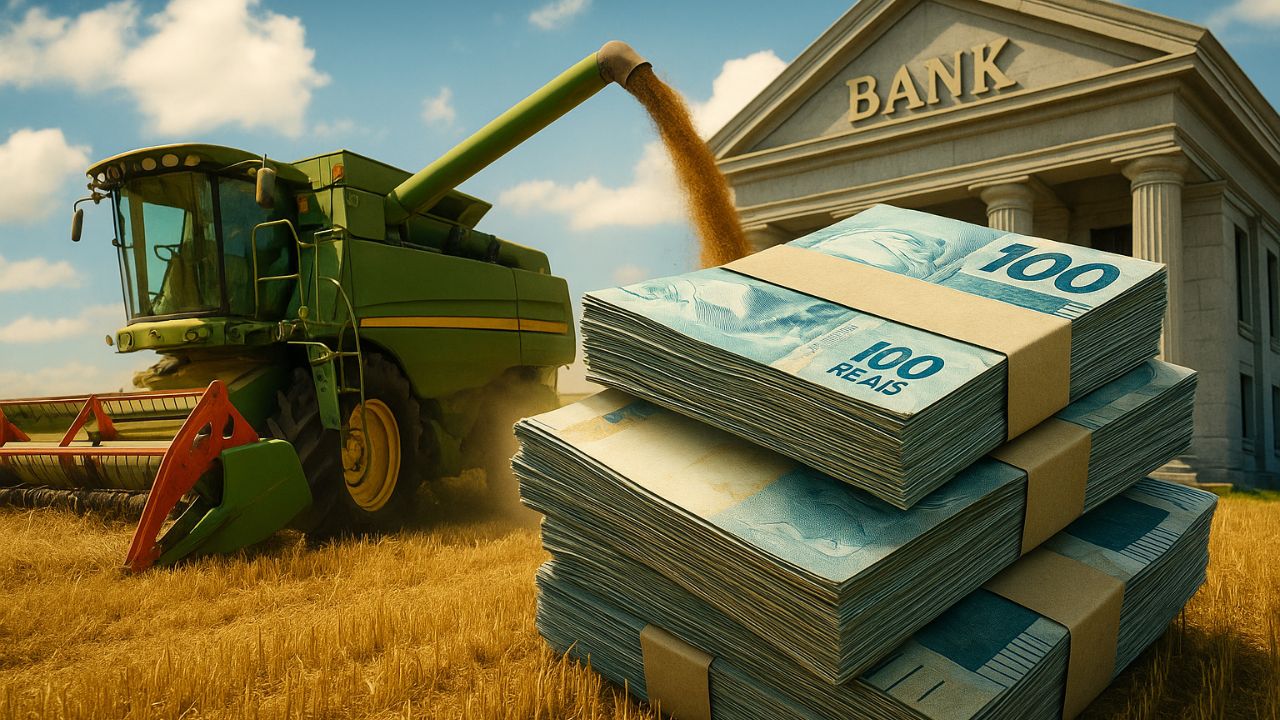


While Agriculture Supports Almost a Quarter of Brazilian GDP, A Good Part of The Money Does Not Stay in The Field and Is Captured by Banks and Financial Intermediaries
The agriculture sector in Brazil reached R$ 2.7 trillion in GDP in 2024, something close to a quarter of all the wealth produced in the country. Producers, cooperatives, trading companies, industries, and distributors form a machinery that employs millions of people, accounts for almost half of exports, and sustains the trade balance. However, behind this power lies a point that almost no one talks about: most of the money that circulates in agriculture does not stay within the gate, it ends up in the hands of banks.
Through rural credit, advances, insurance, exports, currency operations, and means of payment, the financial system positions itself at every link in the chain.
Banks control credit, mediate transactions, and capture a slice of profit at each stage, often without planting, harvesting, or storing a single grain. The good news is that this game has started to turn around.
-
India’s Sugar Export Cuts and Ethanol Shift Amid El Niño Threat Could Impact Global Prices and Stocks

-
Quarantine Pest Threatening Palm Trees Puts Brazilian Authorities on Alert, Prompts Monitoring at University of Taubaté and Potential Control Measures Across São Paulo
-
Global Alert: Report Finds 159 Pesticides in Coffee Beans Sold in Europe, Posing Serious Risks to Millions of Farm Workers
-
Low-Demand Brazilian Beef Offal Gains Popularity Abroad: Indonesia Purchases $19.5 Million, Boosting Revenue and Reducing Waste



The field is learning to transform credit into business, payment into product, and financial flow into its own profit. In other words, agriculture is about to become its own financial infrastructure.
The Size of Agriculture and The Size of The Financial Gap
To understand the dimension of this turnaround, one must first look at the scale of agriculture. For every four reais generated in Brazil, practically one comes directly or indirectly from the field. There are over 28 million people involved in production, food industry, and distribution.
The sector accounts for about 49% of Brazilian exports, with a trade surplus of tens of billions of dollars.
Even so, agriculture still heavily relies on third-party capital to function. Rural credit remains a central pillar. In the 2024/2025 harvest, the application of rural credit has already totaled around R$ 330 billion, with most resources controlled by public and private banks.
More than 70% of rural financing in the country still comes from these institutions, meaning that most of the financial flow of the sector passes outside the field and returns in the form of interest, fees, and spreads.
Where The Money from Agriculture Really Goes
Behind the image of productivity and surplus, there is a predictable dynamic. The rural producer:
- Takes out credit to cover planting costs
- Buys inputs often already financed
- Sells the production to a trading company, often with an advance
- Receives payment in stages
- Pays off loans, pays interest, and starts the cycle again
At every step of this journey, there is a financial intermediary capturing part of the value that agriculture generates. The bank finances the crop production. The trading company advances part of the production. The cooperative mediates payments. The bank manages the currency exchange for exports. The insurer covers climatic and operational risks, always charging a premium.
The result is what many economists already see as a financial gap in agriculture. The field generates value but does not capture it in the same proportion. Money originates in agriculture, but the consolidated profit tends to end up in the city, in the balances of those who control credit, information, and means of payment.
The Five Great Financial Pains of Agriculture Today


Despite its productive strength, agriculture faces a set of problems that limit its financial efficiency and pressure margins, going far beyond climate and harvest. Among the main pains are:
Fragmentation of the Production Chain
The Brazilian agriculture sector is made up of millions of producers, resellers, cooperatives, trading companies, processors, and exporters. Each link has its own operational model, financial needs, and level of digitization.
The result is a disconnected ecosystem, where money and information take time to circulate, generating inefficiency, cost, and loss of bargaining power for the producer.
Excessive Dependence on Third-Party Credit
A large portion of producers depends on banks, credit cooperatives, or trading companies to finance inputs and operations. When credit becomes more expensive, interest rates rise, or there are delays in the Crop Plan, the impact goes straight to the base of production.
Rural credit remains essential, but it is still bureaucratic, concentrated, and difficult to access for those without robust guarantees or a consolidated banking history.
Low Integration and Data Management
In many regions, agriculture still operates with a low level of digitization. Data regarding harvest, climate, inventory, credit, and market remain scattered, without connection between systems.
This limits planning, increases risk management costs, and reduces the producer’s bargaining power, since those with the best information about credit, prices, and transactions are the intermediaries, not the producers.
Growing Operational Risk and Tight Margins
Costs of fertilizers, pesticides, logistics, and energy rise, while currency and commodity volatility tightens margins.
The producer deals with uncertainties in harvest and market, but their financial commitments are fixed, creating an asymmetry between the risk of production and the cost of capital.
Logistical Costs and Lack of Liquidity
Deficient transportation and distribution infrastructure increases timelines, inventory, and tightens cash flow. In a sector where the interval between planting and receiving can exceed a year, any delay in credit or sales settlement compromises reinvestment in the next harvest.
Together, these five pains reveal something evident: agriculture is huge in production, but still lacks proprietary financial structure. And it is precisely here that one of the greatest opportunities in the history of the sector arises: transforming these pains into financial businesses within the chain itself.
Why Agriculture Has Everything to Be a Financial Infrastructure
If you look closely, you will see that agriculture already has all the ingredients a bank needs to operate:
Predictable Financial Flow Throughout the Year
Base of Recurring Customers
High Volume of Transactions
Long-Term Relationship History
Real Guarantees, such as Land, Machinery, Warehouses, and Contracts
What was missing was technology, appropriate regulation, and ownership vision over the money that circulates within the field. In recent years, this has begun to change for three main reasons.
First, the accelerated digitization of agriculture. Fintechs specializing in credit and financial services for the field, such as Trave, Set, and Terra Magna, already show that it is possible to operate credit, insurance, and payments in a fully digital manner, using data on harvest, climate, and productivity to reduce costs and risks.
Second, the regulatory change. The Central Bank has been encouraging models such as SCDs and payment institutions, allowing agriculture companies to offer credit with their own resources or create customized financial solutions for their producers and partners.
What was once a monopoly of banks is now open to those who understand the day-to-day operations of farms, cooperatives, and resellers.
Third, the most powerful asset of all: data. Agriculture is one of the sectors that generate the most information in the country. Production, climate, payment history, guarantees, purchasing behavior—this can all be converted into financial intelligence.
When this data is used to assess risk, price credit, and anticipate defaults, the field begins to control its own financial flow and capture value on operations it already conducts.
How Agriculture Is Already Becoming Its Own Financial Infrastructure
This transformation is not theoretical, agriculture has already started to fintex the field in practice. In recent years, companies and structures have emerged showing how the sector is creating its own financial infrastructure:
- Set, for example, has digitized the barter process, the model in which the producer exchanges part of the harvest for inputs or credit. What previously depended on paper, notary, and months of bank analysis is now done digitally, from the contract to the settlement. This reduces costs, increases security, and opens up space for direct financing, without entirely depending on banks.
- Trave uses artificial intelligence to analyze credit risk for producers and investors, connecting those who need capital with those who want to finance agriculture, without necessarily going through traditional banks. It’s the sector learning to use data from the field to create tailored financial solutions.
- Financial cooperatives like Ccred and Ccob have expanded their digital presence and now offer accounts, credit, insurance, and means of payment integrated into the agriculture ecosystem, understanding that it is not enough to finance production; it is necessary to dominate the financial flow of the chain.
- Resellers and trading companies are also taking action. Companies that previously only sold or bought inputs are starting to create financial arms for receivables anticipation, customer financing, and payment management. Agrofy, for example, structured Agrofy Pay, a payment solution integrated into the agricultural marketplace, allowing producers to buy inputs on credit and pay entirely digitally.
When we sum all this up, we see a new scenario: an agriculture that does not solely depend on a bank to operate, but is starting to build its own financial structures within the sector itself.
Step by Step for Agriculture to Capture Its Own Flow of Money
If agriculture truly wants to become its own financial infrastructure, the path involves a few practical steps:
Map The Complete Financial Flow
Understand where the money comes in, where it goes out, and at which points third parties capture margins. Each financing fee, each commission on payments or insurance reveals a potential space for value capture within the chain.
Digitize Relationships and Transactions
Without digitization, there is no financial intelligence or scale. Platforms, apps, and integrated systems need to centralize credit, payments, receipts, and contracts. This allows for transforming relationships into financial products.
Choose the Appropriate Regulatory Model
The Central Bank offers paths such as SCDs, peer-to-peer lending societies, and payment institutions. Additionally, partnership models with already licensed institutions allow for quick starts, testing solutions without the need to set up a bank from scratch.
Transform Data into Credit and Financial Products
Use data from productivity, payment history, climate, and logistics to create products such as customized credit, smart insurance, and receivables anticipation with calibrated risk. Finance becomes a natural extension of agriculture operations, not a strange service coming from outside.
Operate in Partnership, Not Improvisation
Fintexing agriculture is not about taking unnecessary risks; it is about structuring sustainable, regulated, and technological models. Cooperatives, industries, and resellers that have succeeded in this movement work in partnership with licensed institutions, combining knowledge of the field with secure financial structures.
In the end, fintexing agriculture is not about becoming a bank on paper; it is about owning its own financial flow. It is about transforming each transaction, each invoice, each line of credit into margin that remains in the field, and not just in the balances of intermediaries.
Agriculture as a Force of Financial Innovation
Agriculture has always been synonymous with strength, productivity, and resilience. Now, it is also becoming synonymous with financial innovation, using data, technology, and regulation to its advantage to capture value from the very money it already handles.
This transformation is already happening with producers, cooperatives, resellers, and industries that have decided to look at the financial flow with the same attention they give to the harvest. The more agriculture understands money, the less vulnerable it will be to banks and the more of a protagonist it will become in its own story.
And in your view, should agriculture accelerate this shift to control its own money and depend less on banks, or does the current model still make sense for the sector?