





 Portuguese
  English
  Spanish
  4 min of reading
  0 comments


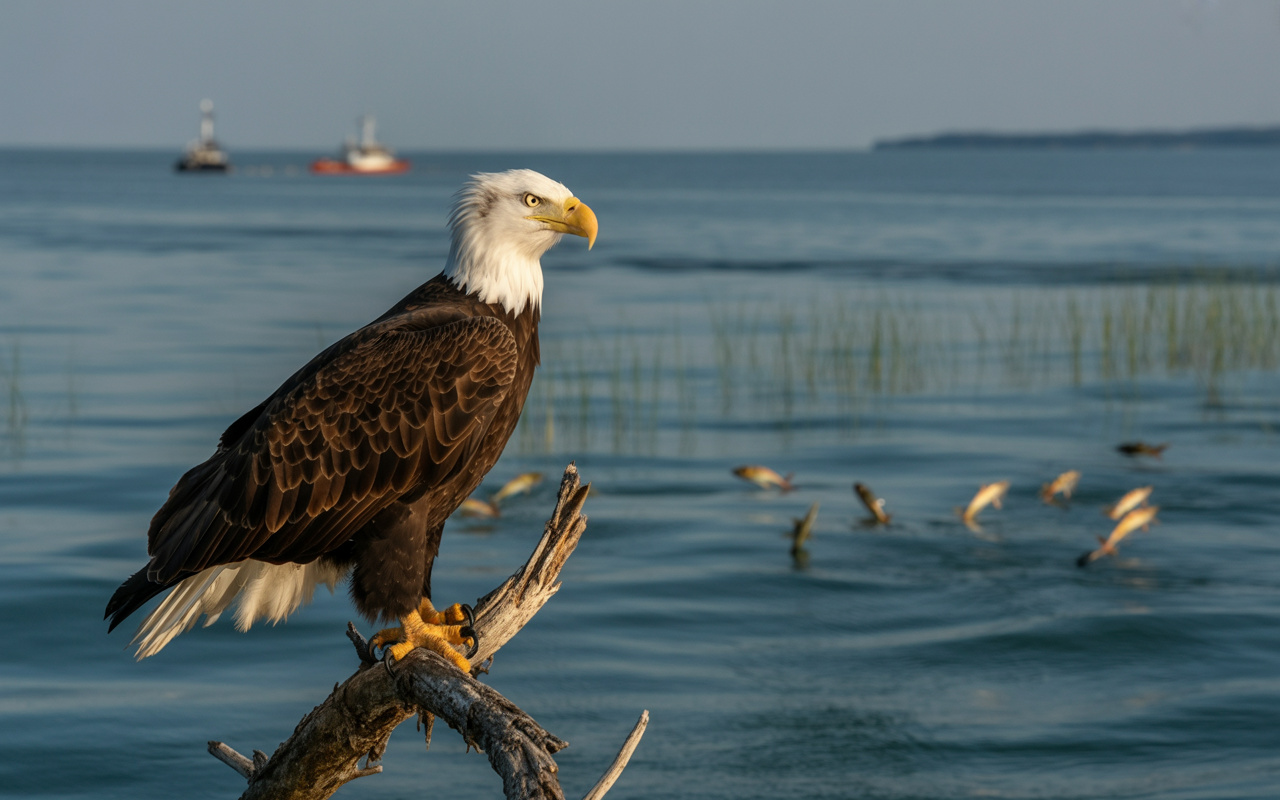
The Return of Bald Eagles to the Great Lakes Indicates a Decrease in Contaminants in Fish and Helps Scientists Monitor Freshwater Recovery.
According to data from the U.S. Fish and Wildlife Service, the Environmental Protection Agency (EPA), and regional scientific programs such as the Great Lakes Bald Eagle Health Project, the recovery of bald eagles (Haliaeetus leucocephalus) in the Great Lakes region is now one of the clearest indicators of environmental changes that have occurred over the past five decades in the world’s largest freshwater surface water system. The growing presence of these apex birds not only represents a conservation success for the species but is also a direct reflection of the chemical, biological, and sanitary transformations that the lakes have undergone since the second half of the 20th century.
For decades, bald eagles virtually disappeared from the region. The intensive use of organochlorine pesticides, especially DDT, combined with the bioaccumulation of PCBs and other industrial pollutants in fish, led to severe reproductive collapses. The thinning of egg shells, incubation failures, and high chick mortality rates made the species rare in areas where it was once common.
The Collapse of Eagles as a Direct Reflection of Water Contamination
In the 1950s and 1960s, the Great Lakes were among the most contaminated aquatic ecosystems on the planet. Industrial discharges, untreated urban sewage, and agricultural pesticides created an environment where toxic compounds accumulated in sediments and, particularly, in fish. As fish specialists, bald eagles began to concentrate these substances at even higher levels in their tissues.
-
Amid the United States’ economic blockade, China delivers 15,000 tons of rice to Cuba as part of a 60,000-ton donation personally approved by Xi Jinping. The package includes 80 million dollars and solar panels for hospitals.

-
For around 200 reais, anyone can buy a kit and have a chip implanted between their fingers to replace cards, keys, badges, and even medical information in case of a hospital emergency.
-
A 600-meter hill in the interior of Santa Catarina hides a volcanic past of almost 600 million years. The Morro do Garrafão in Corupá may have been an ancient extinct volcano, and science now confirms what the residents have always suspected.
-
Family has lived for over 50 years without electricity and running water at home in the South of Minas, 10 minutes from the city, improvising light, bath, and water while facing a lack of basic resources and awaiting property regularization.







Studies from that time showed critical concentrations of DDT and PCBs in eggs and adults, which resulted in nearly zero reproductive rates in various areas of Lake Michigan, Erie, and Superior. The near-local extinction of eagles was not an isolated phenomenon but a clear biological signal that water quality had reached a critical point.
The Recovery of the Species After the DDT Ban
The turnaround began in the 1970s, with the ban on DDT in the United States and the implementation of stricter environmental laws, such as the Clean Water Act.
Over time, the concentration of persistent pollutants began to slowly decline in aquatic ecosystems, first reflecting in the lower trophic levels and, years later, in top predators.
The recovery of bald eagles was gradual and uneven but consistent. Nests began to be recorded around the Great Lakes, and reproductive success increased as contaminant levels in fish decreased. This return was so significant that the species was removed from the endangered species list in the United States in 2007.
Bald Eagles as Biosentinels of Water Quality
Today, bald eagles play a central role in environmental monitoring programs of the Great Lakes.
Scientists use blood, feather, and egg samples to measure the presence of historical and emerging contaminants, transforming the species into a true biosentinel of water quality.
Being at the top of the food chain and having a diet heavily based on fish, eagles accurately reflect what is happening at the lower levels of the ecosystem.
When pollutant levels decrease in fish, this reduction also appears in the birds’ tissues. When new contaminants emerge, such as PFAS compounds, they are also detected in the eagles’ organisms.
Living Indicators of Recovery and New Environmental Risks
The stable presence and reproductive success of bald eagles indicate that many historical contaminants have been significantly reduced in the Great Lakes. However, studies also show that the recovery is not absolute.

Modern substances such as PFAS continue to be found in concerning concentrations in some areas, revealing that the chemical pressure on the system has not disappeared but has only changed in nature.
In this context, eagles do not “clean” the water or directly control diseases. Their role is different: they accurately reveal, through biological means, the health status of the aquatic ecosystem. Where eagles thrive, contamination levels tend to be lower.
Where they experience reproductive or physiological problems, scientists find clear clues of ongoing environmental imbalances.
An Ecological Thermometer of a Continental Freshwater System
The Great Lakes system contains about 20% of all the planet’s surface freshwater. Monitoring its health is a colossal challenge that involves thousands of kilometers of shorelines, multiple countries, and decades of environmental liabilities.
In this scenario, species like the bald eagle serve as a living thermometer, capable of integrating into a single organism the cumulative effects of pollution, environmental management, and regulatory changes.
The return of bald eagles is not just a symbol of successful conservation but an active scientific tool. They help researchers measure what has improved, what still poses a risk, and which past environmental decisions have had real effects in the present.
When observing the flight of these birds over the Great Lakes, scientists see not only a recovered predator but a real-time biological report on water quality, fish safety, and the resilience of one of the planet’s most important ecosystems.










-

-

-

-

-

-

24 people reacted to this.