






 Portuguese
  Spanish


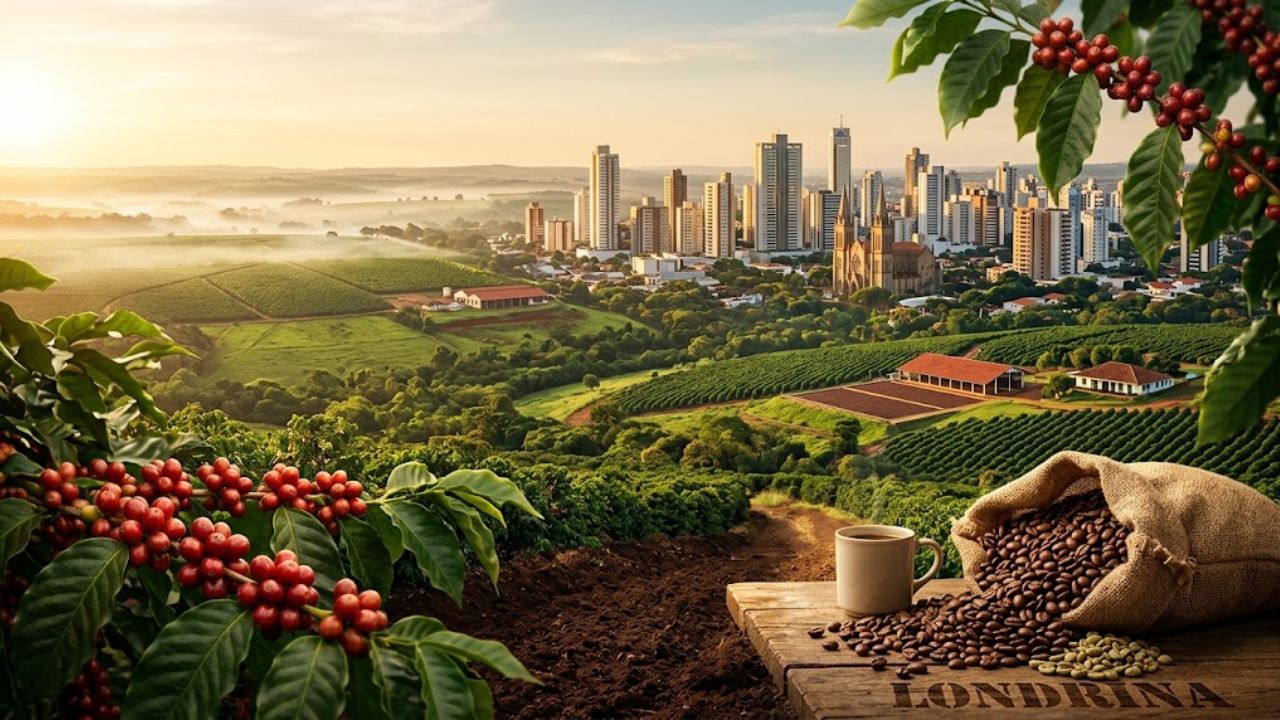

Londrina emerged in 1929 as an outpost of an English colonization company. Discover the history of the Brazilian city that coffee helped build.
An expedition of engineers, a landmark planted in the middle of a forest, and a name inspired by London — this is how, on August 21, 1929, what would become Londrina, today the third most important city in Southern Brazil, was born. According to information from the City Hall of Londrina, the municipality in Paraná emerged as the first outpost of an audacious British colonization project in Northern Paraná, driven by coffee production and inhabited by waves of migrants who, over decades, transformed ‘terra roxa’ (purple soil) into one of the largest urban and regional centers in the country’s interior.
The land before Londrina: forest, promises, and frustrated plans
Before any landmark was planted, Northern Paraná was an extensive forest on terra roxa soil — a type of dark, fertile soil, ideal for agriculture. The colonization of the region began spontaneously, with the arrival of pioneers mainly from Minas Gerais and São Paulo to the Cambará area, between the years 1904 and 1908.
In this initial period, the lands between Cambará and the Tibagi River were quickly occupied by large properties, whose owners subdivided and sold them as urban or rural lots. On the other hand, the vast areas of ‘terra roxa’ west of the Tibagi River — belonging to the state government — remained practically untouched.
-
How to Prevent Brown Recluse Spider Bites: Common Hiding Spots and Free Tips to Reduce Risks

-
Natto: The Unusual Japanese Superfood Gaining Popularity on Social Media and Driving Record Exports
-
Brazilian Mayor Goes Undercover as Homeless for 24 Hours to Assess Public Services

-
15-Year-Old Entrepreneur Malu Lira Publishes 20 Children’s Books on Financial Education, Earns $500,000, and Expands Her Project to the Amazon Rainforest




The public sector’s attempt to colonize this region progressed slowly and disorganized. By 1920, failure was already evident: there was a lack of resources, continuity, and management efficiency. The situation had also been aggravated by World War I, which interrupted the flow of immigrants and generated distrust among those already inhabiting the region.
Given this scenario, from 1922 onwards, the Paraná government began granting land to private colonization companies, preferring to direct its resources towards the construction of schools and roads.

The arrival of the English and the birth of the project that created Londrina
In 1924, an invitation from the Brazilian government to foreign investors changed the course of Northern Paraná. The so-called Montagu Mission, led by Lord Lovat — an expert in agriculture and reforestation —, arrived in Brazil interested in exploring cotton cultivation.
Lord Lovat was impressed by the quality of the Northern Paraná soil and acquired two plots of land with the support of the Brazil Plantations Syndicate, from London. The initial intention was to establish farms and machinery for cotton processing. The plan, however, did not work: low prices and the lack of healthy seeds in the market made the business unfeasible.
From the reformulation of this frustrated project emerged, in London, Paraná Plantations Ltd. and its Brazilian subsidiary, the Companhia de Terras Norte do Paraná (Northern Paraná Land Company). The new strategy: to transform the acquired properties into real estate colonization projects.
The English company’s differential was immediate and revolutionary for the standards of the time. The Company began granting definitive property titles — an uncommon practice in Brazil — and divided the lands into relatively small lots, sold with payment conditions adapted to the financial reality of each buyer.
The Company itself defined its philosophy as follows: “To favor and support small farmers, without failing to take into consideration those who had greater resources.”
In addition to land access, the project included:
- Large-scale propaganda to attract settlers;
- Free transport for new residents;
- Definitive possession of the lands within four years;
- Technical and financial assistance;
- Topographic survey and soil mapping in various zones.
This model was called, at the time, “the most remarkable work of colonization Brazil has ever seen” — a private agrarian reform, without state intervention, which stimulated coffee production, accelerated urban growth, and fostered the emergence of a rural middle class in Northern Paraná.
The day Londrina was born
On the afternoon of August 21, 1929, the first expedition of the Companhia de Terras Norte do Paraná arrived at the place called Patrimônio Três Bocas. There, engineer Dr. Alexandre Razgulaeff planted the first landmark on the lands that would give rise to the city.
The chosen name was a tribute to the British capital: Londrina, which in Portuguese means “daughter of London”. The name was given by Dr. João Domingues Sampaio, one of the Company’s first directors.


Its elevation to municipality status occurred on December 3, 1934, through State Decree No. 2,519, signed by interventor Manoel Ribas. The official installation took place on December 10, 1934 — a date celebrated to this day as the city’s anniversary. The first appointed mayor was Joaquim Vicente de Castro.
Londrina decade by decade: from coffee to regional metropolis
The growth trajectory of the Brazilian city can be followed by the rhythm of each era:
| Decade | Main milestones |
| 1930–1940 | Commercial strengthening; arrival of companies from São Paulo; structure focused on coffee and cereal processing |
| 1940–1950 | Implementation of storm drains, construction of schools, and development of the first urban plan |
| 1950–1960 | Demographic explosion driven by coffee: population jumps from 20,000 to 75,000 inhabitants; university, hospitals, radio stations, and leisure spaces emerge |
| 1960–1970 | Creation of the first housing complexes (COHAB) and founding of SERCOMTEL (telephone service) |
| 1970–1980 | Reaching 230,000 inhabitants; creation of the first industrial centers; inauguration of Arthur Thomas Park, Cathedral, and Moringão Gymnasium |
| 1980–1990 | Urban restructuring: removal of the railway from the city center, creation of the North-South Expressway and East-West Avenue, installation of the Public Transport Terminal |
| 1990–2000 | Development of the first Master Plan; consolidation as a regional hub and the third most important city in Southern Brazil |
The role of coffee in the construction of a Brazilian city
It is not possible to tell the history of Londrina without mentioning coffee. Coffee culture was the engine that accelerated the growth of the city and the entire northern region of Paraná throughout the 1950s. During that period, agricultural production aimed at export boosted the primary sector and attracted a flood of new inhabitants.
In just one decade — between the beginning and end of the 50s — Londrina’s population almost quadrupled: from 20,000 to 75,000 inhabitants. Almost half of this contingent still lived in rural areas, but the city was already emerging as an urban reference on the national scene, with an infrastructure that included higher education, health, and communication.
Therefore, coffee was not just an agricultural crop: it was the fuel for accelerated urbanization that transformed a colonization outpost into one of the largest cities in Brazil’s interior.

Londrina today: regional influence hub
Over almost a century of history, Londrina has consolidated its position as the main reference point in Northern Paraná and one of the most influential cities in Southern Brazil. Its constant growth, decade by decade, has been shaped by economic cycles, urban planning decisions, and the ability to reinvent itself after each transformation.
From the forest to the first landmark established in 1929, from the peak of coffee production to industrialization, from urban planning to consolidation as a regional metropolis — the trajectory of the Brazilian city born with an English accent is also a portrait of the forces that built the interior of modern Brazil.
With information from Londrina City Hall







