Portuguese
  Spanish


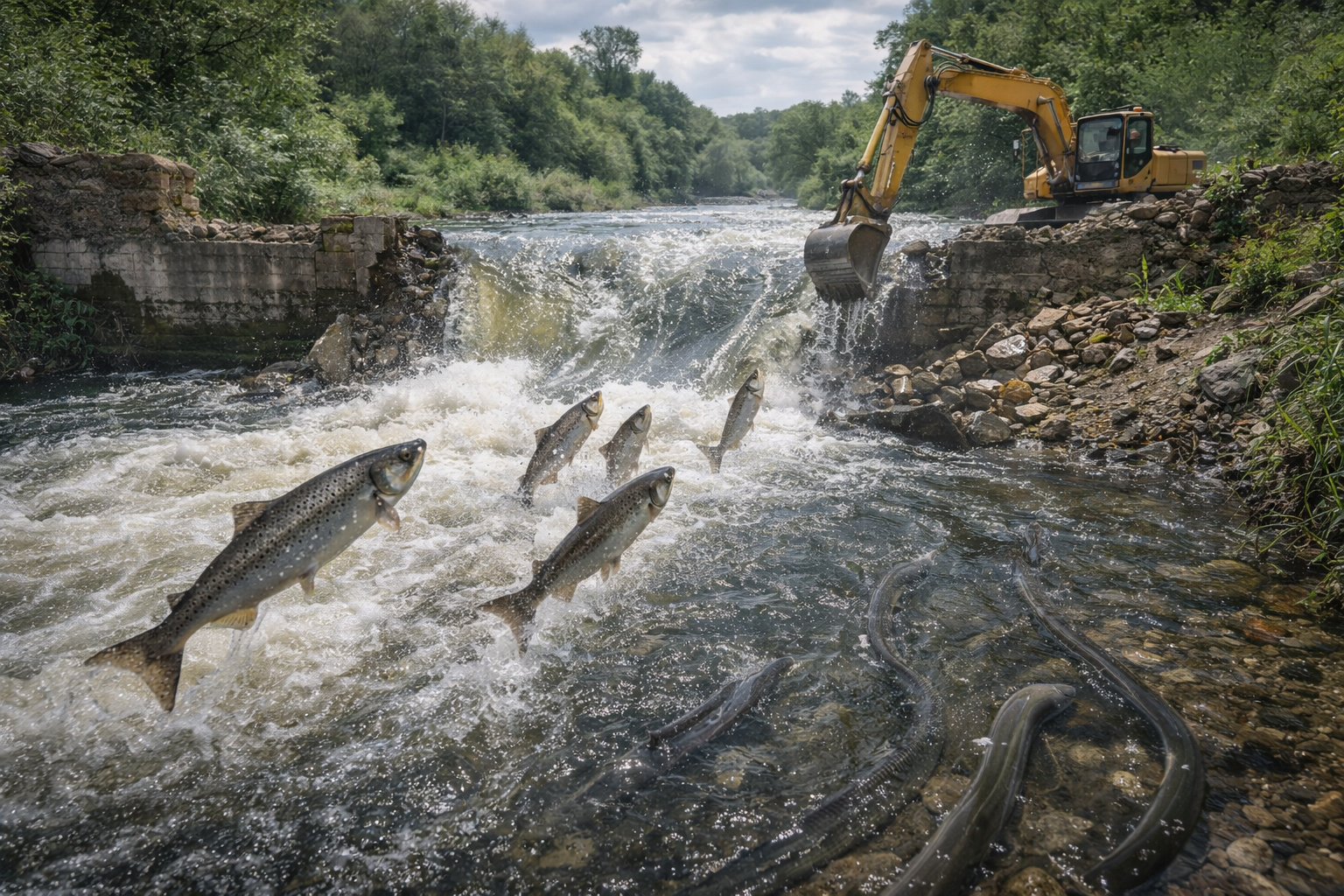

Germany Removes Over 120 Small Dams, Reconnects Hundreds of Kilometers of Rivers and Bets on the Return of Salmon and Eels After a Century of Interruptions.
The discussion about the destruction of river ecosystems due to river fragmentation is not new — but Germany has been turning this debate into real policy. By systematically removing small dams, weirs, and artificial obstacles along rivers and streams, the European country is rebuilding hydrological connectivity, reducing stagnation points, improving water quality, and encouraging the return of nearly extinct migratory species in the 20th century.
This initiative is not isolated: it is part of a broader European movement driven by the Water Framework Directive (WFD) of the European Union, which set clear goals to restore “good ecological status” in inland, coastal, and groundwater. Germany adopted the plan and began to account for demolitions and reopenings of closed sections since the 2000s, with accelerated expansion in recent years.
How Many Dams Are Being Removed and Why?
When we talk about dams, many people imagine large reservoirs or hydropower plants — that is not the case here. The German barriers are largely composed of small dikes, mill dams, artificial falls, gates, and stone cofferdams, many of which are less than two meters high, built over the last 200 years for industry, irrigation, navigation, or milling.
-
Germany Opens World’s Largest Smart Power Semiconductor Factory with €5 Billion Investment, Creating 1,000 Jobs and Doubling Capacity for AI and Energy Needs

-
Kazakhstan’s Torysh Valley Holds Thousands of Giant Stone Spheres, Intriguing Scientists with Ancient Oceanic “Cannonballs”

-
Egypt Discovers 18 Ancient Tombs with Gold Tongues, Unveiling Unusual Funeral Rituals and Amulets Believed to Give Voice to the Dead

-
Nigeria Dumps 120 Million Tons of Sand into Atlantic to Build Massive City with 8.4 km Sea Wall for Protection Against Ocean Waves and Erosion




According to data compiled by European Dam Removal, Germany has already surpassed 120 cataloged removals, with a strong concentration in the states of North Rhine-Westphalia, Saxony, Lower Saxony, and Thuringia, freeing hundreds of kilometers of previously fragmented rivers. These numbers do not count smaller interventions, such as the opening of fish passages, which are also expanding.
The logic is simple: each small barrier creates a “cascading effect” on biodiversity. Upstream sections accumulate sediments, rise in temperature, and lose oxygen; downstream sections suffer erosion and structural impoverishment. In addition, migratory species interrupt vital cycles — and the entire river loses vitality.
The Return of Migratory Species: The Bet on Salmon and Eels
Among the symbols of this revival are long-distance migratory fish, primarily the Atlantic salmon (Salmo salar) and the European eel (Anguilla anguilla). Both were abundant in Germany until the end of the 19th century, but barriers and industrialization drastically reduced their populations.

With the removal of obstacles and restocking programs, the first results are already being observed, especially in the Rhine and its tributaries, where spawning and wild individuals have begun to be identified again after more than 100 years of absence in some sections. The European eel, considered critically endangered, is also benefiting from the restoration of longitudinal corridors and improved water quality.
Technology, Ecological Engineering, and River Rehabilitation
Not all projects are just demolition: many involve ecological engineering, redesigning riverbeds, restoring meanders, and reintroducing natural wood (Large Wood Debris), a practice now common in European rivers. Sets of fish ladders, submerged passages, gravel ramps, and side channels also complement the removals when the surrounding infrastructure does not allow for the total elimination of the barrier.
In addition, environmental sensors and hydrobiological monitoring indicate consistent gains in temperature, turbidity, oxygenation, and benthic diversity, essential components for the recovery of the river ecosystem.
Why Do Small Dams Cause So Much Damage?
To understand the impact, it is essential to highlight three key effects:
- Interrupted Hydrology: the flow ceases to be continuous, harming sediments and nutrients;
- Biological Blockage: prevents fish, macroinvertebrates, and even amphibians from accessing spawning areas;
- Water Quality: impounded water bodies heat up, lose oxygen, and promote algae.
When hundreds of these obstacles accumulate, the effect ranges from microscopic to continental.

Europe Leads — Germany Accelerates
The removal of dams has grown rapidly in Europe over the last decade, driven by countries such as France, the Netherlands, Sweden, and Spain, but Germany stands out for its combination of public policy, inventory of obstacles, and ecological prioritization. In the 2023 European report, it was one of the countries with the highest number of removals recorded that year.
The ultimate goal is not just to unclog rivers, but to reactivate functions lost for generations: migrating, spawning, digging, filtering, and oxygenating — silent actions that create living rivers instead of dead channels.