Portuguese
  Spanish


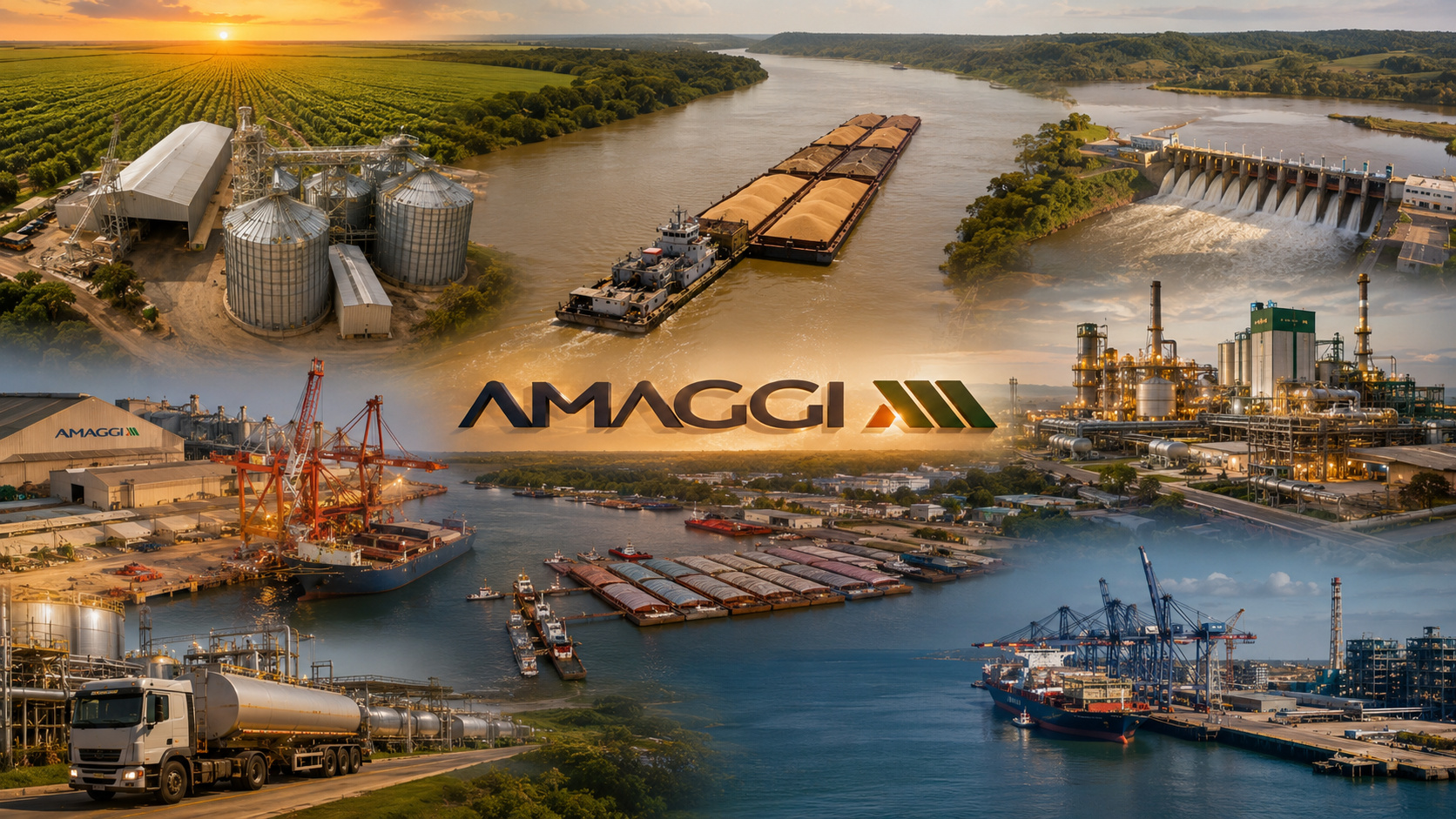

Amaggi moved 19 million tons of grains and fibers in 2024, operates ports, a river fleet, five SHPs, and a biodiesel factory in Mato Grosso, revealing how Brazilian agribusiness controls soy, logistics, energy, and fuel in an integrated chain.
According to Amaggi, the company founded by André Maggi and Lucia Borges Maggi in 1977, in Paraná, currently operates in four business areas: Commodities, Agro, Logistics and Operations, and Energy. Annual revenue exceeds R$ 23 billion, and the group traded 19 million tons of grains and fibers in 2024. The company has 74 units spread across 42 municipalities in nine states, in addition to offices in the Netherlands, China, Argentina, Norway, Paraguay, Switzerland, and Singapore. But what stands out, besides soy, is the logistics, energy, and biofuel structure that supports the operation.
Amaggi operates a floating port in Itacoatiara, a transshipment terminal in Porto Velho, a stake in the Guarujá Bulk Terminal, and a terminal acquired in Paranaguá in 2025. It also owns five Small Hydroelectric Plants in Mato Grosso and a biodiesel factory in Lucas do Rio Verde with a capacity of 338 thousand m³ per year.
Amaggi ceased to be just a soy trading company and became an integrated conglomerate of Brazilian agribusiness
Amaggi is not just a soy trading company with complementary logistics assets. It is an integrated agro-industrial conglomerate, capable of controlling the grain from before planting until it leaves the Brazilian port heading to the Asian market.
-
India’s Sugar Export Cuts and Ethanol Shift Amid El Niño Threat Could Impact Global Prices and Stocks

-
Quarantine Pest Threatening Palm Trees Puts Brazilian Authorities on Alert, Prompts Monitoring at University of Taubaté and Potential Control Measures Across São Paulo
-
Global Alert: Report Finds 159 Pesticides in Coffee Beans Sold in Europe, Posing Serious Risks to Millions of Farm Workers
-
Low-Demand Brazilian Beef Offal Gains Popularity Abroad: Indonesia Purchases $19.5 Million, Boosting Revenue and Reducing Waste



The company operates in agricultural production, origination, commercialization, transport, storage, energy, and biofuel. This integration reduces dependence on third parties, increases operational predictability, and creates a competitive advantage in a chain marked by expensive freight, long distances, and port bottlenecks.
The most strategic point is that part of the fuel used by its own fleet comes from soy processed by the company. The group plants, processes, transports, exports, and supplies part of the operation with biodiesel produced from its own crops.
From seeds in Paraná to the Madeira-Amazonas logistics corridor
Amaggi’s history began in 1977, in Vila Gaúcha, a locality in Paraná that would later become São Miguel do Iguaçu. André Maggi and Lucia Borges Maggi started the business with seeds before expanding operations to the Midwest.


In the 1980s, the family acquired land in Mato Grosso and began large-scale soy production. The transfer of the headquarters to Rondonópolis and then to Cuiabá accompanied the company’s geographical expansion and the state’s consolidation as one of the country’s largest agricultural frontiers.
In 1994, Amaggi built its first Small Hydroelectric Plant, Santa Lucia, in the municipality of Sapezal, on the Juruena River. The decision anticipated a logic that would mark the group: to create its own infrastructure in regions where energy, transport, and logistics were still bottlenecks.
Floating port in Itacoatiara and terminal in Porto Velho changed soy logistics
In 1997, Amaggi began river navigation through the Madeira-Amazonas Corridor, with barges departing from Porto Velho, in Rondônia, heading to Itacoatiara, in Amazonas. During the same period, it built its grain transshipment terminal in Itacoatiara.

The strategy was clear: to control the logistics of its own product instead of relying solely on long road routes to ports in the South and Southeast. This decision helped transform the company into one of the main operators of the waterway corridor connecting Mato Grosso to the Atlantic.
Barges carry soy and corn along the Madeira River to the Amazon River, where the cargo arrives at the floating terminal in Itacoatiara. From there, ocean vessels take the grains to markets such as Europe and Asia, with lower logistics costs than conventional transport via long land routes.
Terminal in Paranaguá reinforces Amaggi’s presence in the country’s largest grain corridor
In 2025, Amaggi acquired a port terminal in Paranaguá, Paraná, strengthening its presence in Brazil’s largest grain port complex. The purchase expands the company’s operations in a strategic route for agricultural exports.
CEO Judiney Carvalho stated that Amaggi’s expansion is planned, coordinated, and strategic, with market studies and opportunity mapping. In practice, the move reduces yet another intermediary between the product originated by the company and the ship that carries the cargo abroad.
With 19 million tons traded in 2024, every logistical gain has a significant impact. Having its own terminal in Paranaguá means greater control over the flow, shipment, cost, and competitiveness of Brazilian soybeans in the international market.
Five small hydroelectric plants provide energy autonomy to operations in Mato Grosso
The Energy area is one of Amaggi’s less visible, but also one of its most strategic, parts. The group owns five Small Hydroelectric Plants built on the Juruena and Formiga rivers in Mato Grosso.
Together, these plants total approximately 70 megawatts of installed capacity. For comparison, this volume would be enough to supply about 140,000 homes, depending on the consumption pattern considered.
Amaggi did not build these Small Hydroelectric Plants just to sell energy. The central logic was to ensure its own supply in remote regions of Mato Grosso, where farms, warehouses, and industrial units needed to operate before the full arrival of the conventional electrical grid.
Biodiesel factory in Lucas do Rio Verde uses soybean oil from its own chain
In Lucas do Rio Verde, Amaggi’s soybean crushing plant received an investment of R$100 million and has been operating since 2023 with the capacity to produce 338,000 cubic meters of biodiesel per year. The raw material is degummed soybean oil, a byproduct of the soybean processing itself.
The biodiesel produced supplies the company’s road fleet, consisting of 1,100 trucks. According to the base text, 100 units already run on B100, pure biodiesel, without mixing fossil diesel.
This model closes a rare production cycle in Brazilian agribusiness. Soybeans become meal, oil, biodiesel, logistical energy, and fuel to transport part of its own production. The crop ceases to be just a commodity and begins to feed the group’s operational machinery.
Amaggi, ADM, Bunge, Cargill, and Louis Dreyfus show the strength of logistical integration
The most direct comparison to understand Amaggi is with the major global agricultural trading companies: ADM, Bunge, Cargill, and Louis Dreyfus, known as the ABCD of global agribusiness. All possess their own logistical infrastructure, port terminals, and distribution chains.
Amaggi built a similar model, but with a significant difference: vertical integration all the way to energy generation and fuel. This combination brings agricultural production, logistics, hydroelectric plants, and biodiesel together into a single operational strategy.
None of the four major international trading companies are known for operating, in Brazil, a chain so linked to their own energy generation and fleet supply with biofuel made from grain. This is what makes Amaggi a unique case in Latin American agribusiness.
Lucia Maggi and the silent construction of one of Brazil’s largest agro-industrial groups
Lucia Borges Maggi, co-founder and matriarch of the group, has an estimated fortune of nearly US$7 billion by Forbes and appears among Brazil’s wealthiest people. Despite this, she remains a little-known figure to the general public.

Part of this low exposure comes from the fact that Amaggi is not publicly traded on the stock exchange. Another part comes from the public association of the Maggi surname with Blairo Maggi, former governor of Mato Grosso, who is more nationally known than the company’s co-founder herself.
Over decades, Lucia participated in the construction of one of the few truly integrated agro-industrial conglomerates in Latin America. Amaggi reveals how part of Brazilian agribusiness stopped depending solely on production and began to control logistics, energy, ports, and fuel on its own scale.