






 Portuguese
  Spanish


Prime Day 2026 will take place from July 1st to 7th in Brazil with the World Cup, Amazon promising to surpass Black Friday, 9,000 temporary jobs, more than 300 logistics hubs, unlimited free shipping, Recurring Pix, artificial intelligence, and the GRU9 center in Cajamar operating 24 hours during the promotional event.
The Prime Day 2026 will be held by Amazon in Brazil between July 1st and 7th, amidst the World Cup, with the declared goal of surpassing Black Friday by turning the game atmosphere into a sales engine. The information was published by Exame on June 16, 2026.
The strategy involves offers, unlimited free shipping, categories of immediate consumption, electronics, sports items, food, beverages, 9,000 temporary jobs, and logistical reinforcement throughout the country. The operation will have as one of its bases the GRU9 distribution center in Cajamar, capable of processing more than 10,000 packages per hour.
Amazon wants to use the World Cup as a shopping engine
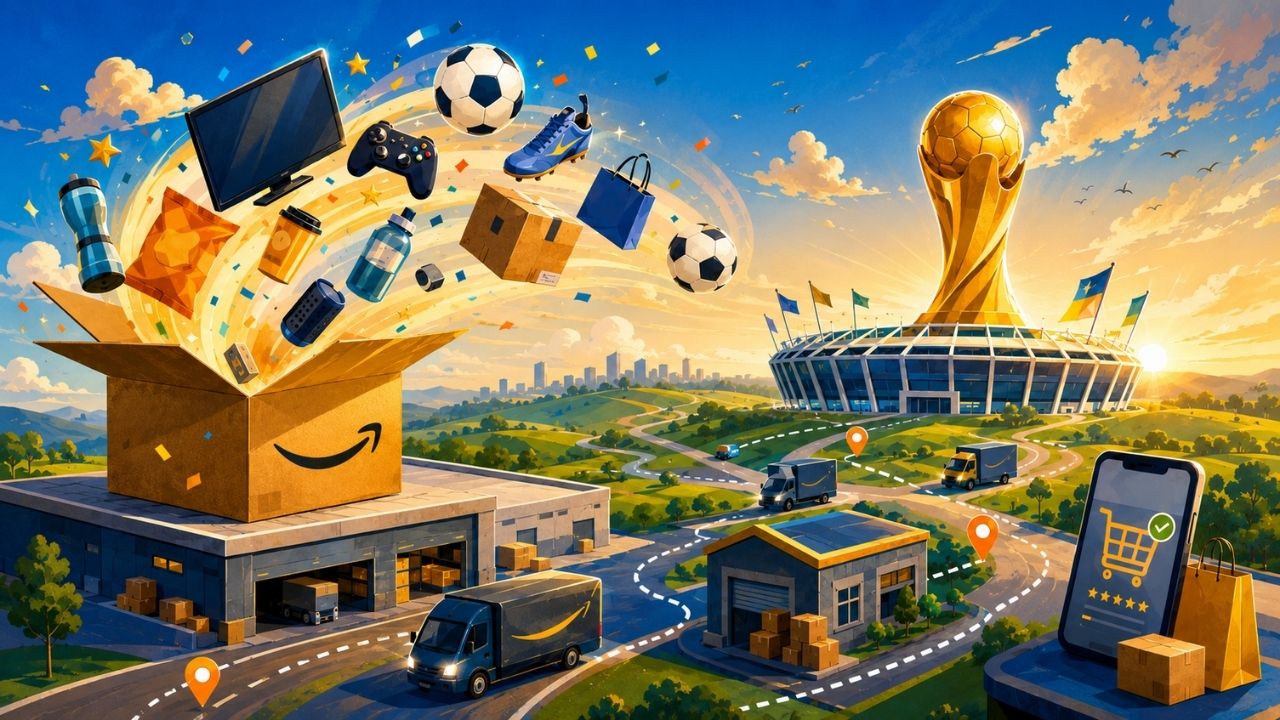
Amazon sees the World Cup as a consumption window capable of moving various categories at the same time. The logic is simple: when there is a game, the consumer anticipates buying food, beverages, party items, electronics, audio, and everyday products.
-
Brazil to Issue “Panda Bonds” in China, Aiming to Raise Up to 5 Billion Yuan at Lower Interest Rates Than Dollar Debt
-
NATO Faces Internal Tensions as U.S. Pushes for Increased Defense Spending, Targeting 5% of GDP by 2035, with Warnings for Countries Near 2% Level

-
Brazil to Introduce B16 Diesel with Increased Soybean Oil Content for Trucks by 2026
-
Brazil’s July Bolsa Família Payments May Include Extra $150 and $50 for Families with Children, Pregnant Women, and Updated CadÚnico Registration


According to Mariana Roth, leader of the Amazon Prime Program in Brazil, Brazilians usually prepare for celebrations. The World Cup becomes, in this context, more than a sporting event: it becomes a trigger for planned purchases.
The Prime Day fits precisely into this reading. Instead of relying solely on the traditional appeal of discounts, Amazon tries to connect the promotional event to a strong cultural behavior, which involves gathering at home, quick consumption, and the search for convenience.
Event will last seven days in July
The Prime Day 2026 will take place between July 1st and 7th. The seven-day duration increases the company’s chance to capture different shopping moments, from the consumer who researches beforehand to the one who decides at the last minute.
The date also places the event in the middle of the World Cup, which may favor categories associated with games, gatherings, and celebrations. Electronics, Amazon devices, sports items, food, beverages, hygiene, cleaning, and personal care are among the bets cited in the source.
Amazon’s great ambition is to turn the event into something bigger than the previous Black Friday. According to the executive, the idea is that on the very first day, the performance surpasses that of Black Friday 2025.
Black Friday became the benchmark that Amazon wants to beat
Black Friday is usually one of the main dates for online retail. Therefore, the expectation of surpassing this performance right at the start of Prime Day shows the size of Amazon’s bet on the July event.
The company states that it has been improving its results from event to event. The World Cup comes as a reinforcement for this ambition because it mixes urgency, shopping lists, entertainment, and convenience.
The central point is that Amazon is not treating Prime Day just as a discount week. The company is trying to position the event as a complete solution for those who want to shop before or during the games without relying on physical travel.
Immediate consumption is expected to drive demand
The source reports that immediate consumption products, cleaning, hygiene, and personal care had high demand in 2025. Amazon believes this behavior should continue in 2026, driven by convenience.
At the same time, the World Cup increases interest in products related to the experience of watching the games. TVs, speakers, party items, food, and drinks are on the radar of consumers who want to host friends or watch matches at home.
A survey by Amazon with HarrisX indicates that 29% of Brazilians already plan to buy TVs, speakers, or party items around tournaments. Another 41% say that having food and drinks to host guests is important when watching major sports events.
Unlimited free shipping becomes a convenience weapon
One of Amazon’s bets for Prime Day is unlimited free shipping, with no minimum value. The benefit appears as a way to reduce shopping barriers and encourage smaller or recurring orders.
In practice, this can be decisive for everyday items. When the consumer needs something quickly, the shipping charge can make a difference in the final decision.
Convenience becomes as important as price. The consumer wants a discount, but also wants reliable delivery, simple purchase, easy payment, and predictability to avoid running out of product during the game.
Prime becomes an ecosystem to retain the customer
Amazon also wants to strengthen Prime as a subscription that encompasses different benefits. The strategy involves increasing the program’s relevance and keeping the customer within the company’s ecosystem.
According to Mariana Roth, subscribers tend to shop more frequently and stay connected to the platform longer when they trust the shopping experience. Speed and reliability of deliveries appear as central factors in this relationship.
Prime Day serves as a showcase for this ecosystem. The event not only sells discounted products; it reinforces shipping, subscription, payment, delivery, streaming, and consumer relationship.
Recurring Pix enters the Brazilian strategy
Another front mentioned by Amazon is Recurring Pix. The feature allows the customer to authorize automatic debit only once, with billing at the stipulated period.
According to Mariana Roth, the company was a pioneer in including Recurring Pix in a subscription program after the feature was launched by the Central Bank. The decision was made for Brazilians who prefer Pix and installment payments as payment methods.
This detail shows that Amazon tries to adapt Prime Day to local behavior. In Brazil, payment methods can influence conversion as much as price, delivery time, and product variety.
Logistics is the foundation of the promise
To turn expectation into delivered sales, Amazon relies on a broad logistics structure. The company operates around 300 logistics hubs in Brazil, including distribution centers, sorting units, and delivery stations.
The operation also includes 19 distribution centers in seven states, 100,000 independent sellers in the marketplace, and more than 55,000 direct and indirect jobs. According to the source, the company invested R$ 75 billion in Brazil over 15 years, with R$ 19 billion in 2025 alone.
Without logistics, Prime Day becomes just a promise of discounts. Fast delivery is what turns an offer into a positive experience, especially when the consumer buys close to an important date or game.
Cajamar will be a key piece in Prime Day
Most of the operation will be carried out at the distribution center in Cajamar, São Paulo, nicknamed GRU9. The unit was inaugurated in February 2025 and covers 75,000 m².
The location has more than 3 km of interconnected conveyor belts, the capacity to process over 10,000 packages per hour, and more than 3,500 direct and indirect employees. During the event, the operation will run 24 hours.
GRU9 is the type of structure that shows the physical weight of digital commerce. Behind a click, there is inventory, conveyor belt, sorting, packaging, routing, transportation, and real-time monitoring.
Artificial intelligence helps predict demand
According to Ana Laura Bueno, leader at GRU9, preparation for the peak of Prime Day begins months in advance. Artificial intelligence helps analyze demand, search and navigation trends, as well as position inventories close to consumers.
The technology also assists in real-time resource adjustment. This matters because promotional events create order spikes, and any planning failure can lead to delays, stockouts, or delivery bottlenecks.
AI acts as an operational tool, not as a technological ornament. It helps decide where to place products, how to distribute demand, and which routes can be faster during the period of highest pressure.
9,000 temporary positions reinforce the operation
Amazon announced 9,000 temporary positions for Prime Day 2026 in Brazil. The positions will be distributed among distribution centers, delivery stations, and logistics operations.
According to the source, the positions include training in safety and operation. This reinforcement shows that even with automation, artificial intelligence, and conveyor belts, the event still relies on a large mobilization of people.
E-commerce grows with technology, but continues to require labor on a large scale. During peak dates, human strength remains essential to sort, pack, move, and deliver products within the promised timeframe.
Amazon Now and fast deliveries enter the game
The source also mentions the growth of Amazon Now, the retailer’s ultra-fast delivery service. Currently, the operation is present in eight cities and offers about 30 product categories in São Paulo and Rio de Janeiro.
This type of service directly aligns with the World Cup logic. If the consumer notices a lack of food, drink, party item, or essential product before the game, fast delivery becomes a competitive advantage.
Additionally, the operation will be reinforced with airline partnerships with Azul and Latam, including additional routes. Programs like Amazon Hub and Favela Log also join the capillarity strategy.
Competition with Mercado Livre and Shopee pressures Amazon
Amazon’s investments are part of a larger battle for Brazilian e-commerce. The source mentions competition with Mercado Livre and Asian companies like Shopee.
In this scenario, Prime Day serves as a showcase to demonstrate price, assortment, delivery, technology, and consumer relationship. It is not just a promotional date, but a battle for shopping habits.
Those who gain customer trust during major events can secure recurring purchases afterward. Therefore, reliable delivery, free shipping, transparency in offers, and a frictionless experience are as important as the discount.
World Cup, logistics, and discount become a single strategy
The Prime Day 2026 shows how Amazon intends to turn the World Cup into a sales engine in Brazil. The event will last seven days, offer unlimited free shipping, Recurring Pix, 9,000 temporary jobs, around 300 logistics hubs, and support from GRU9 in Cajamar.
The goal of surpassing Black Friday 2025 on the first day reveals the size of the bet. But the result will depend on the combination of price, stock, delivery, trust, and the ability to meet consumer demand at the pace of the games.
Do you think Prime Day can really surpass Black Friday in Brazil, or is the strength of the traditional date still greater? Would free shipping, fast delivery, and the World Cup change your purchase decision? Share your opinion.







