






 Portuguese
  Spanish




Starlink would have signed contracts with 41 airlines to bring onboard internet to more than 7,000 aircraft. The service uses low-orbit satellites, advancing among United, Emirates, Lufthansa, and Qatar Airways, while Amazon competes in the market with Project Kuiper and pressures the connection in global commercial flights.
Starlink, SpaceX’s satellite internet service, would have signed contracts with 41 airlines to bring onboard internet to more than 7,000 aircraft worldwide, using low-orbit satellites in a market that also attracts Amazon. The information was published by Exame on June 16, 2026, with an update on the same day.
The advancement involves the global aviation sector and companies like United Airlines, Emirates, Qatar Airways, Lufthansa, Hawaiian Airlines, Air Canada, and EL AL. The competition occurs at a time when airplane internet is beginning to be seen not just as a luxury but as part of the routine of commercial flights.
Airplane internet enters a new phase

Onboard internet has always been seen by many passengers as an expensive, unstable, or limited service. On some flights, the connection still depends on paid packages, reduced speed, and irregular coverage, especially on long routes.
-
2,000-Year-Old Gold Rings Found with Human Bones in Thailand Reveal Rare Burial and Feature Ancient Indian Inscription

-
Lenovo Unveils Legion Y700 Tablet with RGB Backlighting, 5G, and SIM Card Support

-
World’s First Nuclear Hydrogen Unit Begins Operation: Copper-Chlorine Technology with Initial Capacity of 150 Liters per Hour, Aiming for 3,000 Liters per Hour
-
Mechanics Retrofit Old Fiat Uno with BYD Electric Motor for Silent, Low-Voltage Operation Reaching Nearly 60 km/h in Home Test



The arrival of Starlink to more airlines changes the perception because it places a company known for low-orbit satellites within a transforming market. The promise is not just to connect passengers but to make onboard internet more like the experience on the ground.
Even so, the advancement does not mean that all flights will have free or perfect connection immediately. The final quality depends on the aircraft, route, local regulation, network capacity, and the commercial policy of each airline.
Contracts target more than 7,000 aircraft
According to the source, Starlink has signed contracts with 41 airlines to equip more than 7,000 planes. This number shows that the race for in-flight internet has moved from the experimental field to commercial scale.
Among the companies mentioned are United Airlines, Emirates, Qatar Airways, Lufthansa, Hawaiian Airlines, Air Canada, and EL AL. These are companies with different profiles, with domestic, international, and intercontinental routes.
When a technology enters thousands of aircraft, it ceases to be a niche novelty. The service begins to influence passenger experience, airline strategy, and competition for differentiation in commercial flights.
Low orbit satellites are the technical trump card
The main technical argument of Starlink lies in the use of low Earth orbit satellites. These satellites are closer to the planet than the geostationary satellites used in many traditional systems.
This proximity can reduce latency, that is, the response time of the connection. In an internet experience, this matters for calls, messages, browsing, remote work, and real-time app usage.
Lower latency alone does not mean a perfect connection. Stability also depends on the number of connected users, the plane’s route, coverage, the equipment installed on the aircraft, and the available network capacity.
SpaceX expands presence within the aviation sector
Starlink is the satellite internet service of SpaceX, a company by Elon Musk. By advancing within airlines, the operation begins to compete for a strategic space: the passenger’s connection time during the flight.
This market is valuable because the airplane is no longer an isolated environment. Passengers want to respond to messages, work, watch content, access social networks, and maintain communication during long trips.
For airlines, better internet can become a competitive advantage. On competitive routes, the quality of the connection can influence the passenger’s choice, especially among executives, frequent travelers, and international flight customers.
United, Emirates, Lufthansa, and Qatar appear among partners
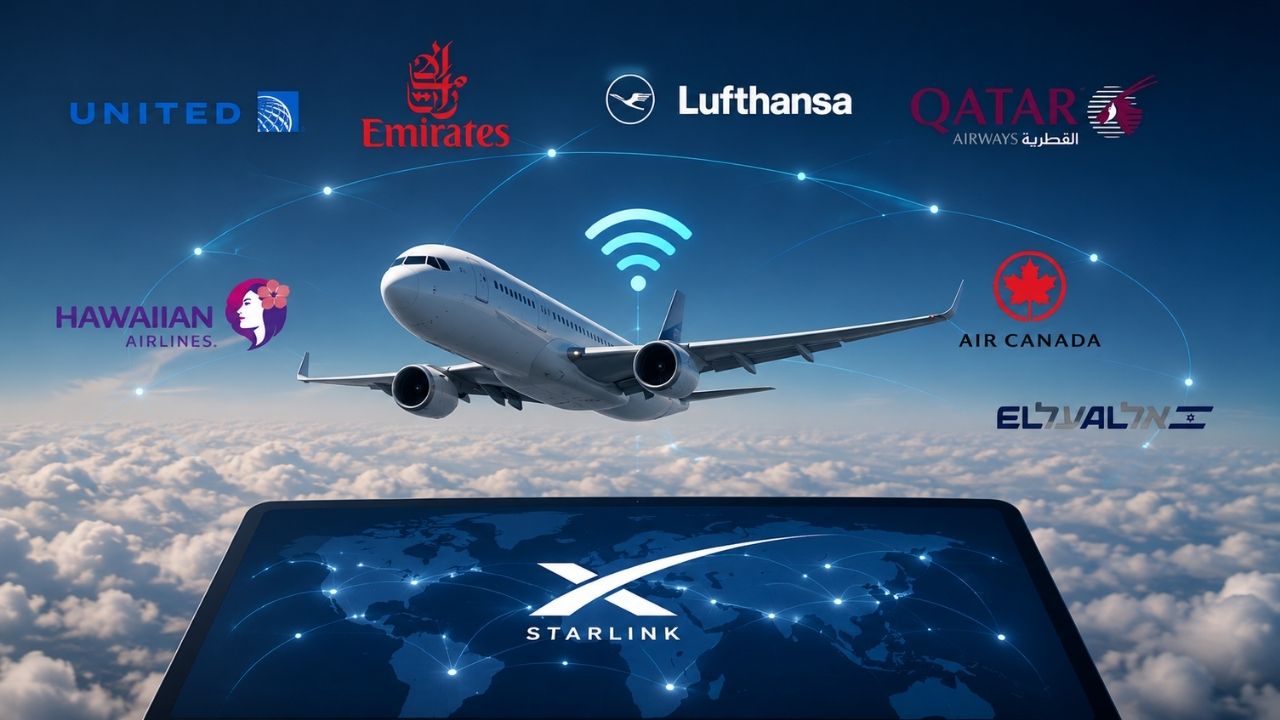
The list mentioned by the source includes companies with a strong international presence. United Airlines, Emirates, Lufthansa, and Qatar Airways appear as relevant names because they operate routes with great reach and high visibility.
Hawaiian Airlines, Air Canada, and EL AL are also mentioned among the partner companies. This indicates that the advancement of Starlink is not restricted to a single type of market or region.
The presence of these companies helps to scale the service. The more companies adopt the technology, the greater the pressure on competitors to improve onboard internet.
Amazon enters the competition with Project Kuiper
The competition for internet in the sky does not involve only Starlink. The source mentions that Finnair is evaluating different providers, including Starlink and Project Kuiper, Amazon’s satellite internet project.
This detail shows that the market is still open and competitive. The entry of new providers can pressure prices, accelerate investments, and improve the quality of services offered to passengers.
The fight is not just for antennas on planes, but for the dominance of a new layer of global connectivity. Amazon enters this scenario because it also targets satellite internet and can compete with Starlink in airlines.
Onboard internet may become a common service
For years, airplane internet was treated as an extra. In many cases, the passenger needed to pay a high price for limited packages or accept a connection too slow for everyday use.
With the expansion of Starlink and competition from companies like Amazon, this scenario may change. The trend is that airlines will start treating connectivity as part of the flight experience, especially on higher-value routes.
This does not mean the service will be the same across all companies. Some may offer free internet, others may charge, and others may limit usage according to class, segment, or loyalty program.
Quality still depends on route, airplane, and network
The source highlights that the architecture of low-orbit satellites can improve stability and reduce data transmission delays. However, the final experience does not depend solely on space technology.
Each aircraft needs to be equipped. Each route needs to have adequate coverage. Each country may have specific rules. In addition, the network needs to support the demand of passengers connected at the same time.
Therefore, airplane internet must advance in phases. First come contracts, installation, and testing; then, expansion by fleet, routes, and service models adopted by each airline.
Passenger could be the biggest beneficiary
For the passenger, the most visible impact is the possibility of flying connected with more stability. This can change the routine of those who work in transit, take long trips, or do not want to be without communication for hours.
On international flights, a better connection can allow meetings, messages, access to documents, and entertainment with fewer interruptions. The plane ceases to be a forced pause in digital life and becomes an extension of the connected environment.
But the real benefit will depend on commercial conditions. If the internet is expensive or very limited, the user’s perception may remain negative. If it is stable and accessible, it can become a new expected standard on commercial flights.
Airlines also gain a new showcase
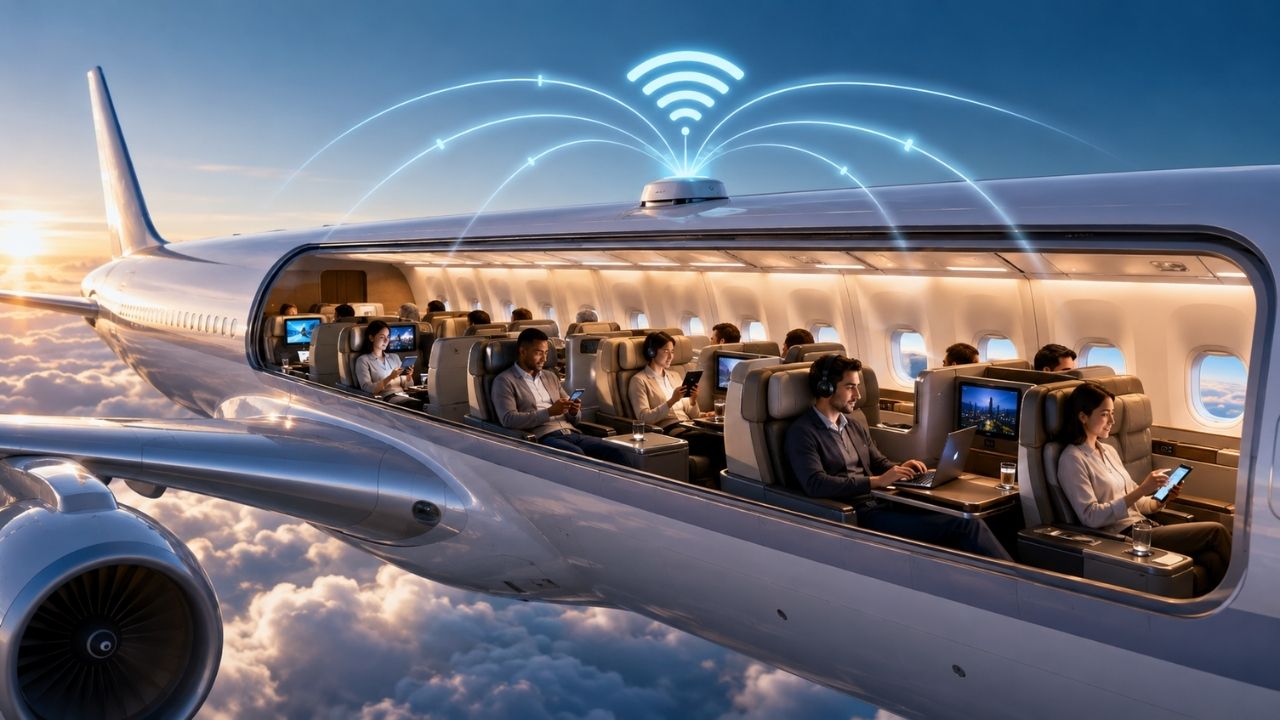
For airlines, onboard internet can function as a brand differentiator. In a sector where comfort, punctuality, service, and price are constantly compared, connection can enter the list of decisive factors.
The adoption of Starlink by large companies can also serve as a signal to the market. If passengers start associating certain companies with better internet, competitors will have more incentive to react.
Connectivity becomes part of the flight experience as much as seating, entertainment, and food. On long trips, this detail can change the complete perception of the service.
Internet in the sky becomes a new billion-dollar dispute
Starlink advances in the aviation sector with contracts that, according to the source, involve 41 airlines and more than 7,000 aircraft. The use of low-orbit satellites places the company in a strong position to compete for onboard internet.
At the same time, the presence of Amazon and Project Kuiper shows that this market can still change a lot. Emirates, United, Lufthansa, Qatar Airways, and other mentioned companies indicate that in-flight connectivity is entering a new phase.
Do you think fast internet on airplanes should be free on all flights, or does it still make sense to be charged as an extra service? Can Starlink transform the flying experience, or does it depend more on the airlines? Share your opinion.


