






 Portuguese
  Spanish
  5 min of reading
  0 comments


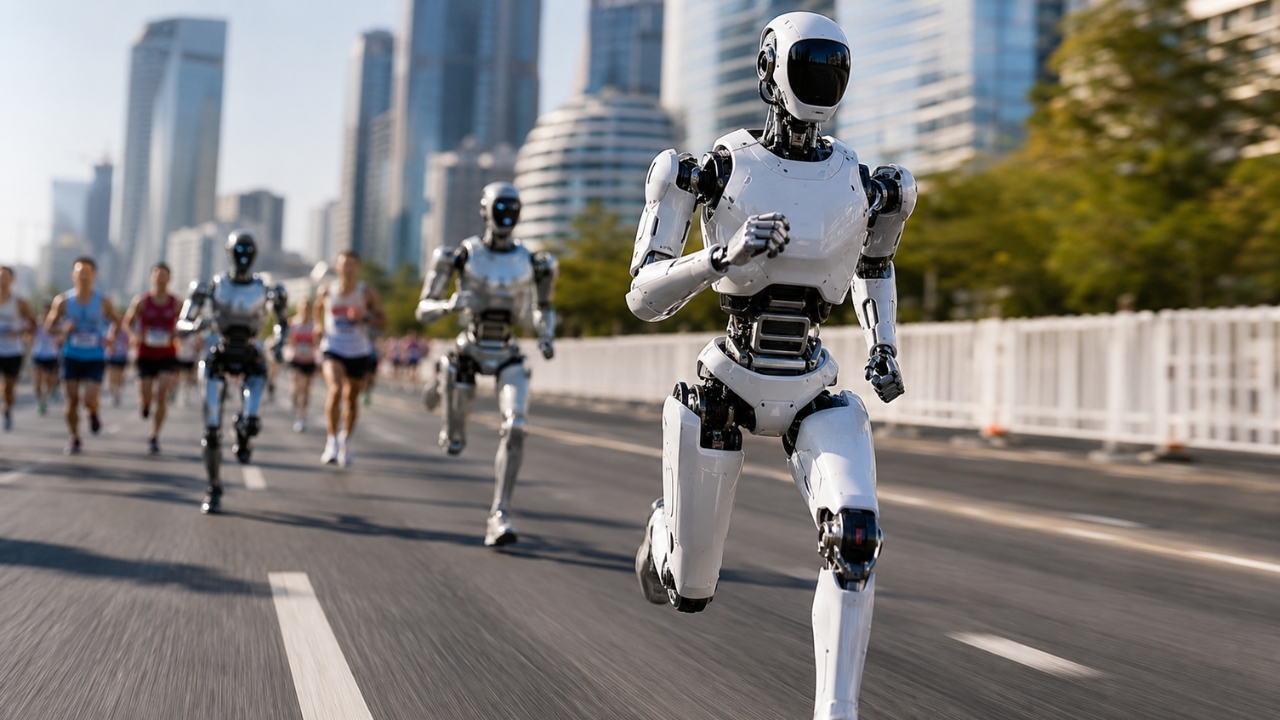
Robot performance in China shows how physical AI is advancing rapidly and can transform industry, services, logistics, and the global automation market
China has just transformed a simple race into a technological message to the planet. In Beijing, Chinese humanoid robots participated in an official half marathon and showed that the race for leadership in artificial intelligence, robotics, and automation has entered a new phase.
The event, held in the Beijing E-Town region, brought together humans and machines in a 21.0975 km race. According to information released by Beijing’s official portal, the big winner among the robots was the humanoid Shandian, also called Lightning, who completed the race in an impressive 50 minutes and 26 seconds. See the main source on Beijing’s official portal.
What was most striking was not just the time. The number of participating teams reportedly grew almost 5 times in just one year, while about 40% of competitors have already achieved autonomous navigation. In other words: many of these robots were not just being controlled remotely. They were making movement decisions on their own.
-
Helicopter Drops 180 Tons of Sand and Gravel on Swedish River to Revive Ecosystem Damaged by Decades of Exploitation

-
Brazilian Company Launches Retro Smartphone with 48 MP Camera, T9 Keyboard, and Privacy Features for Social Media-Free Use

-
Self-Taught Chinese Farmer Builds 5-Ton Submarine from Scrap, Launches It in Anhui River
-
Invisible Induction Technology Enables Wireless Power for Blenders, Coffee Makers, and Air Fryers, Reducing Countertop Cables





The race that seems like science fiction, but actually happened
The humanoid robot half marathon in Beijing seemed like a scene from a futuristic movie, but it was a real test of endurance, balance, software, sensors, and embedded intelligence. The machines had to face a long distance, maintain stability, and follow the course without completely collapsing.
The winning robot, linked to the Qitian Dasheng team, also known as Monkey King, became a symbol of a new stage in Chinese robotics. Its performance placed China at the center of the global debate about the future of bipedal robots, capable of walking, running, and operating in human environments.
The comparison with human athletes caused enormous repercussions. The time of 50:26 was presented as lower than the men’s human world record for the half marathon, which is 57:20, a mark set by Jacob Kiplimo. Still, experts point out that the race conditions and rules for robots are different.

The alarming detail: 40% already navigate autonomously
The most explosive data from the event is that about 38% to 40% of the teams competed with some level of autonomous navigation. This means that the robots used their own systems to interpret the route, maintain direction, and adjust movements without relying entirely on human operators.
This advancement completely changes the meaning of the race. It’s not just about getting a machine to run. It’s about testing spatial perception, decision-making, motor control, dynamic stability, and artificial intelligence applied to the physical world.
In practice, China used a sporting competition as a showcase to demonstrate that its robots are moving out of laboratories and into real-world scenarios. What today seems like entertainment could tomorrow become technology for factories, logistics, security, healthcare, urban services, and high-risk operations.
Number of teams grows almost 5 times in one year
Another impressive point is the growth of the ecosystem. In just one year, the number of teams reportedly increased almost fivefold, a sign that the race for commercial humanoid robots is accelerating at a brutal pace.
This leap reveals that Chinese universities, startups, tech giants, and research centers are heavily investing in embodied intelligence, an area that combines AI with robotic bodies capable of acting in the real world.
The message is clear: China doesn’t just want to develop artificial intelligence applications. The country wants to create machines that move, work, observe, learn, and physically interact with the environment. It’s AI leaving the screen and gaining legs.
Lightning’s victory and the controversy of comparison with humans

The robot Lightning completed the race with an official time of 50 minutes and 26 seconds in the autonomous navigation category. The mark generated catchy headlines because it was below the human record cited for the half marathon.
But there’s an important detail: the competition had specific rules for robots. Some models were autonomous, while others could be remotely controlled. To balance the competition, remotely controlled robots received a penalty in their final time.
This makes Lightning’s victory even more symbolic. The feat was not just about running fast, but winning within a logic that valued technological autonomy. In other words, the real prize was proving that the machine could decide, adjust, and continue.
Not all finished well: falls, failures, and limits were exposed
Despite the triumphant tone, the race also showed that humanoid robotics still faces enormous challenges. Some robots experienced instability, stumbled, lost pace, or needed assistance during the course.
These failures are fundamental to understanding the current state of technology. Robots can already achieve impressive results, but they are still far from replicating the versatility, energy efficiency, and natural adaptation of the human body.
Even so, every fall becomes data. Every balance failure, every overheating, and every route error helps teams improve their systems. Therefore, the half marathon served as a high-pressure public laboratory.
Why this event matters to the world
The impact of the Beijing robot half marathon goes far beyond sports. It shows that China is using popular events to accelerate, test, and showcase its strength in advanced humanoid robotics.
While many countries are still discussing the impact of generative AI in offices and schools, China seems to be moving towards the next frontier: AI with a physical body, capable of executing tasks in the real world.
This type of technology can redefine entire production chains. Resilient, autonomous, and inexpensive humanoid robots could transform sectors such as industry, transportation, construction, customer service, surveillance, and personal care.


A silent message to the United States, Europe, and Brazil
The Beijing race also serves as a geopolitical warning. The country that dominates autonomous humanoid robots could lead a new industrial revolution, with economic effects comparable to those of the internet, smartphones, and artificial intelligence itself.
For Brazil, the episode is a sign of urgency. While China transforms a half marathon into a global technological showcase, countries that do not invest in scientific education, robotics, semiconductors, and applied AI may only remain as consumers of this new wave.
The spectacle in Beijing left an image difficult to ignore: robots running, competing, and learning in front of the public. The future that seemed distant has begun to cross the finish line — and China wants to get there first.





Be the first to react!