Portuguese
  Spanish


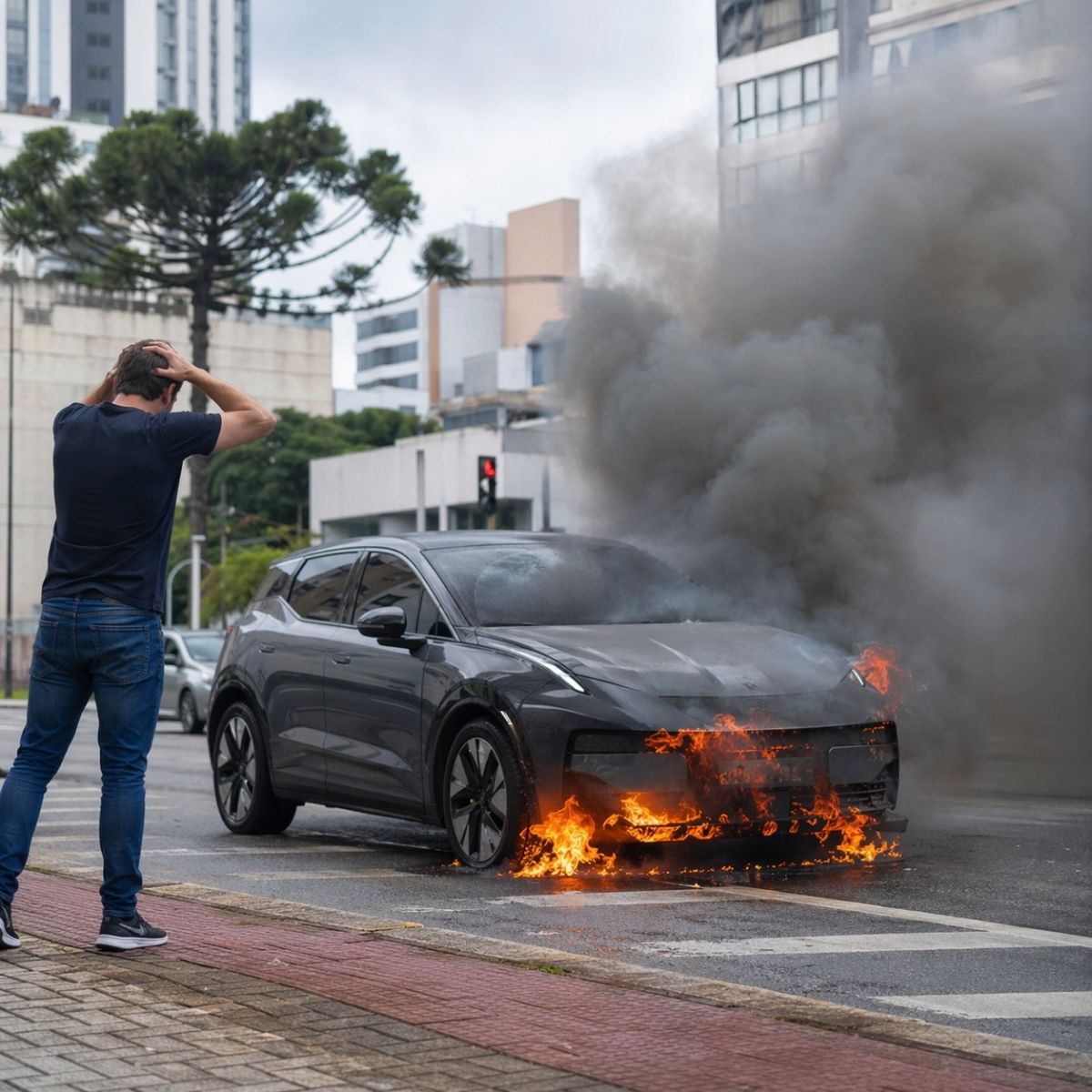

A Volvo C40 electric car began to emit smoke on Niterói Street, Cajuru, in Curitiba, on Tuesday (21), and the driver managed to stop and abandon the vehicle before the fire spread, escaping unharmed while the Fire Department fought the flames.
An electric car from the brand Volvo, model C40, caught fire on Tuesday (21) on Niterói Street, in the Cajuru neighborhood, in Curitiba, near the access to BR-277. The driver noticed that the vehicle was starting to emit smoke while driving, reacted by stopping immediately, and exited the car before the flames spread through the structure. The Fire Department of Paraná was called and fought the fire on site. No one was injured, and Volvo Car Brazil classified the damages as exclusively material.
The manufacturer released an official statement informing that it became aware of the incident on Tuesday morning and opened an internal investigation process to determine the cause of the fire in the electric car. According to preliminary information from Volvo, the vehicle began to emit smoke unexpectedly, and the quick reaction of the driver was crucial in preventing the incident from resulting in casualties. The company reaffirmed its commitment to safety and transparency and made itself available to provide new information as the investigation progresses.
What is known about the fire in the Volvo electric car in Curitiba


The incident occurred on Niterói Street, located in the Cajuru neighborhood, eastern Curitiba, an area with heavy traffic due to its proximity to the access to the BR-277 highway. The C40 electric car, a fully battery-powered vehicle that Volvo positions as a premium compact SUV, began to show signs of trouble during transit, and the smoke that came from the vehicle was the first alert noticed by the driver. Videos recorded by witnesses and shared on social media show the car already engulfed in flames while fire crews worked to extinguish the fire.
-
Renault Kwid Outsider 2023: Affordable Used Hatchback with 1.0L Engine, 15.7 km/l Efficiency, and Ample Cargo Space for Around $11,000

-
Chevrolet SUV Offers 153 hp Engine, 620 km Range, and ADAS Features at a Lower Price Than a New Kwid

-
London buses run on biofuel made from coffee grounds, turning café waste into sustainable public transport fuel without engine modifications.

-
Major Automaker Considers Closing 4 Factories, Putting 45,000 Jobs at Risk Amid Chinese Competition in Brazil


Volvo did not specify which part of the electric car originated the fire. In battery-powered vehicles, the most serious risk is associated with failure in the lithium cells that make up the energy pack, a situation known as thermal runaway, in which the temperature of one cell rises uncontrollably and can ignite adjacent cells in a chain reaction. There is no confirmation that this mechanism caused the fire in the C40 in Curitiba, and the manufacturer’s internal investigation will determine whether the origin was electrical, mechanical, or related to an external factor.
The reaction of the driver who saved his life in the burning electric car
The difference between tragedy and scare in this case was the immediate perception of the problem. The driver of the electric car noticed the smoke while still driving and made the right decision: he stopped the vehicle immediately and left the compartment before the fire compromised the exit routes. In electric vehicle fires, the window of time between the first sign of smoke and the full spread of flames can be short, and any delay in evacuation exponentially increases the risk.
Vehicle safety experts recommend that upon noticing smoke, the smell of burning, or abnormal heat coming from the floor or cargo compartment of an electric car, the driver should stop as soon as possible in a safe location, turn off the vehicle, exit, and move at least 30 meters away. Attempting to fight the fire with a household extinguisher is discouraged in fires involving lithium batteries, as the flames can reignite even after apparent extinction, and the volume of water needed to cool the cell pack far exceeds the capacity of conventional equipment.
What Volvo said about the electric car fire
The official statement from the manufacturer was published on the same Tuesday and adopts a cautious tone. Volvo Car Brazil confirmed the incident, reported that no one was injured, and that an internal investigation has already been opened, but did not point to a probable cause nor offered hypotheses about what caused the combustion of the C40. The company mentioned that safety has been its fundamental principle since 1927, referencing the Swedish brand’s tradition in occupant protection, and promised transparency in disclosing the results of the investigation.
This positioning is standard for incidents of this type in the automotive industry. Manufacturers avoid pointing out causes before the conclusion of technical analyses to not assume premature responsibility or fuel speculations that could affect consumer confidence in the model or technology. For Volvo, which has heavily invested in the transition to a fully electric line and positions the C40 as a showcase of this strategy, the fire in Curitiba is an image problem that the investigation needs to resolve quickly and clearly.
What the fire in Curitiba means for confidence in electric cars
Every fire involving an electric car gains disproportionate repercussions compared to the actual frequency of these events. Statistics compiled in markets with a high volume of electric vehicles, such as Norway and China, indicate that battery-powered cars catch fire as frequently as or less than combustion models, but public perception is the opposite because each case involving the new technology becomes news while fires of conventional vehicles are rarely reported. Still, the intensity and difficulty of extinguishing a lithium battery fire are real and require specific protocols from firefighters.
The incident in Curitiba does not invalidate the safety of electric cars as a category, but reinforces the importance of two points. The first is that battery vehicle drivers need to be aware of warning signs and know how to react, just like the driver of the C40 did by stopping and exiting immediately. The second is that Brazilian fire departments need proper training and equipment to handle lithium battery fires, a reality that will become increasingly frequent as the electric fleet grows in the country. The electric car is statistically safe, but when something goes wrong, the response needs to be quick and specialized.
And you, would you be worried about driving an electric car after this fire? Do you think Brazilian firefighters are prepared for this type of occurrence? Leave your opinion in the comments.