






 Portuguese
  Spanish
  5 min of reading
  0 comments


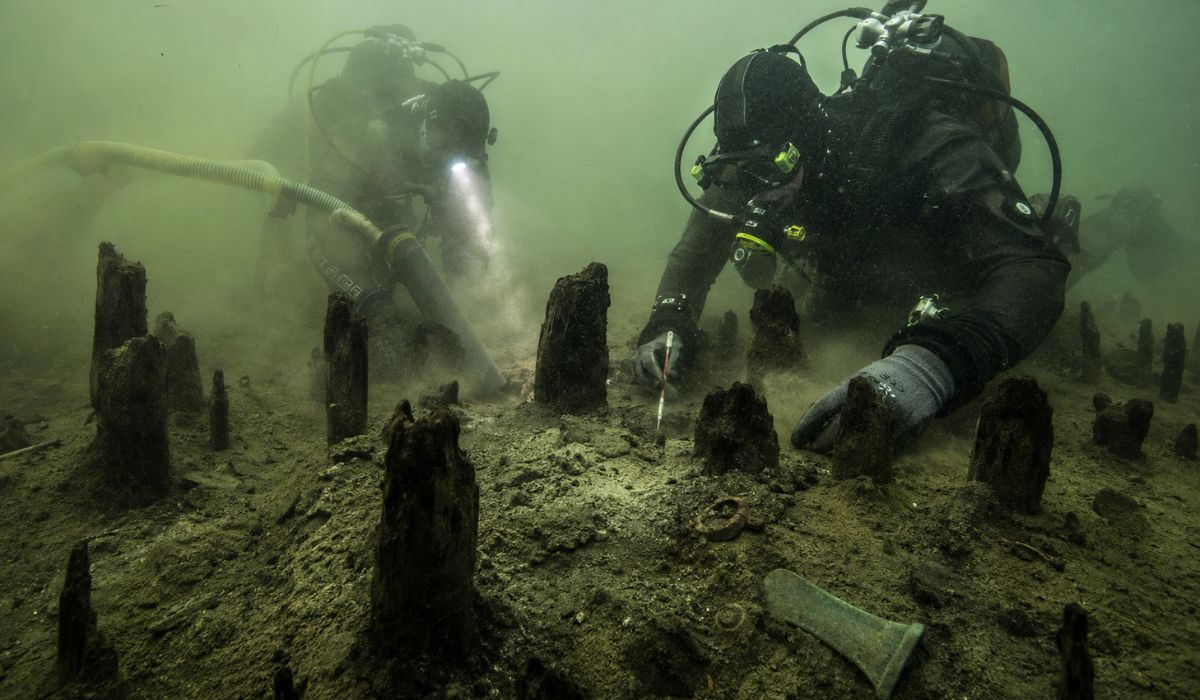
An underwater campaign in an Italian volcanic lake brought to the surface remains preserved under sediments, with wooden structures and bronze objects that help reconstruct part of an ancient Bronze Age occupation.
Underwater archaeologists mapped more than 600 wooden stakes at the bottom of Lake Mezzano, in Valentano, in the province of Viterbo, Lazio, Italy.
The structure belongs to an ancient pile-dwelling village from the Bronze Age, dated approximately 1700 to 1150 BC, according to information released by the Soprintendenza Archeologia, Belle Arti e Paesaggio for the province of Viterbo and Southern Etruria.
The work was presented by the Italian agency in a statement published on October 13, 2025, after the first phase of a new campaign of underwater research at the site.
-
They call it the “Shopee house” and even cardboard, but the R$ 20,000 house is a certified Wood Frame from Alea, financed by Minha Casa Minha Vida: understand if it’s worth more than masonry.

-
Egypt wants to divert 10 million m³ of Nile water per day, equivalent to 4,000 Olympic swimming pools, to build a glass city in the desert and irrigate 2.28 million acres, in a project that attempts to push life out of the country’s most contested valley.

-
Brazilian military personnel spend weeks in extreme training in the Amazon and receive a badge reserved for Jungle Warriors during the celebration of the 60th anniversary of one of the most demanding and respected courses in the world.
-
After the divorce, a woman spent four years building a studio apartment with skylights, mirrors, a bathtub hidden under the sofa, and family mementos for a fresh start.




The team reported that the objective of the operation is to document, preserve, and study the remains of the settlement, which remains submerged in the volcanic-origin lake.
Located in the Latera caldera, in the Tuscia Viterbese region, Lake Mezzano holds layers of clay, sediments, and organic materials accumulated over millennia.
These conditions helped preserve part of the wooden structures and metal objects associated with the ancient occupation.
Submerged village in Lake Mezzano
The stakes identified in the clayey bottom cover about one-third of the already known area of the settlement.
According to the Soprintendenza, these elements probably supported wooden platforms used by pile-dwelling communities, built in flooded areas or near the shores.
The remains appear at depths ranging from approximately 2.5 meters to 10 meters.
For the team responsible for the campaign, this distribution helps analyze changes in the lake level during the occupation period, estimated at about six centuries.
Before the specific excavations, the researchers conducted a morphobathymetric survey of the entire lake bottom.
This type of mapping records the shape and depth of the submerged terrain, allowing the location of areas with a higher concentration of archaeological materials.
From this survey, the divers concentrated their work on points where ancient deposits were still protected by compact layers of clay.
The procedure avoided a broad excavation without prior delimitation and allowed progress over areas considered more preserved.
The removal of the sediments was done with suction hoses, called “sorbone” in Italian operations.
According to the Soprintendenza, the work took place in conditions of low visibility and cold water, which required controlled excavations and detailed recording of the findings.


Bronze artifacts preserved under the clay
During the campaign, the team recovered more than 25 bronze artifacts.
The Italian body attributes the state of conservation of the objects to contact with the superficial layer of clay, which reduced the direct exposure of the metals to oxidation processes.
Among the materials removed from the water are flanged axes, spearheads, fibulae, rings, a pin, a sickle, and decorative elements.
Fragments of bronze ingots, associated with smelting processes, were also found.
The presence of these ingots indicates, according to the Soprintendenza, the possibility of metallurgical activities within the village or in nearby areas.
One of the pieces mentioned by the body is a perforated bronze object with decoration related to a solar symbol.
After the removal of the materials, restorers worked to stabilize the objects and reduce risks of deterioration caused by the change of environment.
Part of the artifacts appeared in areas with volcanic stones.
The team relates this distribution to possible ancient landslides, but treats the interpretation as a working hypothesis, without presenting it as a definitive explanation for the formation of the archaeological deposit.
Traces with fire marks
Some bronze objects show signs compatible with exposure to fire.
According to the Soprintendenza, these materials may have fallen or been abandoned along with burned wooden structures, identified among the remains of the settlement.
The evaluation still depends on the continuation of the research.
As the materials remained submerged for thousands of years, part of them may have shifted due to changes in water level, bank erosion, sediment movement, or episodes of structure collapse.
The study of the layers suggests a relationship between depth and antiquity of the materials, according to the initial analysis released by the body.
The oldest items seem to be in deeper areas, while more recent traces have been located in shallower points.
This reading still needs to be compared with the study of ceramics, metals, and stakes.
The team also intends to associate the findings with different sectors of the settlement to understand how the community occupied the lake’s edge and what activities were carried out in each area.
What the campaign reveals about the Bronze Age
The Mezzano lake site was already known to Italian authorities, but the new campaign expanded the documentation on its extent, preservation, and internal distribution.
The national catalog of cultural assets of Italy identifies the site as a lakeside settlement in Valentano, under the same Soprintendenza’s supervision.
With the mapping of the stakes, researchers now have more elements to reconstruct the spatial organization of the settlement.
The bronze objects help to understand technical practices, material circulation, and daily or symbolic uses in the context of the Bronze Age.
The Soprintendenza reports that the nature and total extent of the settlement are not yet fully defined.
Even so, the data obtained indicate that the materials and wooden structures may spread over a significant part of the lake, under layers of silt and clay.
The next steps should prioritize the continuation of underwater documentation and stratigraphic excavations at selected points.
This type of work can help identify different phases of occupation and the relationship between the objects found, the wooden stakes, and the ancient lake shores.
The campaign also includes conservation actions for materials removed from the water.
Since submerged wood and metals can degrade quickly after exposure to air, technical treatment is a necessary step to allow further studies and eventual presentation of the objects to the public.
The set of remains from Mezzano lake offers new information about communities that lived in central Italy about 3,000 years ago, according to the archaeologists responsible for the research.







Be the first to react!