Portuguese
  Spanish


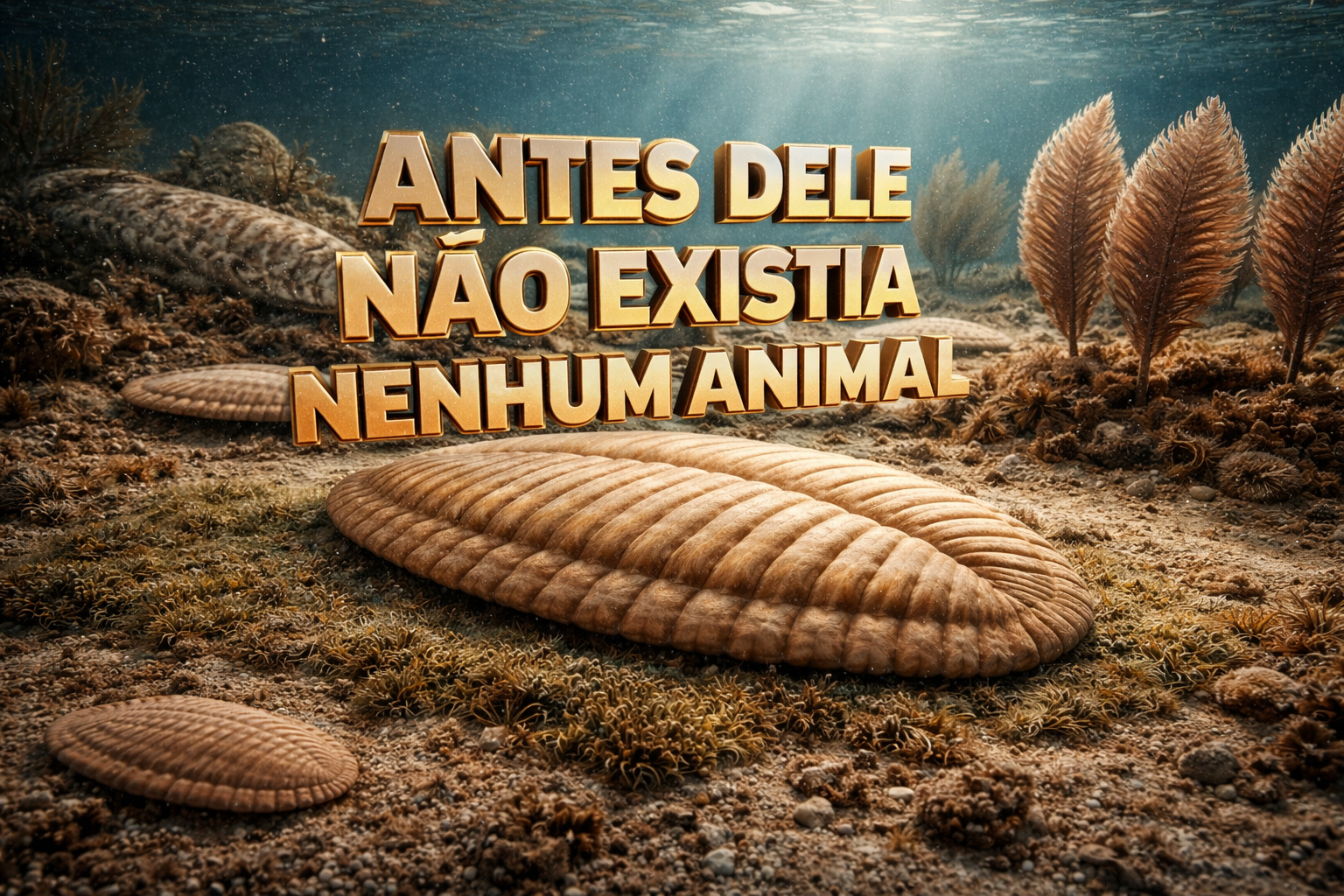


The Article Shows How Dickinsonia Was Confirmed as the Oldest Known Animal, Explains Its Way of Life in Primitive Oceans, and Details Why This Discovery Changed the History of Evolution
A significant scientific discovery has been changing the understanding of the origin of animal life on the planet. Dickinsonia, considered the oldest animal ever identified by science, lived about 550 million years ago. This period belongs to the Ediacaran, much earlier than what was believed to be the start of complex animal life on Earth.
The fossil records indicate that this organism inhabited the depths of primitive oceans. In this environment, it continuously fed on microbial mats. These layers were rich in microorganisms and covered marine sediments. Thus, from very early stages, the presence of animals on Earth was already occurring, which displaces traditional milestones of evolutionary biology.
In this way, this finding repositions the Ediacaran period, which occurred between 635 million and 541 million years ago. This interval has begun to be seen as central to the emergence of the first animals. It precedes the famous Cambrian explosion, dated to approximately 541 million years ago.
-
China Develops Custom 140-Ton Electric Mining Truck with 770 kWh Swappable Battery, Deploys 290 Units in Xinjiang’s Largest Zinc Mine

-
Meta to Launch Arena, a New Prediction App Targeting 3.56 Billion Users, Competing with Polymarket and Kalshi

-
Scientist Challenges Famous Human Evolution Theory, Argues Homo Sapiens Evolved Gradually Over Thousands of Years
-
15-Year-Old American Builds Ocean Generator with PVC Pipe and 3D-Printed Propeller for $12, Wins National Prize, Presents at White House, and Makes Forbes 30 Under 30 List




Ancient Discovery, Prolonged Scientific Debate

Dickinsonia was first identified in 1946, from fossils found in Australia. Since then, the organism has sparked intense scientific debates. This occurred because its body was flattened, segmented, and difficult to compare with modern animals.
For decades, researchers disagreed on its classification. Initially, some scientists believed it was a lichen. Others argued that it was a protist, due to its unusual characteristics. Thus, for much of the twentieth century, Dickinsonia remained a biological enigma. There was no consensus within paleontology.
This deadlock reflected, above all, the technical limitations of the time. The available tools did not allow for detailed chemical analyses. Therefore, organic compounds preserved in the fossils could not be identified.
Modern Analyses Confirm Animal Nature
The scenario began to change decisively from the 2010s. During this period, laboratory advances allowed for more precise studies of ancient fossils. In 2018, research conducted by scientists from the Australian National University presented what were considered conclusive evidence.
The studies identified fossilized cholesterol molecules in the remains of Dickinsonia. This type of compound is characteristic of animal metabolism. It is not found in fungi, plants, or protists. Thus, the scientific community confirmed that Dickinsonia belongs to the animal kingdom. The controversy was then resolved after more than 70 years.
Direct Impact on the History of Evolution
The confirmation of Dickinsonia as an animal prompted a profound revision of classical models of evolution. Until then, it was believed that animals emerged abruptly. This event would be concentrated in the Cambrian explosion, about 541 million years ago.
However, the existence of an animal dated to 550 million years ago demonstrates another scenario. Animal life had existed much earlier than this event, albeit in a simple form. Thus, the Cambrian explosion began to be seen as a period of diversification. It ceased to be interpreted as the absolute beginning of animals.
Scientific Recognition and New Perspectives
Studies highlighted by scientific journals such as Nature and Science have reinforced the importance of this discovery. These works have broadened the debate on evolutionary biology. Additionally, international research centers have begun to reassess fossils from the Ediacaran period.
In this way, Dickinsonia has solidified as a watershed in paleontology. The discovery demonstrated that the history of animal life is longer and more complex.
If animals existed 550 million years ago, how many other ancient life forms are still waiting for new technologies to reveal their role in the evolution of Earth?