Portuguese
  Spanish


California almonds dominate the global market, but they have a gigantic water consumption: more than 4 trillion liters per year, in the midst of California’s drought. They also depend on billions of bees brought by truck. By exporting 70% of the crop, the state sends virtual water away.
They are in plant milk, granola, chocolate, and fitness snacks worldwide. What few people realize is the size of the bill these seeds leave behind. California almonds account for about 80% of all global production, but they pay for this dominance with a colossal thirst for water, precisely in a state that lives from drought to drought. It’s the kind of turnaround that the consumer doesn’t see when biting into the snack.
The warning appears in analyses like that of the agro platform Farmonaut, from 2026, which unravels the risks of the model. Planted to supply the planet, California almonds consume more than 4 trillion liters of water per year and still depend on an army of billions of bees brought by truck from all over the country to pollinate the orchards. Supplying the world, in this case, is costly to the land and the bees themselves.
The turnaround: the dried fruit that dries the land
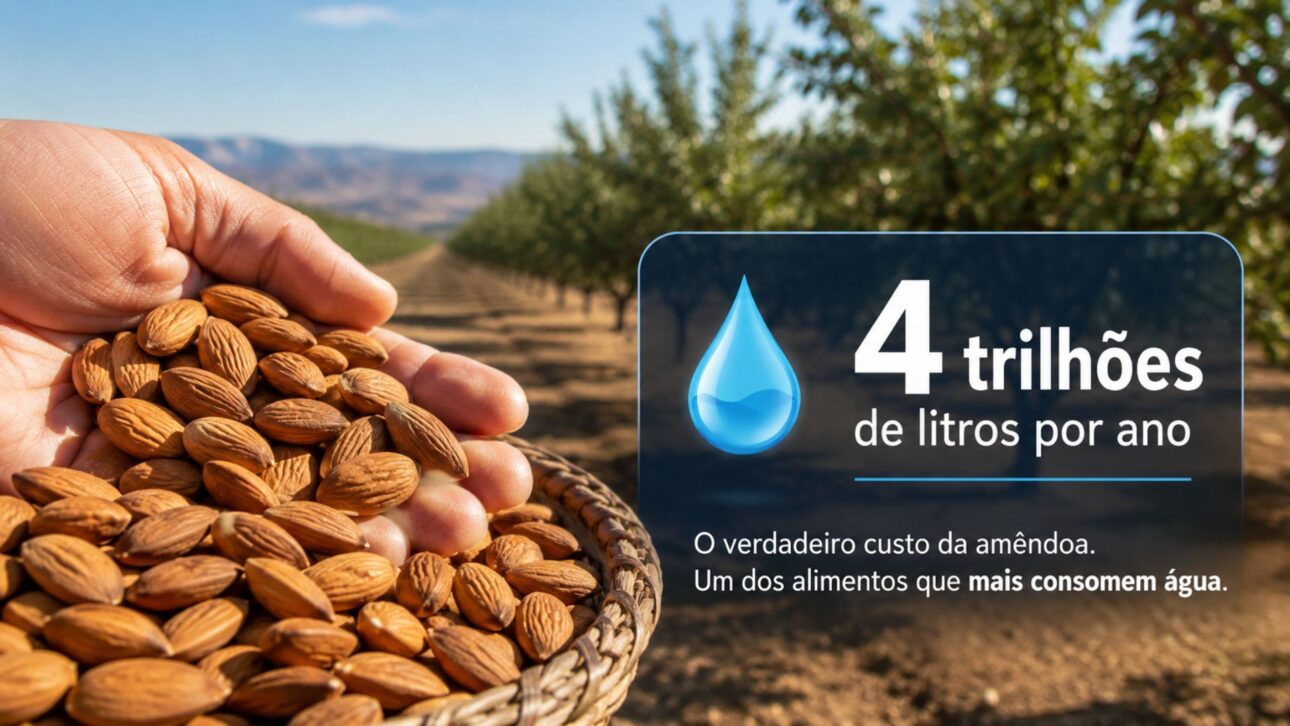
California has turned the almond into an export powerhouse, with about 80% of the planet’s almonds and nearly 70% of the crop sold abroad. But this commercial success was built on a lacking resource: water. Cultivating almonds on a large scale amidst California’s drought is planting thirst in dry land.
-
India’s Sugar Export Cuts and Ethanol Shift Amid El Niño Threat Could Impact Global Prices and Stocks

-
Quarantine Pest Threatening Palm Trees Puts Brazilian Authorities on Alert, Prompts Monitoring at University of Taubaté and Potential Control Measures Across São Paulo
-
Global Alert: Report Finds 159 Pesticides in Coffee Beans Sold in Europe, Posing Serious Risks to Millions of Farm Workers
-
Low-Demand Brazilian Beef Offal Gains Popularity Abroad: Indonesia Purchases $19.5 Million, Boosting Revenue and Reducing Waste



The turnaround is in the detail that the label doesn’t tell. Each almond is a tree that drinks all year round, even in years of severe drought, when it doesn’t rain enough to sustain the orchards. The water consumption of California almonds doesn’t stop in the drought, and that’s where the problem lies, because the plant doesn’t understand water crises or rationing.
It is the same script as other export monocultures that have become symbols of dry rivers, like avocado in some regions. The difference is the American scale and a unique aggravating factor. The almond not only drinks too much but also needs to rent billions of bees to exist, a dependency that no other major crop has to the same degree.
4 trillion liters: the water bill that frightens
The numbers explain the extent of the astonishment. According to a survey by the California Water Impact Network, the network that monitors water use in the state, almond orchards consume around 3.2 million acre-feet of water per year, equivalent to more than 4 trillion liters. It’s enough water to supply entire cities, dedicated to a single crop.
This water consumption takes on dramatic contours during the drought in California. When rain and rivers can’t keep up, producers resort to increasingly deeper wells, drawing from underground aquifers that take centuries to replenish. The result is the ground sinking in some regions, a phenomenon of subsidence caused by over-extraction of water, leaving a physical scar on the landscape.
Some translate this into the image of water consumption per unit: it is estimated that each almond requires about a gallon, nearly 3.8 liters of water to form. The number is debated, but it gives the dimension of the problem. Multiplied by trillions of almonds, the water consumption turns into this mountain of 4 trillion liters, hard to justify amid the drought in California.
Billions of trucked bees: the most expensive pollination in the world
If the water is already impressive, the logistics of the bees are jaw-dropping. California almonds bloom almost all at once, at the end of winter, and need mass pollination in a very short interval of a few weeks. There aren’t enough local bees to handle it, so the solution is to bring them from outside, by the millions.
The operation is one of the largest directed animal migrations on the planet. Every February, about 2 million hives, totaling tens of billions of bees, are loaded onto trucks and cross the United States towards California’s orchards. They come from distant states, from the icy North to Florida, traveling over a thousand kilometers on wheels just to pollinate the almond blossoms.
This army of billions of bees represents the majority of all commercial bees in the United States, gathered in one place. The almond has become, in practice, the largest employer of bees in the world, and this has a cost that doesn’t fit just in the water bill. The price is paid by the bees themselves.
The side effect that sickens the bees
Here is the second twist, the one that hurts. Bringing together almost all of a country’s commercial bees in one place is the perfect recipe for spreading diseases and pests among the hives, which return home contaminated. The pollination of almonds, which should be just work, ends up being a focus of illness for the bees.
The risks add up inside the orchard. According to Farmonaut, exposure to pesticides and fungicides used in the crop accumulates in the pollen and nectar, harming larvae and adult bees, and the monoculture offers little variety of food. It is estimated that colonies lose a significant portion of workers during the intense pollination season, a strain that weakens the bees precisely when the planet needs them most.
It’s a cruel paradox. The crop that relies entirely on bees is also one of the most stressful for them, in a cycle that threatens those who sustain the business itself. Without healthy bees, there are no California almonds, and that’s why the side effect on pollinators is as concerning as the thirst of the orchards.
Virtual water: when exporting almonds is exporting water
There is a concept that ties all this together and few know: virtual water. Every time California exports an almond, it invisibly exports all the water that was used to produce it. As about 70% of the crop goes abroad, the dry state is, in practice, giving away its trillions of liters of virtual water.
The idea of virtual water helps to see the absurdity of the equation. A state suffering from drought in California uses its scarcest water to manufacture a product that, for the most part, will be consumed in Europe, Asia, and the rest of the world. The water remains in the almond’s past, but the benefit of consumption stays on another continent, while the water cost remains in Californian soil.
This reasoning turns a simple snack into a geopolitical issue. Whoever eats California almonds in another country is, unknowingly, drinking the virtual water of a region in crisis. California almonds have thus become a classic case of how global trade moves invisible water, from the land that doesn’t have it to the table of those who will never see it.
The other side: what the almond industry says
It would be unfair to tell only half the story, because the sector has arguments. The almond industry, represented by entities like the Almond Board of California, argues that the crop has become an easy scapegoat for the drought. According to this side, almost every crop consumes a lot of water, and almonds are not thirstier than other crops when measuring water by nutritional value or per hectare.
Producers also point to real advances. A large part of the orchards has adopted drip irrigation and sensors that have reduced waste, and the tree uses practically everything, from the shell to the wood, which dilutes the impact. The number of one gallon per almond, so often repeated, is contested by the industry as simplistic, for ignoring efficiency gains and the use of by-products.
The truth, as almost always, lies in the middle. California almonds are not isolated villains, but they also cannot escape the fact that they concentrate enormous water consumption, part of it exported as virtual water, in a place without surplus water. Recognizing both sides is what separates honest criticism from exaggeration, and the debate about the drought in California benefits when it avoids the easy extreme.
Is the hidden cost of almonds worth it?
In the end, the almond tells a story that goes far beyond the healthy snack. Behind every handful are trillions of liters of water amidst drought, billions of bees trucked and sickened along the way, and an invisible flow of virtual water crossing the world. It is the hidden cost of a dried fruit that the label never shows. Thinking about this does not mean demonizing the almond, but rather understanding the true cost of what we eat.
The message applies to any country that exports food, including Brazil, which sends virtual water embedded in soy, meat, and many other commodities.
And you, did you know that eating a California almond could carry so much water and so many bees behind it? Share here in the comments if this changes the way you look at what you put on your plate.