Portuguese
  Spanish


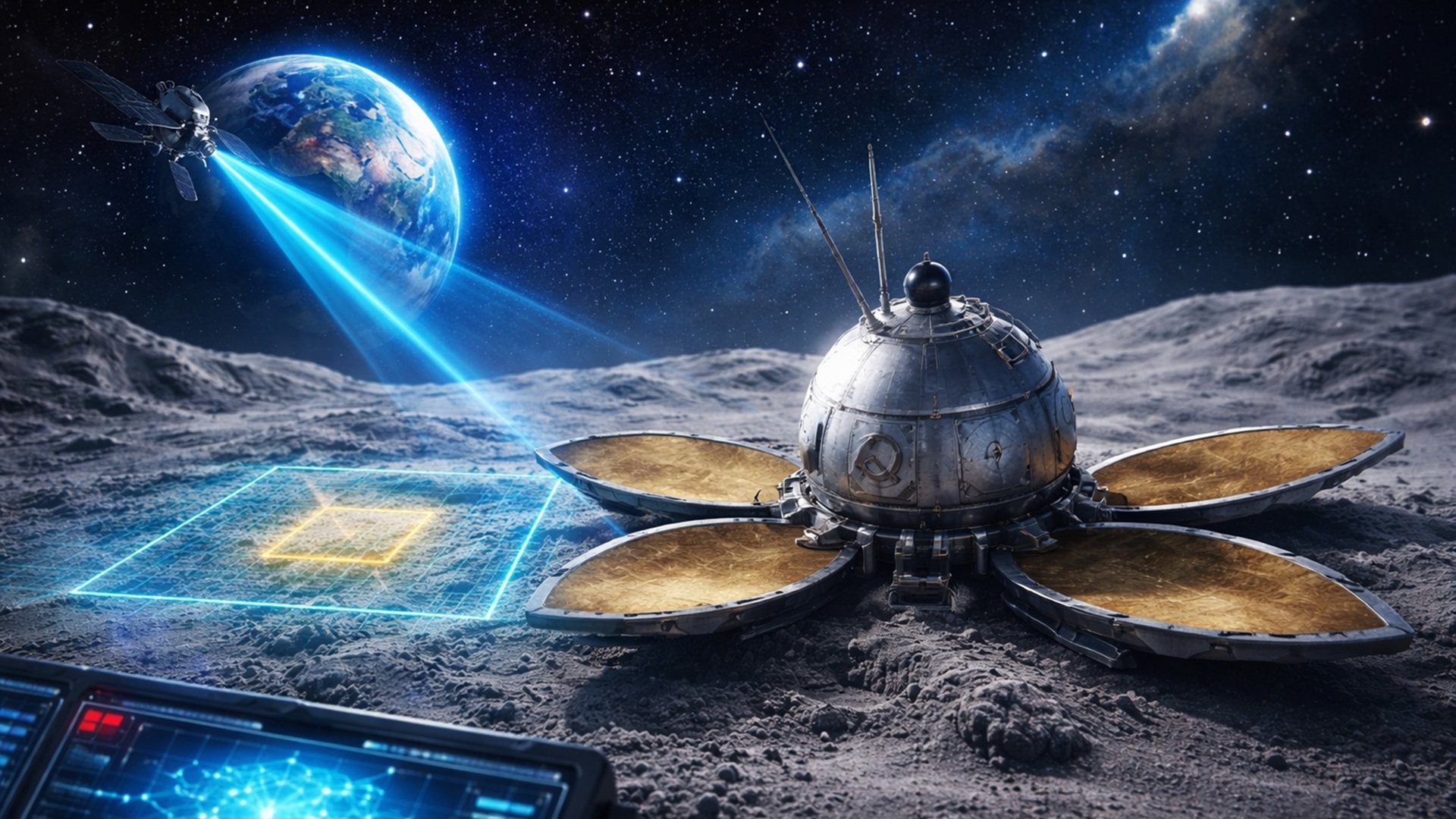


After More Than Six Decades of Uncertainties About the Coordinates Released in 1966, Researchers from University College London Used Artificial Intelligence to Identify Areas of 5 × 5 km with Possible Traces of the Soviet Spacecraft Luna 9, Whose Confirmation Could Occur in March 2026 with New Orbital Images
The location of the Soviet spacecraft Luna 9, missing for more than six decades after the first soft landing on the Moon in 1966, may have been identified by artificial intelligence, according to a team from University College London, with possible confirmation expected in March 2026.
Soviet Spacecraft Luna 9 May Have Location Identified After Decades of Searches
For more than sixty years, the exact location of the Soviet spacecraft Luna 9 has remained undefined. The object was the first to successfully land on the lunar surface and transmit images to Earth, but its official coordinates have been considered inaccurate over time.
The search involved years of analysis with high-resolution lunar images, without success. Now, scientists led by Lewis Pinault from University College London used a machine learning algorithm to identify several potential landing sites.
-
Google Invests Billions in Italian Island’s Innovative Energy Storage Using Liquid CO2 Technology

-
LG Unveils 670-Liter Multidoor Refrigerator in Brazil with Transparent “InstaView” Panel, Independent Temperature Zones, and Smartphone Control, Starting at $15,100
-
Scientists Convert Common Plastic into Synthetic Graphite for Electric Car Batteries, Paving the Way for High-Value Recycling

-
Divers Recover 2,600-Year-Old Phoenician Shipwreck from Seabed in Spain to Prevent Damage


The possible discovery could occur in 2026, provided new images confirm the predictions generated by the computational model.
Historic Mission of 1966 Marked the First Soft Landing on the Moon
In 1966, the Soviet spacecraft Luna 9 became the first to achieve a soft landing on the Moon. The mission launched a spherical capsule 58 cm in diameter and weighing 100 kg, equipped with inflatable shock absorbers.
After touching the ground, the capsule bounced several times before stabilizing with four petal-shaped panels. The operation lasted three days and transmitted vital data, including the first photographs of the lunar surface.
The landing coordinates were published in the Pravda newspaper, the official organ of the Soviet Union. Later, the accuracy of this information was questioned.
Inaccurate Coordinates Complicated Localization of the Soviet Spacecraft
With the launch of NASA’s Lunar Reconnaissance Orbiter in 2009, researchers hoped to resolve the mystery of the Soviet spacecraft Luna 9. The high-resolution images, however, revealed that the coordinates released in the 1960s were inaccurate.
The true landing site could be located several kilometers from the original estimate. The lack of confirmation kept the case as one of the persistent enigmas of lunar exploration.
It was in this context that artificial intelligence began to integrate the investigation, offering a new approach to analyzing the images.
YOLO-ETA Analyzes Images and Identifies Areas of 5 × 5 km with Possible Indications
According to a study published in the journal npj Space Exploration, the team used the YOLO-ETA algorithm, which stands for You-Only-Look-Once–Extraterrestrial Artifact. The system was designed to identify subtle features left by artificial landing modules.
The model was trained with images from the landing sites of the Apollo missions, allowing it to recognize patterns associated with spacecraft impacts. To validate its accuracy, the algorithm was tested with images from the Luna 16 probe, from 1970.
In the known locations of Luna 16, YOLO-ETA demonstrated high accuracy, correctly identifying the landing areas. With this result, researchers applied the model to a region of 5 × 5 km near the published coordinates of Luna 9.
The system identified several points that show disturbances consistent with artificial landing modules. These areas now make up the list of candidates for the historic location of the Soviet spacecraft.
Chandrayaan-2 May Confirm Predictions in March 2026
The next stage of the investigation will take place in March 2026, when the Indian spacecraft Chandrayaan-2 will fly over the region identified by artificial intelligence. The mission’s high-resolution imaging system will be used to verify the candidate sites.
Researchers emphasize that the images will be essential to confirm or dismiss the predictions generated by YOLO-ETA. If confirmation occurs, the location of the Soviet spacecraft Luna 9 could finally be revealed.
If validated, the discovery will end a mystery that has persisted for more than sixty years. It will also highlight the growing role of AI in lunar exploration and the resolution of historical enigmas of the space age, consolidating the investigation initiated in 1966 and maintained over the decades.