Portuguese
  Spanish




International Partnership Strengthens Technological Capacity and Sustainability in Brazilian Offshore Exploration!
The Chinese shipbuilding industry celebrates a new achievement with the shipyard CIMC Raffles securing contracts for the construction of the hulls of the P-84 and P-85 Petrobras platforms. These floating production units, designed for the oil fields of Atapu and Sépia in the Santos Basin, are projected to produce up to 225,000 barrels of oil per day each, according to the website Petronoticias.
Selection of Seatrium and Signing of Contracts with Petrobras
Seatrium was selected by Petrobras to lead the construction of the two FPSO units. The contract was signed by Petrobras directors a day before the appointment of then newly-appointed President Magda Chambriard, without her prior knowledge.
The contracts with the CIMC Raffles shipyard include the engineering, supply, and construction of the hulls of the FPSOs P-84 and P-85, as well as the provision of accommodation rooms and the M15B module. CIMC Raffles plans to integrate advanced technologies into the platforms, such as zero-flaring and routine ventilation, variable speed drives, emission control measures, and CO2 capture. The platforms will utilize a totally electric concept to enhance energy generation efficiency, aiming to reduce greenhouse gas emission intensity by 30%.
-
With a record production of nearly 3 million barrels per day, Petrobras resumes importing diesel in July, highlighting the bottleneck in Brazilian refining.

-
Qantas and Airbus Invest in Company Aiming to Convert Unsorted Household Trash into Jet Fuel

-
Brazil’s ANP Opens 86 New Oil Blocks in the Equatorial Margin, Expanding the Amazon River Mouth Frontier

-
OPEC+ Boosts Oil Supply by 188,000 Barrels per Day in July 2026, Leading to Price Drop from $112 to $89 per Barrel in Under Two Months

Check Out How an FPSO Platform is Built


Impact on National Content and Production of Petrobras Platforms
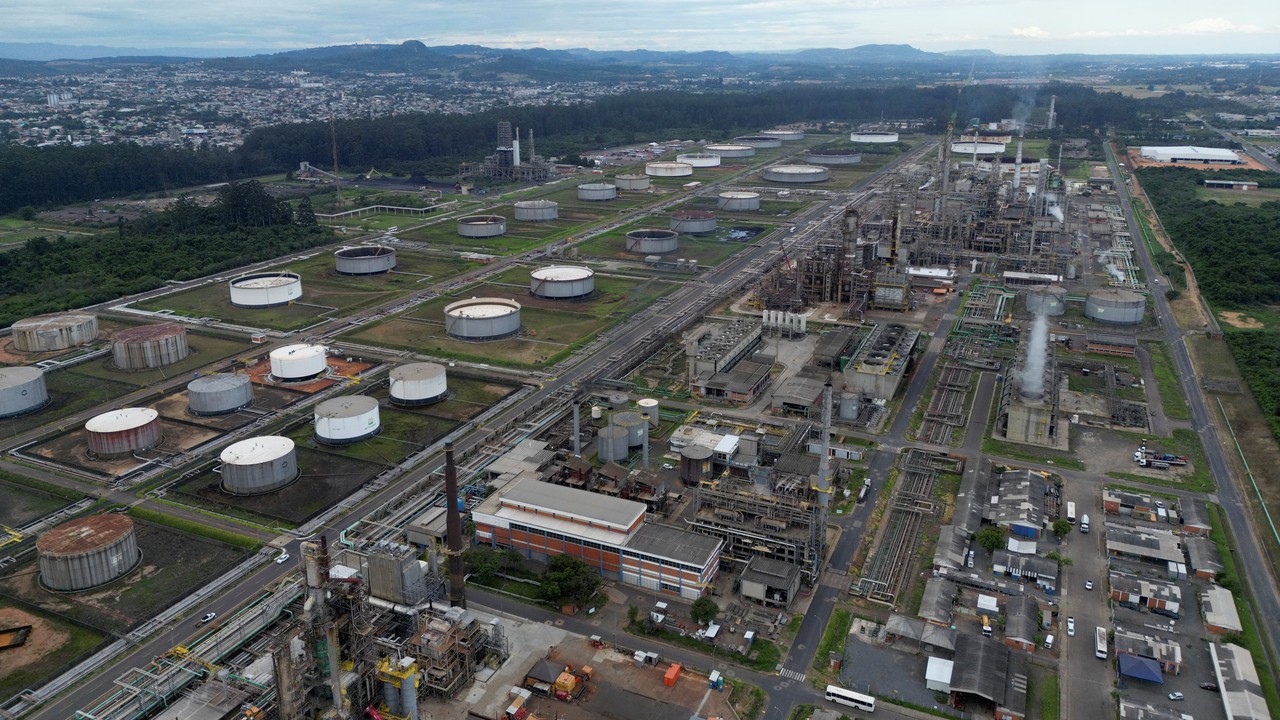
The start of production for the P-84 and P-85 platforms is anticipated for 2029, outside of the current Petrobras Strategic Planning (2024-2028). The expectation is that the P-84 will have 20% national content, while the P-85 will have 25%. Brazilian shipyards will likely be responsible for the construction of modules or commissioning services.
In Brazil, Seatrium operates the shipyards BrasFELS, in Angra dos Reis (RJ), and Jurong Aracruz, in Aracruz (ES). The partnership with CIMC Raffles and the implementation of advanced technologies reinforce Seatrium’s capacity to lead complex and innovative projects in the oil and gas sector.