






 Portuguese
  Spanish
  3 min of reading
  0 comments


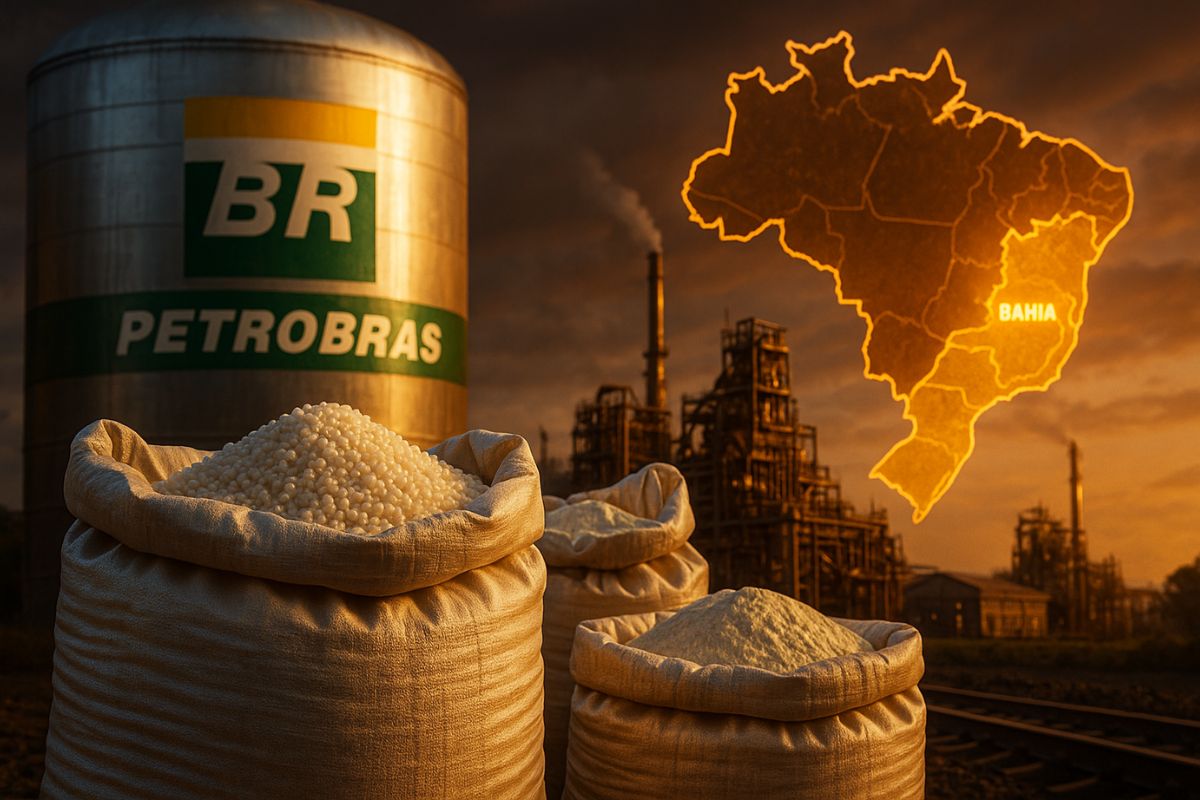
After Years of Paralysis, Petrobras Returns to the Fertilizer Sector and Bets on Partnership with Engeman to Recover Strategic Units in the Northeast
Petrobras announced on Wednesday (16) the hiring of the company Engeman to operate and maintain the nitrogen fertilizer plants located in Bahia and Sergipe, which have been inactive for years. According to the company’s statement, the contract will be valid for up to five years and represents “an important milestone in Petrobras’ return to the fertilizer sector”, especially in the Northeast region.
According to information from UOL, the forecast is that the possession of the plants will be reinstated next month, when the current lessee Unigel should complete the demobilization of its teams and end the lease contract. The measure reinstates Petrobras as a key player in a strategic segment for the food and energy security of Brazil.
Why Petrobras Resumes the Fertilizer Sector
The two units of Petrobras, known as Fafen-BA (Bahia) and Fafen-SE (Sergipe), were deactivated in recent years due to operational difficulties and high production costs.
-
Organic grape juice from São Roque surprises experts, scores over 90 points in a blind test, and wins a national award after six years of agroecological research.

-
In Matopiba, soybeans have replaced rice and beans, and traditional Cerrado communities that used to grow their own food now have to buy it, while pesticides from neighboring farms reach the springs.

-
Foreign tree planted to combat drought invades more than 1 million hectares of the Caatinga, encroaches on riparian forests, and turns an old solution for the semi-arid region into a silent threat to biodiversity.
-
Invasive weed that withstands extreme heat advances with climate change, threatens crops on several continents, and raises a global alert about a silent plant capable of dominating soils, suffocating native species, and reshaping entire ecosystems.




The decision created a strong dependence of Brazil on imported fertilizers, mainly from Russia and the Middle East.
With the resumption, Petrobras intends to reduce the country’s external vulnerability, increasing the supply of agricultural inputs in a scenario of global price instability.
The return of the plants in the Northeast is considered essential to ensure competitiveness for the Brazilian agribusiness, the main sector of the country’s trade balance.
The Role of Engeman in the Process
Engeman will be responsible for ensuring the operation and maintenance of the units, under a five-year contract.
The company is already involved in various technical support and engineering projects in the oil, gas, and energy sectors, and now takes on a central role in the recovery of the fertilizer plants.
According to Petrobras, the partnership with Engeman will allow for the acceleration of the reactivation of the industrial plants and ensure safety and efficiency standards that are compatible with the state-owned company’s new strategy.
This move also generates expectations of direct and indirect job creation in the regions affected by the paralysis.
Pressure and Challenges for Petrobras
Despite the optimism, Petrobras faces political and market pressures.
The agricultural sector demands speed in the resumption of production, while experts warn about the challenges of economic viability of the plants, which previously operated with high costs.
There is an expectation that the company will invest in low environmental impact technologies, as the production of nitrogen fertilizers is associated with carbon emissions.
The pressure for sustainability adds to the demand for economic efficiency, placing Petrobras at the center of a strategic debate.
Impacts on Brazilian Agribusiness
Brazil is one of the largest food producers in the world but still heavily relies on the import of fertilizers.
With the return of Petrobras’ plants, part of this dependence can be reduced, especially in supplying crops such as soybeans, corn, and sugarcane.
Analysts state that if the resumption is successful, the country can become less vulnerable to fluctuations in the international market.
The measure strengthens food security but will require long-term planning and integration with agricultural policies.
The reactivation of Petrobras’ plants in Bahia and Sergipe marks a decisive step for Brazil’s fertilizer policy, but also exposes economic and environmental challenges that accompany the initiative.
The success of the project depends not only on Engeman but also on the state-owned company’s ability to balance costs, sustainability, and agribusiness pressure.
And you? Do you believe that the resumption of fertilizer plants by Petrobras will be sufficient to reduce Brazil’s external dependence? Or do you see risks of repeating past problems? Leave your opinion in the comments — we want to hear from those closely following the impact of this decision.





-

1 person reacted to this.