Portuguese
  Spanish


The Construction of the Baltimore Bridge, Collapsed by a Cargo Ship, Will Take Ten Years. Meanwhile, China Built a Bridge Ten Times Longer in Seven Years, Showcasing Its Efficiency
The collapse of the Francis Scott Key Bridge in Baltimore is equally impactful a few months after the tragedy. Inaugurated in 1977 after five years of construction, measuring 2.57 kilometers in length, in the early hours of March 26 it came down in the blink of an eye due to the collision of a cargo ship against one of the pillars.
The bridge was a key point in the region, and since the government, Biden announced an immediate action plan.


First Steps
The first step was to search for the missing persons. Although it is a bridge that allows more than 11 million vehicles to cross each year, shortly before the collision, the police alerted the authorities and closed the passage to traffic. This saved lives, but unfortunately, there was a construction crew working in the middle of the bridge that could not save themselves. Two of the workers were rescued, but the others were not.
-
Single Mother Working Three Jobs Receives 111 m² 3D-Printed Home with Concrete Walls Built in 12 Hours, Featuring 3 Bedrooms, 2 Bathrooms, and a Printer for Replacement Parts

-
Simple Technique to Restore Rusty Metal Window Grilles Gains Attention for Revitalizing Old Structures Without Full Replacement

-
Couple Transforms Suffolk’s Last 1891 Windmill into Luxurious Four-Story Home with Zinc Observation Room in England
-
Father and Son Build 97 cm Thick Circular Stone House in Brazil, Inspired by Scottish Architecture, Creating a New Agrotourism Hub




The second step was to clear the riverbed so that boats could transit and restore this important maritime route. The third step is the reconstruction with federal funds. It will not be quick or cheap, and according to Andy Winkler, director of housing and infrastructure at the Bipartisan Policy Center, the project will cost hundreds of millions of dollars “if not more.”
Costs and Challenges
Adjusted for inflation, the Baltimore Bridge cost about $316 million, but the reconstruction process will be more expensive. According to Hota GangaRao, a professor of engineering at West Virginia University, rebuilding it will cost about $400 million, provided the old pillars are used. However, this may not be feasible, as there may be a desire to redesign the pillars to be placed further apart and prevent accidents in the future.
This would increase costs, as “it will require more steel, a more complicated construction, and more controls.” Regarding the timeline, Winkler states that there will be many issues to resolve, such as whether it needs to be higher or have more reinforcements, but ultimately “any dramatic change to the structure or design of the bridge will require a stringent environmental review.”
On deadlines, Benjamin Schafer, a professor of civil engineering and systems at Johns Hopkins University, says that the reconstruction could take a decade or more, considering all these factors.
Comparison with the Construction of the Shenzhen Bridge
Facing a construction like the new Baltimore bridge, we already see that it will be complex and lengthy, but when we talk about bridges, we must automatically look to China. They have the longest viaduct in the world, the Danyang-Kunshan Grand Bridge, which measures 164 kilometers in length; the Lvzhijiang at 800 meters, but with a single tower, and the Hong Kong-Zhuhai-Macau at 55 kilometers in length, being the longest sea bridge in the world.
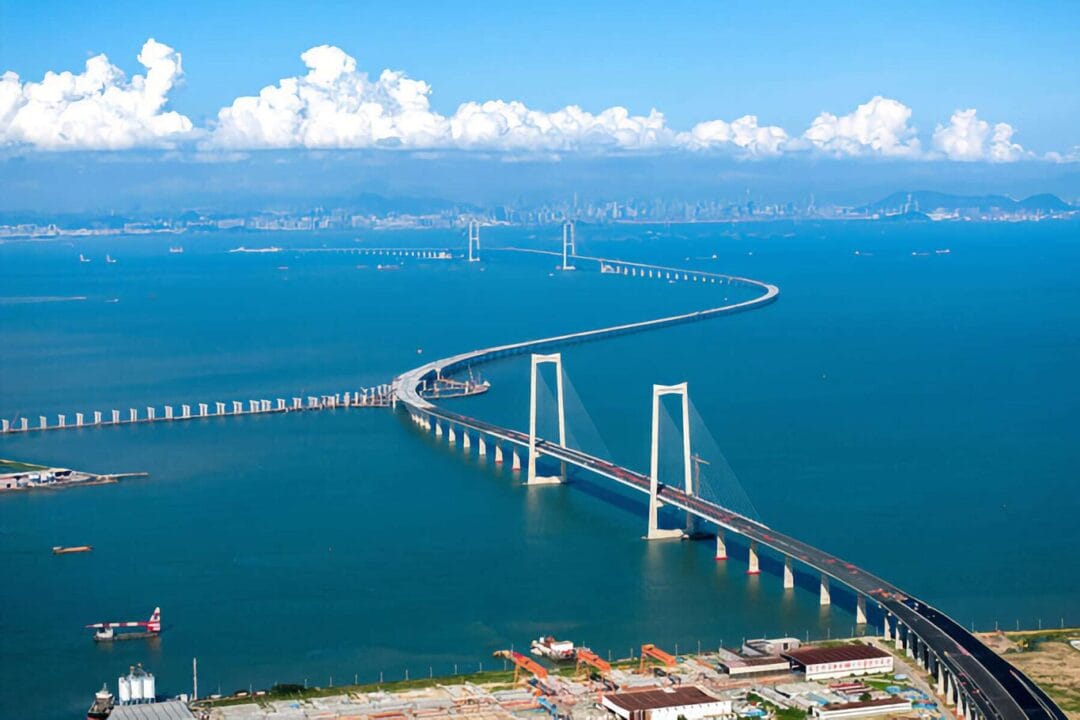
However, the new crown jewel will be the Shenzhen-Zhongshan Bridge. It is a few kilometers from the one in Macau and will be shorter, with a total length of 24 kilometers, nearly seven of which are in tunnel and four lanes in each direction. No matter how you look at it, the Shenzhen bridge will be a monumental project that, furthermore, features quite an interesting aesthetic. Now, the most impressive of all this is the time it took to build it.
Valued at over $6.7 billion, it is something more than ten times longer than the one in Baltimore, more complex due to the underwater areas, and will take seven years to construct. Work began in 2017 and is expected to be completed in 2024, marking a significant achievement not only due to the bridge’s characteristics but also due to the speed with which the project has advanced during this time.
Records and Regulations
Indeed, it holds a world record for paving over 22,600 square meters in a single day, which would be equivalent to 50 basketball courts. These timeframes contrast with the initial assessment that experts are expressing regarding the reconstruction of the Baltimore Bridge and may have a lot to do with environmental regulations.
One of the points Winkler raises when discussing the Baltimore Bridge is this new environmental study that will need to be conducted if there are many changes in relation to the original bridge, something that would negatively affect construction timelines. In China, things are a bit different in this regard.
This is something seen in the automotive industry, with more flexible environmental regulations than in Europe or the United States, but also in the new battleground between the United States, Europe, and China. One example is the ‘German Silicon Valley,’ which wants to attract companies like TSMC and its partners and has already raised suspicions. One reason is the difference between work ethics and cultures between Europe and Taiwan. Another are these more flexible environmental laws in China, which has contributed to making the Asian giant the world leader in rare earth refinement.
Whether it is more or less complicated to build a bridge in the United States or China due to these factors, what is clear is that the new Shenzhen project is titanic and nearing completion.