Portuguese
  Spanish


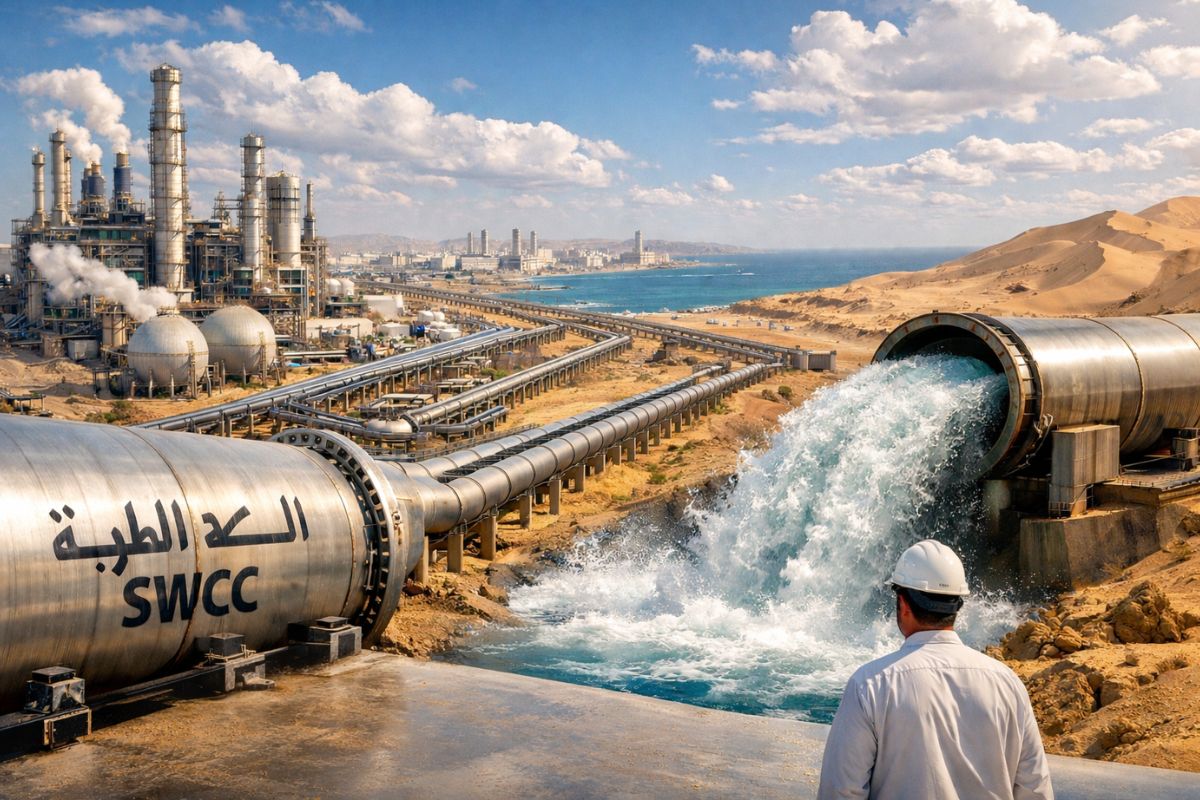


The Largest Desalination Network in Saudi Arabia Turns Seawater into Manufactured Water, Generates Brine on an Industrial Scale, and Ensures Millions Can Survive in the Desert Every Day.
Saudi Arabia is one of the least hospitable places to human life on Earth: it has hardly any rivers, the annual rainfall barely exceeds 100 millimeters, and temperatures exceed 50°C, while underground aquifers are depleting too quickly. Nonetheless, 37 million people live there, drinking, bathing, working, and irrigating parts of their cities. None of this is “natural”: it is manufactured water on an industrial scale to survive in the desert, sourced from a desalination system and pipelines that rival the country’s oil infrastructure.
At the center of this turnaround is a decision made in the 1970s: to turn desalination from a limited experience into state policy, spreading plants along the coasts of the Red Sea and the Persian Gulf and stitching the country together with over 14,000 kilometers of pipelines. Today, Saudi Arabia relies on this system for about 70% of urban water supply and is preparing to double its capacity by 2030, in a race against time to continue surviving in the desert with enough water for cities that keep growing.
A Country That Literally Manufactures Its Own Water

Saudi Arabia sits on more than 40 trillion liters of oil, but this does not buy what does not exist: freshwater in a territory 95% desert, practically without rivers and with weak and irregular rainfall.
-
Eco Invest Auction Aims to Unlock $10 Billion in Investments, Focusing on Green Fertilizers, Critical Minerals, Batteries, and AI for Clean Industry in Brazil

-
Half of Brazilians Prefer Lower Taxes with Private Health and Education, While 44% Opt for Higher Taxes for State-Provided Services, Datafolha Survey Reveals

-
Brazil’s Most Expensive Toll Rises to R$ 40.60 on Route from São Paulo to the Coast, Nearly Matching Bus Fare to Santos

-
As Brazil Expands Social Welfare, Survey Reveals 40% Blame Poverty on Laziness, While 58% Cite Lack of Opportunities





For decades, the solution was to pump underground aquifers, especially for agriculture, which consumed about 80% of the available water in the country.
This model had an expiration date. The aquifers did not recharge at the same speed they were being depleted, and the country found itself facing a tough choice: to slow down economic and urban growth, or to depend on imported water at exorbitant costs and geopolitical risk.
To continue surviving in the desert without being held hostage by borders and conflicts, the government decided to tackle the root: to turn seawater into tap water on a national scale.
In 1974, the Saline Water Conversion Corporation was born, tasked with taking desalination out of laboratories and transporting technology directly to the Saudi coasts.
The idea was simple yet ambitious at the same time: to use the ocean as an infinite source and engineering as a survival lever, accepting that from then on, the country would survive in the desert with water designed to exist.
How Desalination Became Survival Policy in the Desert
The physical basis of the plan is clear: people concentrate on the coasts of the Red Sea and the Persian Gulf and in large inland cities like Riyadh and Mecca.
The water is in the sea, the population is in urban centers hundreds of kilometers away, often separated by mountain ranges and sand plains.
To survive in the desert, it was not enough to build a plant here and there: it was necessary to build a complete system, with highly integrated production and distribution.
Today, there are 33 desalination plants positioned along both coastlines, where seawater intake is simpler and standardized.
These plants continuously convert saltwater into freshwater, 24 hours a day, in an operation that already consumes a significant portion of the country’s energy.
The next step was to stitch Saudi Arabia together with a large-diameter pipeline network. This network of approximately 14,217 km of pipes crosses rocky terrain, sand deserts, and entire mountain ranges, carrying water from sea level to altitudes where no natural source would be available.
It is not an ordinary water line: it is the backbone of a country that decided to survive in the desert through engineering.
Inside the Plants That Turn Sea into Tap
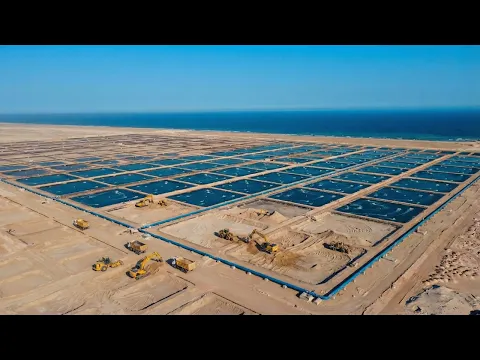

Transforming seawater into drinking water requires breaking the chemical bond between salt and water. The process always starts in the ocean, a few hundred meters from the coast, where intake lines pull millions of liters per day.
Screens and grates block debris and prevent the entry of marine life larger than a few millimeters, reducing the immediate impact on the ecosystem.
After that, the water passes through a sequence of physical and chemical barriers. First come finer screens and sand filters, which use gravity to retain suspended particles.
Next, coagulants and disinfectants agglomerate microscopic residues, which settle to the bottom of specially designed tanks. Filtration cartridges with pores between 1 and 5 microns do the final “fine-tuning.”
The decisive stage is reverse osmosis. High-power pumps elevate the pressure to about 60 bar, or 60 times atmospheric pressure, forcing the water against ultra-thin membranes.
The water passes, the salt remains behind, in a process that reshapes the chemistry of the solution drop by drop. Some plants use two successive stages, with even thinner membranes, to extract the last salt ions and gain efficiency.
In the end, the desalinated water goes through fine adjustments: pH correction, remineralization with calcium and magnesium, and flavor balancing, so that it resembles natural water as much as possible.
Only then is it released into the distribution network that allows millions of people to continue surviving in the desert, with water coming from the tap as if it were something obvious.
The Pipeline Network That Carries Manufactured Water from the Heart of the Desert

Producing water is only half the equation. The other half is making that water survive in the desert and reach cities hundreds of kilometers from the coast, climbing slopes and crossing rock formations.
To do this, Saudi Arabia operates true water highways, with pipelines that reach 3 meters in diameter and flows exceeding 1 million cubic meters per day in some corridors.
These pipes start as high-strength carbon steel rectangular sheets, cut with millimeter precision and bent on multi-axis rollers until the edges meet.
Automated welds, tested with ultrasound, ensure that each joint holds up to decades of pressure. Epoxy coatings are applied to protect the interior against corrosion and incrustations.
On the ground, teams dig trenches with crawler excavators in strips up to 40 meters wide, or use controlled explosives to cut solid rock where machines cannot reach. A layer of fine sand is spread at the bottom to cushion the pipe, distribute loads, and reduce the risk of cracks.
In some sections, tunnels like the Al Hada tunnel, over 12 kilometers long, allow crossing mountain ranges without relying solely on gigantic pumps.
Each kilometer installed represents another safety line for the population, another step in the effort to survive in the desert with manufactured water circulating beneath sand and stone.
It is a system in permanent expansion, with thousands of additional kilometers planned by 2030 to keep pace with megaprojects and new industrial hubs.
Energy, Brine, and the Environmental Cost of Surviving in the Desert
No physical process is “free.” To survive in the desert based on desalination, Saudi Arabia pays a heavy energy bill.
Old thermal plants consumed about 15 kWh per cubic meter of water produced, burning large volumes of fossil fuels.
With the massive adoption of reverse osmosis and hybrid plants, this energy intensity has dropped to below 3 kWh per cubic meter in more modern units, representing a significant efficiency gain.
At the same time, the country began to couple solar plants to projects like Jubail 3A, which already generates a significant portion of the energy needed from the sun.
This reduces dependence on gas and oil, frees up fuels for export, and decreases the carbon footprint of a system that was born energy-intensive.
Still, keeping millions of people surviving in the desert with manufactured water remains a national-scale energy effort.
Besides energy, the major liability is brine, the concentrated salt left over after freshwater is extracted.
Every day, millions of cubic meters of this saltier and warmer fluid are returned to the sea, potentially creating areas of elevated salinity and stressing sensitive ecosystems, such as coral reefs.
The Saudi response involves a new type of engineering: treating brine not as waste but as raw material.
Projects in development aim to extract sodium chloride, bromine, magnesium, and potassium from brine, generating chemicals, fertilizers, and revenue that can help offset part of the water cost.
In parallel, zero liquid discharge technologies seek to minimize direct discharge into the ocean, although implementing this on the necessary scale to survive in the desert with so much desalination is still an open challenge.
Demand Management, Reuse, and the Future of Manufactured Water
Producing more water is not enough if consumption grows uncontrollably. For years, Saudi Arabia maintained heavily subsidized tariffs, encouraging waste and raising per capita consumption to some of the highest levels in the world.
For the strategy of surviving in the desert to be sustainable, the country began to tackle a taboo: raising the price of water as consumption increases and using smart meters to identify excess.
This adjustment has yielded results. In just a few years, average per capita consumption fell from very high levels to something much more contained, freeing up capacity without immediately building new plants.
At the same time, agricultural policy changed, reducing incentives for extremely water-intensive crops and shifting part of production to models more compatible with the climate.
Another pillar is the reuse of wastewater. Reusing treated sewage in irrigation, industry, and non-potable uses reduces pressure on desalination and increases the resilience of both large and small cities.
New decentralized treatment plants are beginning to serve communities far from the major systems, extending the logic of surviving in the desert with manufactured and recycled water beyond the large centers.
On the horizon, ambitious goals combine more desalination capacity, more renewable energy, more reuse, and more brine mining.
The equation is simple and harsh: without this, there is no way 37 million people can continue to survive in the desert with water security in a scenario of accelerated urban growth and increasingly extreme climate.
And you, do you think that other countries in dry regions should follow the path of Saudi Arabia and invest heavily in manufactured water to survive in the desert, or do the environmental and energy risks still outweigh the benefits?