






 Portuguese
  Spanish


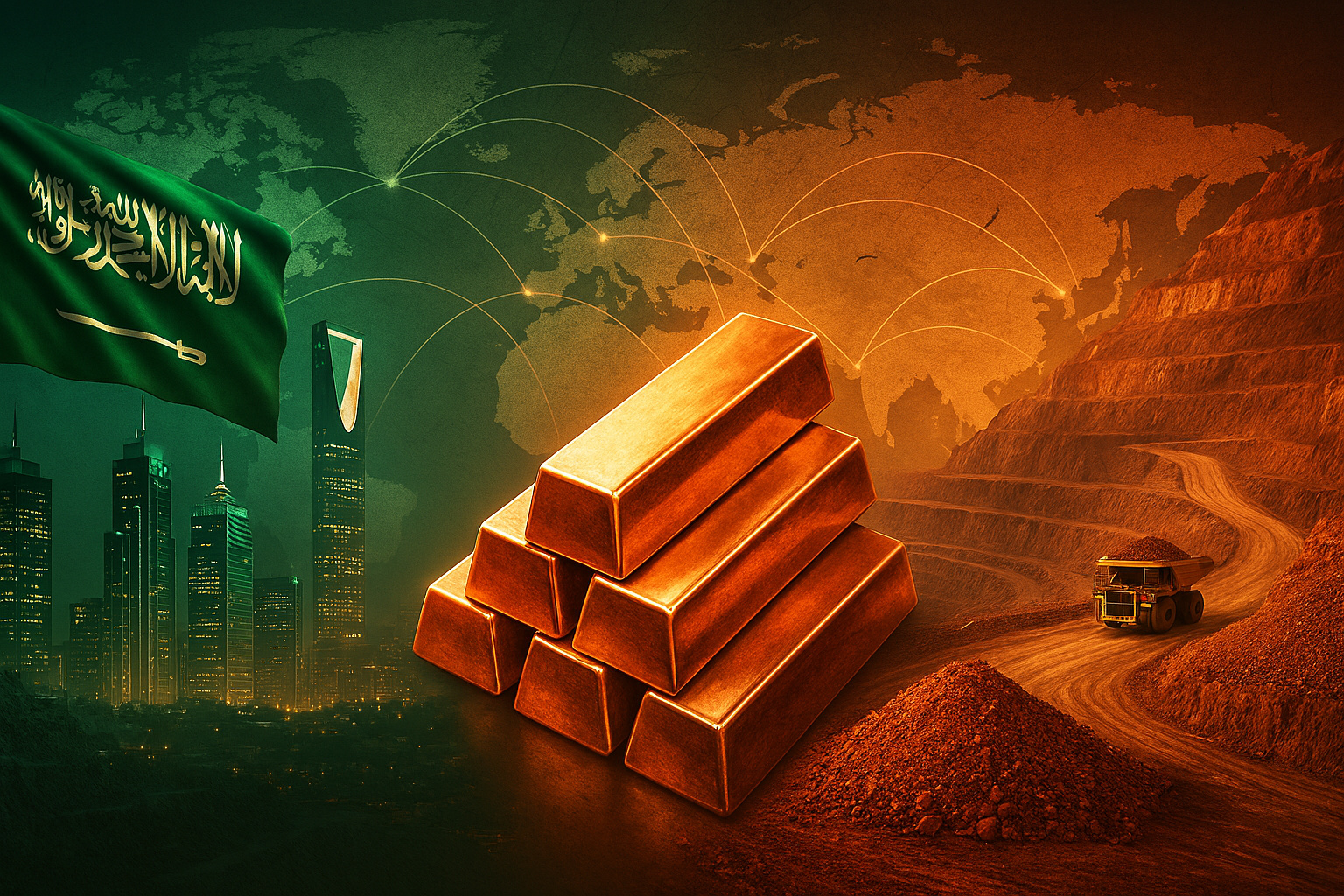


Saudi Arabia Negotiates Investments in Chilean Copper, Aiming for Post-Oil Diversification and Global Competition for Strategic Minerals in the Energy Transition.
In January 2025, international portals such as Mining Reporters and Arab News confirmed that Saudi Arabia began formal negotiations with Chile to invest heavily in the copper sector, in meetings that involved high-ranking officials and executives from the state-owned Chilean company Codelco, the world’s largest producer of the metal. The move is not isolated: it is part of the ambitious Vision 2030 plan, led by Crown Prince Mohammed bin Salman to reduce dependency on oil and transform the kingdom into a global industrial and technological hub.
To achieve this, the country is targeting resources considered strategic for the energy transition — among them, copper, lithium, nickel, and rare earths. In the case of copper, the bet makes sense: electric cars, wind turbines, batteries, and transmission lines rely heavily on the metal, and the world is entering a cycle of tight supply and growing demand.
Why Did Chile Become a Priority Target?
Chile is not only a major producer; it is the largest producer of copper on the planet, responsible for about 28% of global production, according to the US Geological Survey. The country also hosts some of the richest and most technically exploited deposits in the world, along with a consolidated industrial chain and a stable mining policy.
-
France Revamps 530 Social Housing Units with Large Balconies and Glass Facades Without Demolishing Existing Buildings

-
10-Year-Old Max Makes History with Paris Fashion Show, Launches Own Brand, Hires Staff, and Sets World Record as Youngest Runway Designer

-
Bolivian Female Construction Workers Form Association to Combat Discrimination and 38% Pay Gap in the Industry
-
Near Amsterdam, residents buy land and discover they must also build streets, manage drainage, handle waste, and grow food on half their plot.




Among the assets of Saudi interest are:
- physical copper (for domestic consumption and export)
- stake in operating and greenfield mining projects
- technological cooperation in underground access and metallurgy
- complementary minerals such as lithium and iron
In a statement released to outlets such as Mining Reporters, Chile and Saudi Arabia are discussing joint investments, bilateral funds, and even shareholding in state and private projects, including potential discussions with Codelco itself, a symbol of Chilean mining.
What Do Saudis Want with Copper?
The logic is strategic:
Post-Oil National Industry
The country wants to build industrial chains for renewable energy, batteries, green hydrogen, and electrification — all dependent on copper.
Mineral Sovereignty and Security
Countries like the US and China are already engaged in trade wars over lithium, cobalt, and rare earths. Saudi Arabia does not want to be left out.
Diversification via Global Mining
The Saudi plan envisions acquiring mineral assets outside the Gulf, especially in Latin America and Africa.
Integration with Vision 2030
The Vision 2030 already anticipates over US$ 170 billion in industrial and energy investments by the end of the decade.
Energy Transition Has Pushed Copper to the Center of the Board
Until a few years ago, copper was treated as a “classic industrial metal,” associated with civil construction and conventional electrical networks. Today, it is a critical metal, and the reasons are clear:
- An electric car uses 2x to 4x more copper than a regular car
- Each onshore wind turbine uses up to 4.7 tons
- Offshore turbines can exceed 8 tons
- High-voltage direct current (HVDC) lines consume thousands of tons
Reports from the IEA (International Energy Agency) indicate that global demand for copper for the energy transition could triple by 2040, while new mines take 10 to 20 years to enter production — a perfect imbalance for price appreciation and geopolitical competition.
In this context, Chile becomes an indispensable player — and Saudi Arabia a new competitor in a field already contested by China, the US, Canada, Australia, Japan, and the European Union.
What Does Chile Gain from This?
The potential entry of Saudi capital comes at an opportune moment: Chile needs to increase investments, reduce infrastructure bottlenecks, and finance large expansions of underground and surface mines. Among the potential gains for the country are:
- direct investment in new projects
- creation of joint ventures with Saudi funds
- financing of logistical and port routes
- expansion of the refined copper value chain
- greater international exposure and commercial diversification
Moreover, Chilean experts believe that approaching the Gulf could also attract clients and buyers from the Middle East for refined copper, electric cables, and intermediate products.
Mineral Geopolitics: The New Map of Energy
The Saudi movement does not occur in a vacuum. Over the past five years, the planet has been experiencing a silent war for minerals. Examples include:
- China dominates lithium, graphite, and rare earths
- The US is creating laws to cut dependence on China
- Europe seeks agreements with Latin America and Africa
- India and Japan are financing mines in Oceania
- Saudi Arabia is advancing in Africa and now targets South America
If in the 20th century oil defined alliances, in the 21st century copper, lithium, and nickel are likely to play that role.
Saudi Arabia has not yet bought Chilean mines, but the fact that it is negotiating directly with the government, state enterprises, and industry executives — as reported in outlets like Mining Reporters and Arab News — already indicates a relevant geopolitical shift.
Chile, for its part, is positioned to become not only the “King of Copper” but also one of the pivots of the global energy transition. If billion-dollar investments are confirmed, the country could increase production, add value, and strengthen its dominance over one of the most critical commodities of this century.
In the end, the question is not whether Saudi Arabia will enter into copper but how much it will invest and how much the world will be willing to pay for this new chapter in global energy.









O BRASIL É O MAIS RICO EM TERRAS RARAS!”
O Brasil, vendo o cavalo arriado passar na sua porta e nada fazendo. Uma lástima! Estamos condenados ao fracasso.
E o Brasil e a Vale como vão encarar essa oportunidade?