






 Portuguese
  Spanish
  2 min of reading
  0 comments


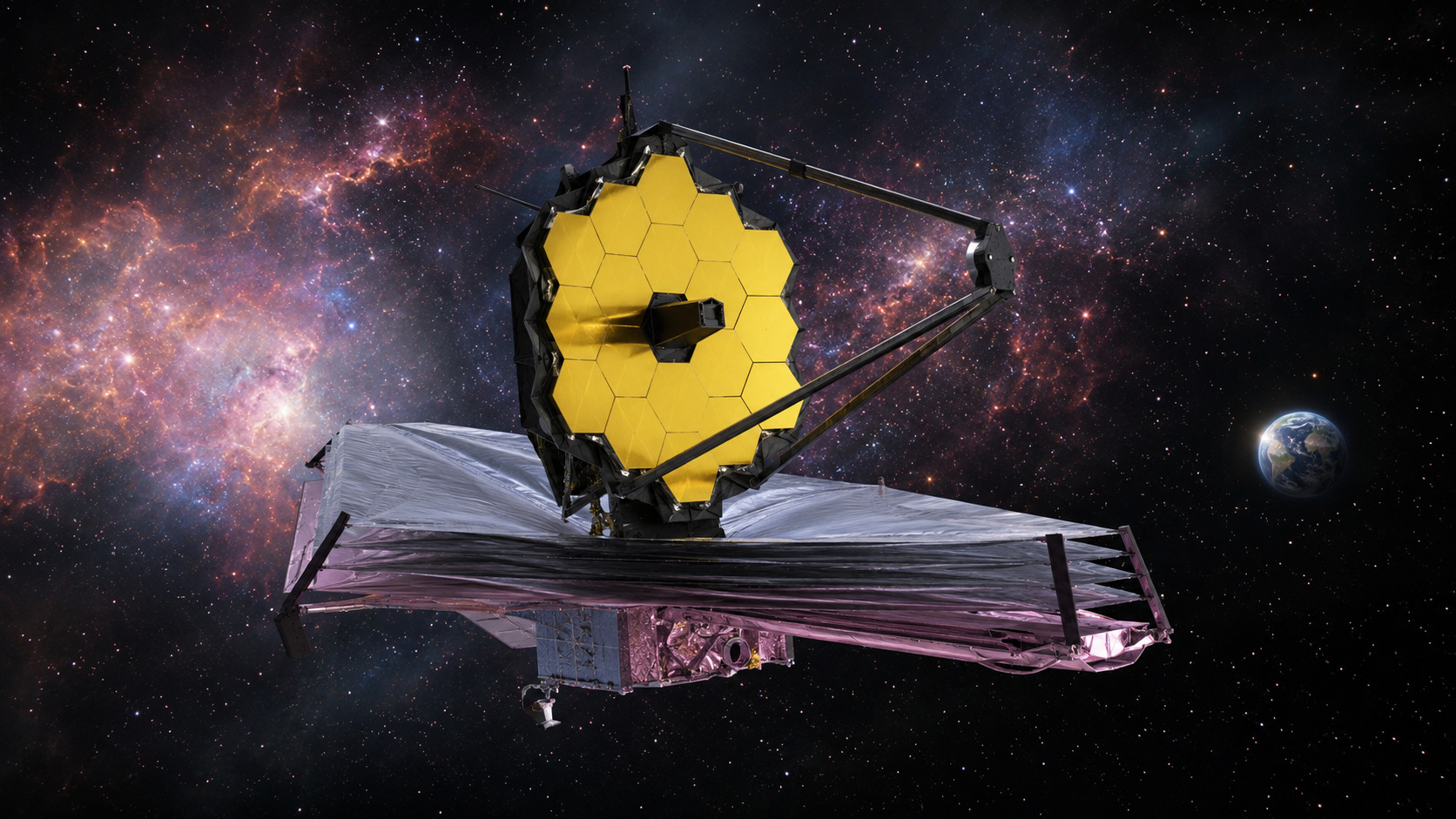
Installed about 1.5 million kilometers from Earth, the James Webb Space Telescope gathers engineering solutions that include a 6.6-meter segmented mirror, a five-layer sunshield, and infrared observation to study galaxies, forming stars, and exoplanet atmospheres.
The James Webb Space Telescope has become one of the most important scientific instruments in modern astronomy by enabling deep observations of the universe in infrared light. Launched to study ancient galaxies, forming stars, and atmospheres of planets outside the Solar System, the observatory also draws attention for its engineering curiosities.
One of them is its position in space. Unlike the Hubble, which orbits Earth, the James Webb operates in a region known as L2, about 1.5 million kilometers from the planet. This point allows greater stability to observe the cosmos and keep the telescope aligned with its sunshield.
Main Mirror
Another highlight is its main mirror. It is composed of 18 gold hexagonal segments, which together form a structure approximately 6.6 meters in diameter. This size increases the ability to capture light from very distant and faint objects, essential for understanding the early phases of the universe.
-
Space technology used to search for water on Mars is now hunting for invisible leaks under the streets of São Paulo, using satellites, AI, and chlorine signals to help Sabesp recover up to 6.7 billion liters of water.

-
Japan sends ship to extract mud rich in rare earths at nearly 6,000 meters deep in the Pacific, attempts to lift 350 tons per day from the seabed, and transforms sediments near Minamitori Island into a strategic weapon to reduce dependence on China.
-
Venus Aerospace promises a rotating detonation hypersonic engine that takes the Stargazer to Mach 9 and crosses oceans in 1 hour, but the flight that made history barely surpassed the speed of sound.

-
Brazilian student creates a cheap formula that makes plants grow up to 90% faster and wins an award in a global scientific competition.




To reach space, however, the Webb had to be folded. Its size did not fit completely open in the rocket, so the structure was launched compacted and then unfolded in a carefully planned sequence, often compared to a space origami.
The way the telescope views the universe is also special. The Webb primarily observes in the infrared, a light range capable of penetrating dust clouds and revealing hidden regions where stars and planetary systems may be forming.
The fifth curiosity is the five-layer sunshield. This protection drastically reduces the heat received from the Sun, Earth, and Moon, keeping the scientific instruments at extremely low temperatures. Without this insulation, the telescope’s own heat could interfere with the measurements.
These characteristics explain why the James Webb is considered one of the most complex space missions ever put into operation by humanity in recent decades of scientific exploration.


-

1 person reacted to this.