






 Portuguese
  Spanish
  3 min of reading
  0 comments


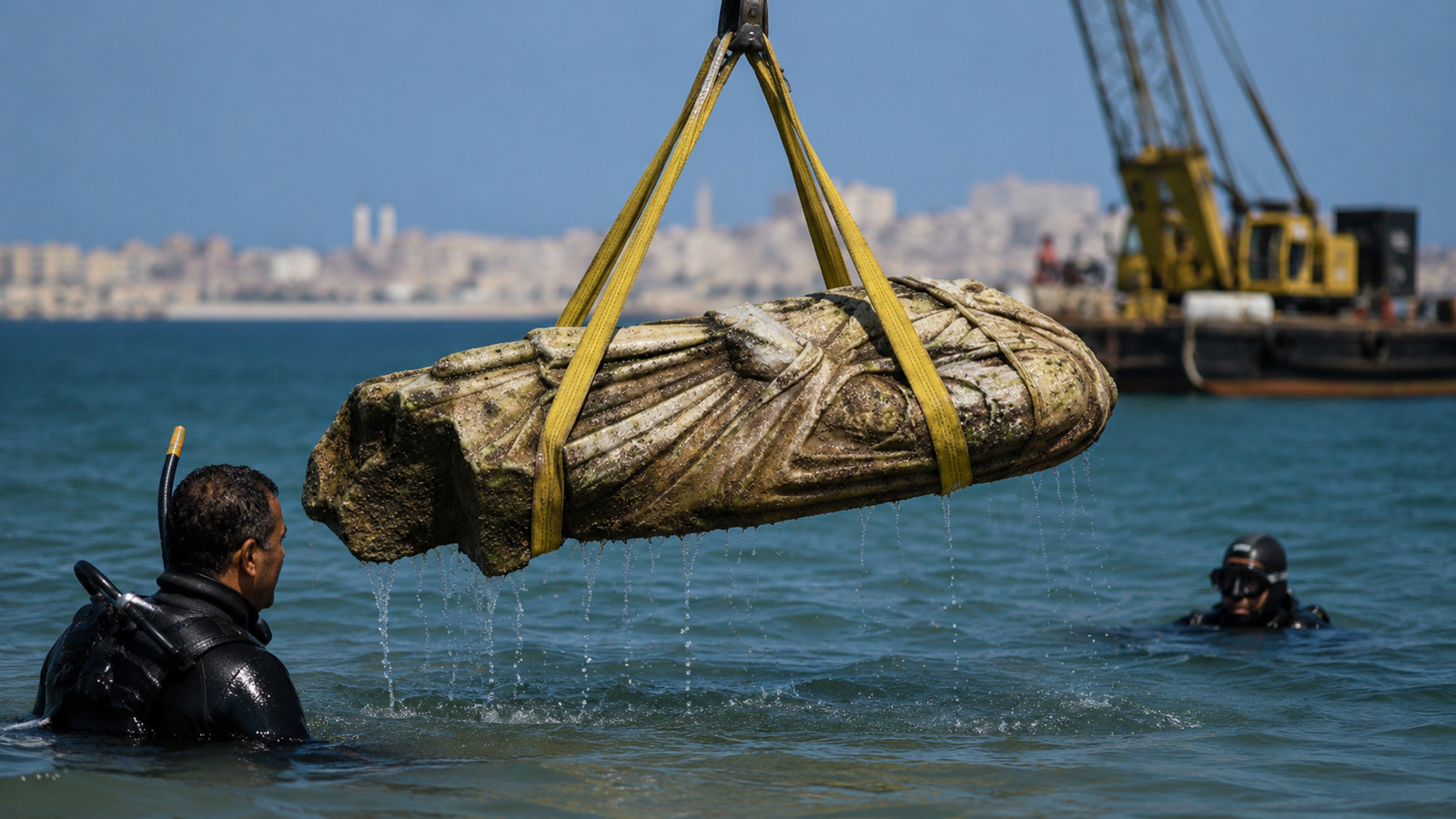
Cranes lifted statues from the waters of Abu Qir Bay, off the coast of Alexandria, where Egyptian authorities revealed ruins, artifacts, sphinxes, and an ancient pier linked to the Ptolemaic and Roman periods
Egypt has unveiled parts of a submerged city over 2,000 years old in Abu Qir Bay, off the coast of Alexandria, including buildings, artifacts, statues, and an ancient 125-meter pier. The site may be an extension of Canopus, an important center during the Ptolemaic and Roman periods.


Submerged city may be part of ancient Canopus
Egyptian authorities reported that the archaeological site is located in the waters of Abu Qir Bay and may be linked to the ancient city of Canopus. The region was significant during the Ptolemaic dynasty, which ruled Egypt for nearly 300 years.
The area also remained relevant during the Roman period, which lasted about 600 years in the country. Over time, earthquakes and rising sea levels submerged the city and the neighboring port of Heracleion.
-
Space technology used to search for water on Mars is now hunting for invisible leaks under the streets of São Paulo, using satellites, AI, and chlorine signals to help Sabesp recover up to 6.7 billion liters of water.

-
Japan sends ship to extract mud rich in rare earths at nearly 6,000 meters deep in the Pacific, attempts to lift 350 tons per day from the seabed, and transforms sediments near Minamitori Island into a strategic weapon to reduce dependence on China.
-
Venus Aerospace promises a rotating detonation hypersonic engine that takes the Stargazer to Mach 9 and crosses oceans in 1 hour, but the flight that made history barely surpassed the speed of sound.

-
Brazilian student creates a cheap formula that makes plants grow up to 90% faster and wins an award in a global scientific competition.




125-meter pier reveals ancient port use
Among the finds are a merchant ship, stone anchors, and a port crane from the Ptolemaic and Roman eras.
The set was found at the site of a 125-meter pier, used as a port for small vessels until the Byzantine period.
The underwater ruins also include limestone constructions. They may have served as places of worship, residential areas, and commercial or industrial structures, according to information released by Egyptian authorities.

Statues and sphinxes were removed from the waters
On the occasion, cranes hoisted statues from the depths, with support from divers. The Egyptian Minister of Tourism and Antiquities, Sherif Fathi, stated that there is “a lot underwater,” but only specific materials will be removed.
Among the discoveries are statues of royal figures and sphinxes from the pre-Roman era. One of them is partially preserved and bears the cartouche of Ramses II, one of the most well-known pharaohs with the longest reign in ancient Egypt.

Part of the heritage will remain at the bottom of the sea
Many pieces are incomplete, including a decapitated Ptolemaic granite figure and the lower half of a marble portrait of a Roman noble.
Reservoirs and rock-carved lagoons were also found to store drinking water and raise fish.
Alexandria is home to ruins and historical treasures but faces risks related to rising sea levels. The coastal city sinks more than 3 mm per year, and in the best scenario predicted by the United Nations, one-third of it will be submerged or uninhabitable by 2050.
This article was prepared based on information provided in the base material about the revelation of the submerged archaeological site off the coast of Alexandria, with data, numbers, and statements preserved as per the consulted material.


-

1 person reacted to this.