





 Portuguese
  English
  Spanish
  4 min of reading
  0 comments


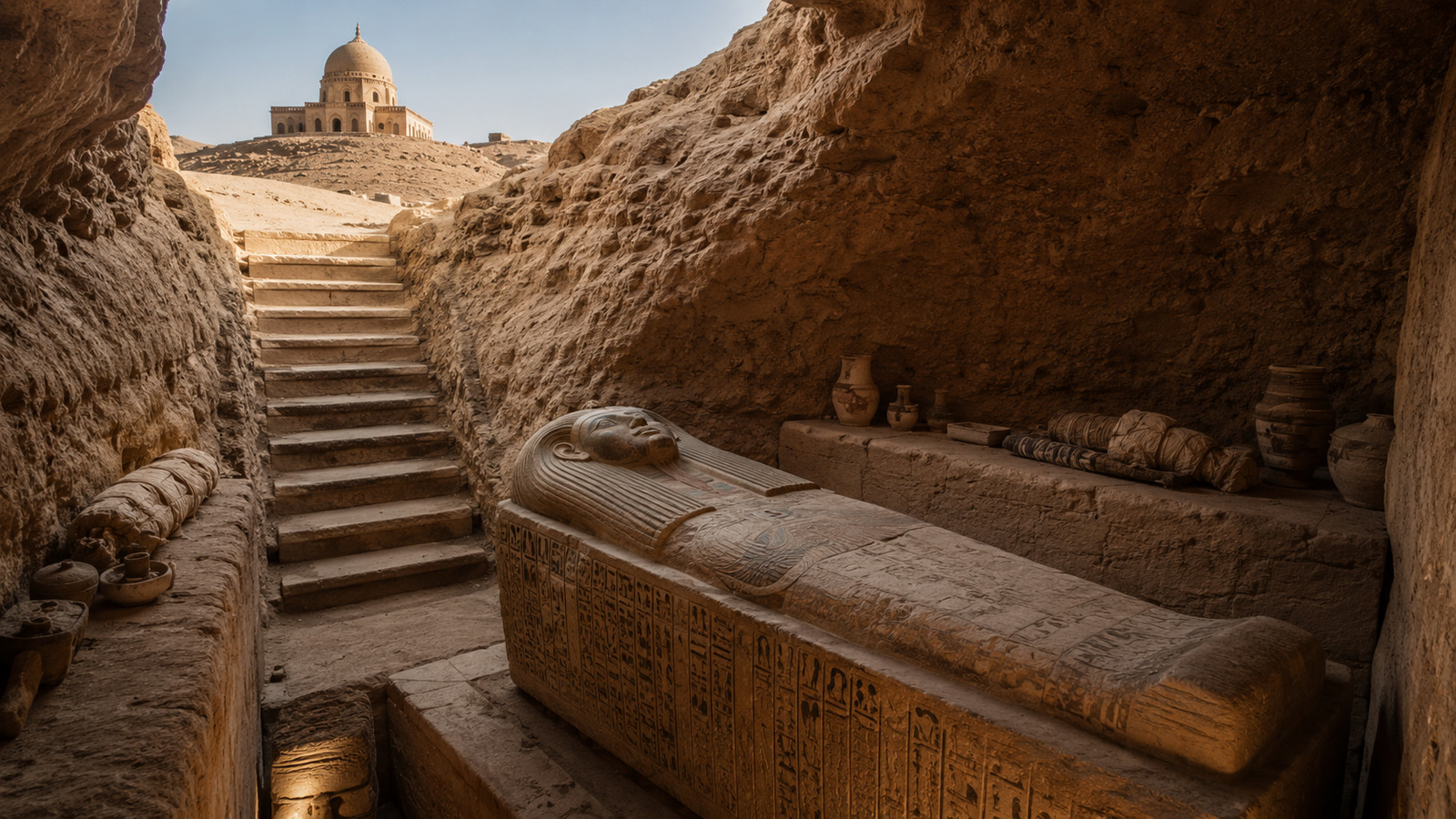
Discovery in Aga Khan necropolis exposes limestone sarcophagus, mummies, and hieroglyphic inscriptions, while research indicates a much larger cemetery used by different social groups in the Ptolemaic and Roman periods
A nine-step staircase led archaeologists to an underground tomb in the Aga Khan necropolis in Aswan, Egypt, where a nearly two-meter limestone sarcophagus covered with hieroglyphic inscriptions was found. The discovery, announced last year, helps expand the understanding of a cemetery used for centuries during the Ptolemaic and Roman periods.


Aga Khan necropolis holds tomb with limestone sarcophagus
The discovery was made by a joint Egyptian-Italian archaeological mission, led by the Supreme Council of Antiquities of Egypt and the University of Milan.
According to the researchers, Tomb No. 38 is among the most architecturally impressive examples ever found at the site.
-
The equipment uses water evaporation cooling, promises to reduce up to 5°C indoors, consumes only 20 VA, and transforms dual-flow ventilation into a natural alternative to air conditioning.

-
For the first time, astronomers detect magnetic activity in giant exoplanets and reveal winds of up to 25,000 km/h.

-
Scientists say that the Big Bang may have started in a different way than many people imagine, and a new theory attempts to explain the initial explosion of the universe without “patches” in current physics.
-
Colorful headphones and unique Bluetooth speakers: Justin Bieber’s brand may debut in the audio market with products that stand out for their design and distinctive colors.




The entrance to the tomb begins with a staircase descending nine steps below ground level. Alongside this passage, mudbrick benches were found, probably used to support offerings during funeral rituals.
At the bottom of the staircase, archaeologists located a limestone sarcophagus about two meters long.
The piece was on a platform carved directly into the rock, reinforcing the planned nature of the funerary structure.
The vertical hieroglyphic inscriptions on the monument contain prayers dedicated to local deities. They also identify the tomb’s owner as Ka-Mesiu, described as a high-ranking official.
Anthropoid lid preserves face, wig, and painting
One of the elements that most caught attention in the discovery is the anthropoid lid of the sarcophagus. It was decorated with a modeled human face, a wig, and painted details that have survived.
The tomb also contained several mummies, including children’s bodies. The researchers, however, did not specify if all the bodies were inside the sarcophagus.
The discovery is not just an isolated find. The tomb is part of a much larger funerary area, linked to ancient Aswan and the region of Elephantine and Siena.
At the time, this area was inhabited by a diverse population, consisting of Egyptians, Nubians, Persians, Phoenicians, Greeks, and Romans.
This context helps explain the importance of the necropolis for the study of social and funerary life in southern Egypt.

Cemetery could reach 200,000 square meters
A chapter of an article published on the University of Milan’s channels stated that more than 400 tombs were georeferenced in an area exceeding 75,000 square meters of the necropolis.
The same publication mentions that more than 500 tombs were originally mapped. The study also suggests that the entire cemetery could extend for approximately 200,000 square meters.
The area currently investigated corresponds to about 25,000 square meters. This indicates that a large part of the necropolis still remains outside detailed excavations.
The Egyptian Minister of Tourism and Antiquities, Sherif Fathi, stated that the newly discovered tombs offer new perspectives on the social dynamics of the region during the Ptolemaic and Roman periods. He also highlighted the historical role of Aswan as a cultural center in southern Egypt.
Technology helps to review ancient interpretations
Research continues in other parts of the archaeological site. Mohamed Ismail Khaled, Secretary-General of the Supreme Council of Antiquities, stated that the site was used by different social groups over several centuries.
According to the studies, elite families were buried at the top of the plateau. Meanwhile, middle-class burials were concentrated on the slopes near the Aga Khan Mausoleum.
Artifacts and mummified remains recovered from tombs AGH038 and AGH039 were dated from the 3rd century BC to the 2nd century AD. In another front, CT scans of two mummies from tomb AGH026 changed a previous interpretation.
Previously, it was believed that the bodies were of a mother and a child. The exams showed that they were two children, one approximately four to six years old, and the other between eight and nine years old.
This article was prepared based on information from the Egyptian Ministry of Tourism and Antiquities, the Supreme Council of Antiquities of Egypt, and the University of Milan, with data, numbers, and statements preserved as per the consulted material.






Be the first to react!