





 Portuguese
  English
  Spanish
  3 min of reading
  0 comments


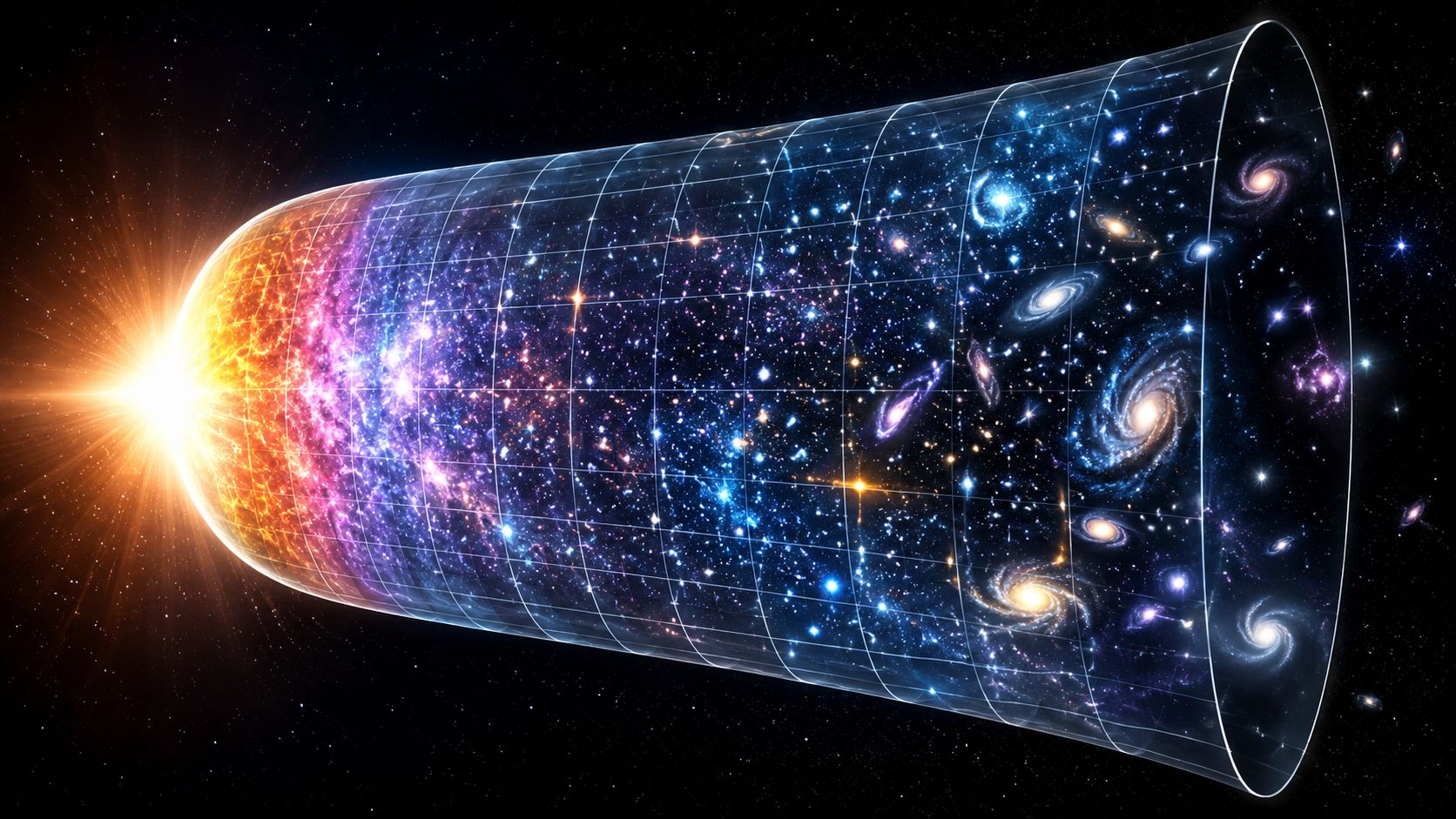
New formulation developed by scientists from Waterloo suggests that cosmic inflation can arise directly from quadratic quantum gravity, without manually added components, and still generate observable predictions about primordial gravitational waves linked to the first moments of the universe.
A quadratic gravity theory indicates that the expansion of the Big Bang can arise from quantum gravity, without extra parts, in a study from Waterloo published in Physical Review Letters.
Quadratic gravity proposes a new reading for the Big Bang
The work, “Ultraviolet completion of the Big Bang in quadratic gravity”, was developed by scientists from the University of Waterloo and addresses a limit of general relativity: its loss of validity in the extreme conditions of the universe’s birth.
The team was led by Niayesh Afshordi, professor of physics and astronomy at the University of Waterloo and the Perimeter Institute. The group investigated how to combine gravity and quantum physics, an area that describes the behavior of particles.
-
Colorful headphones and unique Bluetooth speakers: Justin Bieber’s brand may debut in the audio market with products that stand out for their design and distinctive colors.

-
Scientists from Colorado concluded that a meteorite found in the Sahara is a fragment of a planet that disintegrated about 4.5 billion years ago, at the beginning of the Solar System.

-
Embraer, a company born in Brazil, is redefining global military transport with the KC-390 Millennium: it flies at 870 km/h, carries 26 tons, operates on unpaved runways, and has already won over 8 countries, including NATO members.
-
Fish disappear and microorganisms take over: at 301 meters deep in the sea, the Dragon Hole reveals a world without oxygen in the South China Sea.




The proposal uses Quadratic Quantum Gravity, presented as consistent at high energies, similar to those of the first moments of the Big Bang.
Inflation arises without added ingredients
In many models, the explanation for the beginning of the universe starts from Einstein’s gravity and includes components added manually. In the new formulation, the initial rapid expansion appears as a natural result of a quantum theory of gravity.
This phase of accelerated growth, known as inflation, helps explain why the universe exhibits the characteristics observed today. For the researchers, it emerges from the gravitational structure, without external parts.
Afshordi stated that the initial explosive growth can come directly from a deeper theory of gravity. The interpretation shifts the focus from adjustments on Einstein’s theory to high energies.
Gravitational waves can test the model
The model predicts a minimum amount of primordial gravitational waves, ripples in the geometry of space-time generated in the first moments after the Big Bang. These signals could be sought in future experiments.
Afshordi highlighted that, despite dealing with extremely high energies, the theory produces clear predictions that current experiments can verify. This connection between quantum gravity and observable data is noted as rare.
The advancement comes at a time of greater precision in cosmology. Surveys of galaxies, cosmic microwave background radiation, and gravitational wave detectors are gaining sensitivity to test theoretical ideas.
Ruolin Liu and Jerome Quintin also participated in the research. The team intends to refine predictions and connect the structure to particle physics.
Comment on what you think of this approach to the Big Bang and whether testable predictions make quantum gravity closer to observation. Your opinion can also broaden the debate on cosmology, the primordial universe, and the limits of current theories for curious readers.
The study is available in Physical Review Letters (2026), published on March 18, 2026.








Be the first to react!