






 Portuguese
  Spanish
  3 min of reading
  0 comments


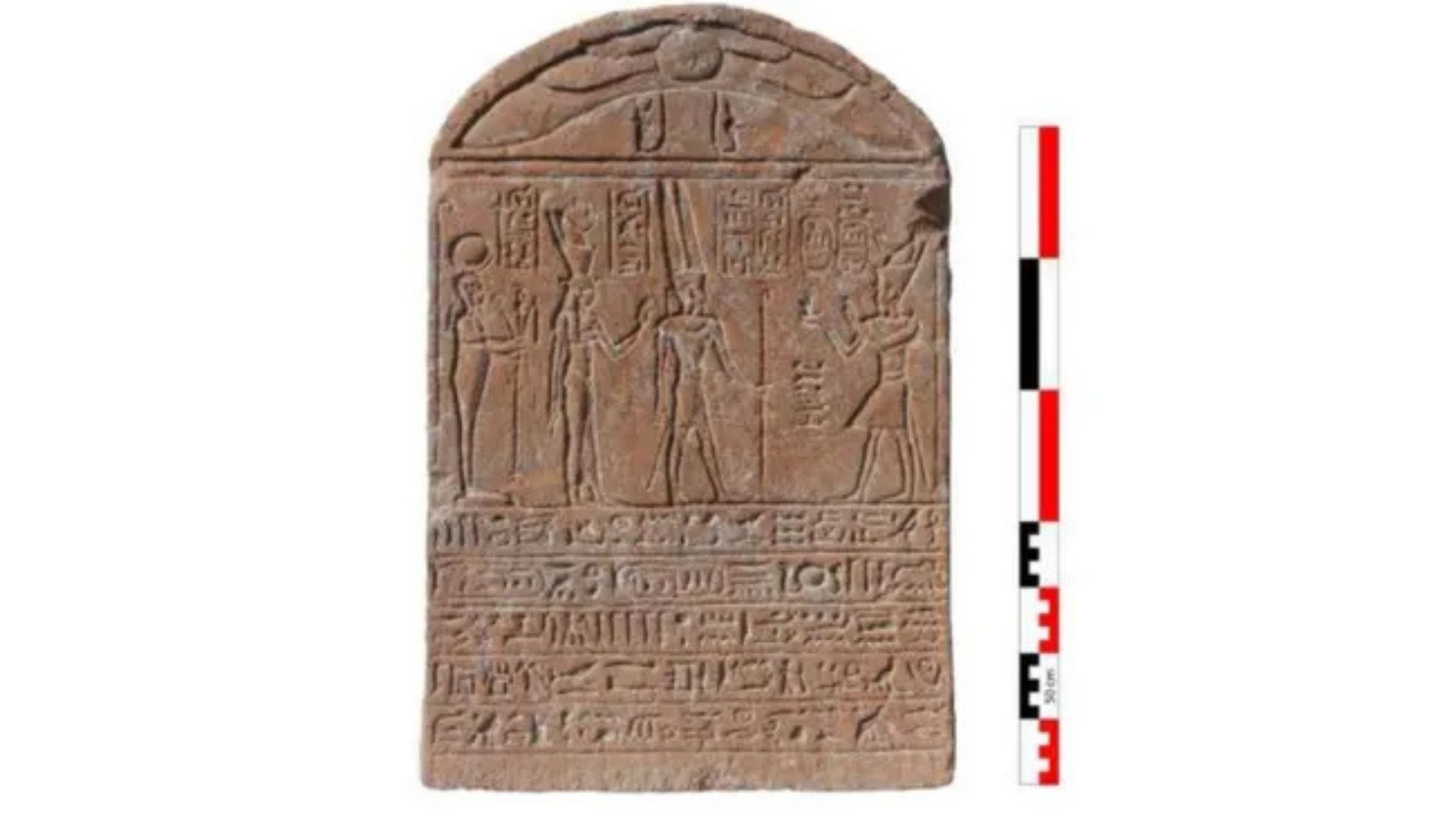
Sandstone monument found in restoration at the Karnak complex details imperial works and the religious relationship between Rome and Egypt.
A team of Egyptian and French archaeologists discovered a 2,000-year-old sandstone stele depicting a Roman emperor as a pharaoh in Luxor.
The monument was located during restoration work on a gate of the Karnak temple complex in ancient Thebes. The piece dates back to the reign of Emperor Tiberius, who ruled from 14 to 37 AD, highlighting the continuity of Egyptian traditions during the Roman occupation.
Discovery at the Karnak temple complex
The stele was found while specialists were working on the recovery of a gate dating from the time of Ramses III, the second pharaoh of the 20th Dynasty. The structure was in a state of deterioration and covered by vegetation when excavations revealed the decorated sandstone block.
-
Space technology used to search for water on Mars is now hunting for invisible leaks under the streets of São Paulo, using satellites, AI, and chlorine signals to help Sabesp recover up to 6.7 billion liters of water.

-
Japan sends ship to extract mud rich in rare earths at nearly 6,000 meters deep in the Pacific, attempts to lift 350 tons per day from the seabed, and transforms sediments near Minamitori Island into a strategic weapon to reduce dependence on China.
-
Venus Aerospace promises a rotating detonation hypersonic engine that takes the Stargazer to Mach 9 and crosses oceans in 1 hour, but the flight that made history barely surpassed the speed of sound.

-
Brazilian student creates a cheap formula that makes plants grow up to 90% faster and wins an award in a global scientific competition.





Researchers noted that several stone blocks from the site were reused from earlier periods, including some belonging to the reign of Amenhotep III.
The find occurred in the context of a restoration effort that has been ongoing for three years in the region of Luxor. During excavations conducted in the summer of 2025, archaeologists also identified a paved road connecting the gate to the courtyard of the Third Pylon of Karnak. This set of discoveries reinforces the historical importance of the area for understanding Greek and Roman architectural interventions in Egyptian temples.
Representation of the Roman emperor as a pharaoh
The monument presents the Roman emperor as a pharaoh positioned before the Theban triad of deities of ancient Egypt.
In the engraved scene, Tiberius appears before the gods Amon-Ra, Mut, and Khonsu, adhering to the traditional artistic canons of the time. Below the religious image, the monument contains five lines of text in hieroglyphics detailing administrative and religious aspects.
The inscriptions specifically document the restoration of a retaining wall of the Temple of Amon, located within the Karnak complex itself.
According to archaeological authorities, this practice of depicting Roman leaders in pharaonic attire and titles was common to legitimize foreign control over Egyptian territory. The Roman emperor as a pharaoh was a figure used to maintain local authority and religious order under Roman rule.
Preservation and future of the monument in Luxor
The sandstone piece underwent a meticulous cleaning and restoration process shortly after being removed from the ground. The general director of the Luxor Museum, Abdel Ghaffar Wagdy, who led the Egyptian side of the mission, confirmed the integrity of the stele. The object is expected to be transferred to a museum at a future date, where it will become part of the region’s collection of antiquities.
The discovery highlights the complex stratigraphy of the Karnak complex, where layers from different periods overlap. The presence of a Roman emperor as a pharaoh on a sandstone stele demonstrates how Roman power structures adapted to ancient local customs.
Archaeologists continue to analyze the hieroglyphs to extract more data about the public works carried out during that period.
With information from Live Science


Be the first to react!