





 Portuguese
  English
  Spanish
  5 min of reading
  0 comments


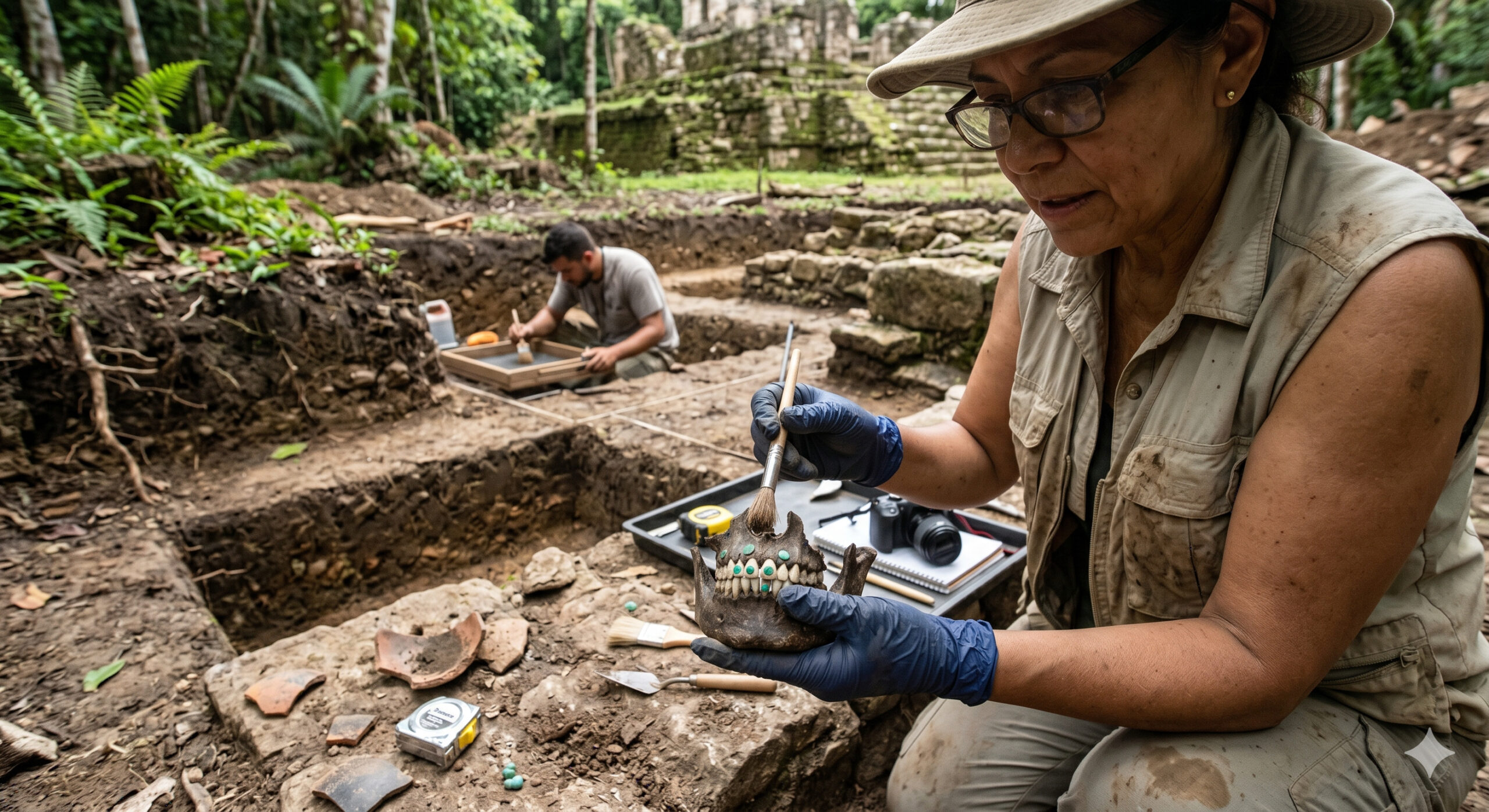
Archaeological studies reveal that the Maya used jade in their teeth over a thousand years ago, possibly for therapeutic purposes against cavities and infections.
Recent research in archaeology and bioarchaeology has revealed that the Maya civilization, which developed between approximately 250 AD and 1500 AD in Mesoamerica, utilized sophisticated dental modification techniques that went far beyond aesthetics or ritual. Studies show that the Maya performed precise perforations in their teeth and inserted precious stones such as jade, obsidian, turquoise, and hematite, creating permanent inlays. These interventions were made while the individuals were still alive, using stone tools and highly controlled techniques to avoid fractures or severe structural damage.
What surprised researchers was not only the existence of this practice but the level of skill required to perform it without the resources of modern dentistry.
Technique involved controlled perforation and use of durable sealants
Archaeological analyses show that the Maya excavated small cavities on the surfaces of their teeth — mainly incisors and canines — and fixed the stones with a type of extremely durable organic natural cement.
-
Amid the United States’ economic blockade, China delivers 15,000 tons of rice to Cuba as part of a 60,000-ton donation personally approved by Xi Jinping. The package includes 80 million dollars and solar panels for hospitals.

-
For around 200 reais, anyone can buy a kit and have a chip implanted between their fingers to replace cards, keys, badges, and even medical information in case of a hospital emergency.
-
A 600-meter hill in the interior of Santa Catarina hides a volcanic past of almost 600 million years. The Morro do Garrafão in Corupá may have been an ancient extinct volcano, and science now confirms what the residents have always suspected.
-
Family has lived for over 50 years without electricity and running water at home in the South of Minas, 10 minutes from the city, improvising light, bath, and water while facing a lack of basic resources and awaiting property regularization.




This adhesive material, according to studies published in the Journal of Archaeological Science: Reports, was able to keep the stones fixed for centuries, resisting moisture, wear, and natural degradation.

Modern examinations with microtomography revealed that, in many cases, Maya artisans were able to avoid reaching the dental pulp, indicating a practical knowledge of tooth anatomy.
This level of precision suggests that it was not an improvised practice, but a technical procedure repeated over generations.
Inlays may have had therapeutic functions, not just aesthetic
For a long time, it was believed that these dental modifications had only aesthetic or symbolic functions, associated with social status, cultural identity, or religious rituals.
However, recent chemical analyses indicate that the material used as a sealant may have had medicinal properties. The identified compounds show potential to:
- Combat bacteria associated with cavities
- Reduce inflammation “` “`html
- Reduce infections in the oral cavity
These findings led researchers to consider that the fillings could function as a kind of “primitive dental treatment”, combining aesthetics and oral health.
Although it is not possible to assert that the Maya had formal scientific knowledge of these effects, the consistent use of these materials suggests an empirical understanding of the benefits.
Practice was common among adults and was also identified in children
Another recent advancement in research was the discovery of dental fillings in Maya children. A study published in 2025 analyzed teeth from individuals aged 8 to 10 years old found in Guatemala and confirmed the presence of embedded jade, something that had until then been documented mainly in adults.
This discovery broadens the understanding of the practice, indicating that it was not restricted to adult elites but could be part of social or transitional rituals into adulthood.
Researchers hypothesize that these dental interventions could mark important moments in life, such as the beginning of social responsibilities within the community.
Dental modifications were common for over a thousand years in Maya civilization
Archaeological evidence shows that this practice was present for centuries in Maya culture, from the classic period to the post-classic.
The modifications included:
- Inlays of precious stones
- Carving and wear of the teeth
- Decorative perforations
These interventions were carried out with simple but extremely effective tools, demonstrating a high level of craftsmanship.
The frequency with which these findings appear in archaeological sites indicates that the practice was relatively widespread, and not a rare or isolated event.
Jade had symbolic and religious value in Maya culture
The choice of jade was not merely aesthetic. In Maya culture, this stone had profound symbolic meaning. Green jade was associated with:
- Life
- Fertility
- Power
- Relations with the divine
The Maya civilization valued jade so much that it was used in funerary masks, jewelry, and ceremonial objects, often linked to the elite and royalty.
“`Inserting this material directly into the teeth transformed the human body into an extension of these cultural symbols.
Procedures required advanced anatomical knowledge for the time
One of the most impressive aspects revealed by the studies is the technical precision involved. Very deep perforations could cause:
- Intense pain
- Infections
- Loss of the tooth
However, many analyzed specimens show that artisans were able to work with controlled depth, avoiding irreversible damage. This level of control suggests:
- Empirical knowledge of dental structure
- Experience accumulated over generations
- Possible specialization of individuals responsible for this type of procedure
Although there was no formal dentistry as we know it today, the Maya demonstrated practical mastery of techniques that require millimeter precision.
Practice challenges modern views on technology in ancient civilizations
The discovery of these dental techniques reinforces a growing trend in archaeology: the revision of the idea that ancient civilizations had limited knowledge.
The Maya are already known for advancements in:
- Astronomy
- Mathematics
- Architecture
- Hieroglyphic writing
Now, evidence suggests that they also mastered rudimentary biomedical practices with practical applications on the human body.
This type of discovery broadens the understanding of the complexity level of these societies and challenges simplified perceptions of the past.
What do you think about the level of knowledge of the Maya in health and aesthetics
The discoveries show that the Maya civilization combined aesthetics, symbolism, and possibly health in a single procedure, using natural materials and sophisticated techniques for the time.
The presence of jade in the teeth, associated with possible therapeutic properties, raises a relevant question: to what extent did ancient civilizations already master practices that we only fully understand today with modern science?
Do you believe that these techniques were merely cultural or did they already represent a type of primitive medical knowledge much more advanced than previously thought?









Be the first to react!