






 Portuguese
  Spanish
  4 min of reading
  0 comments


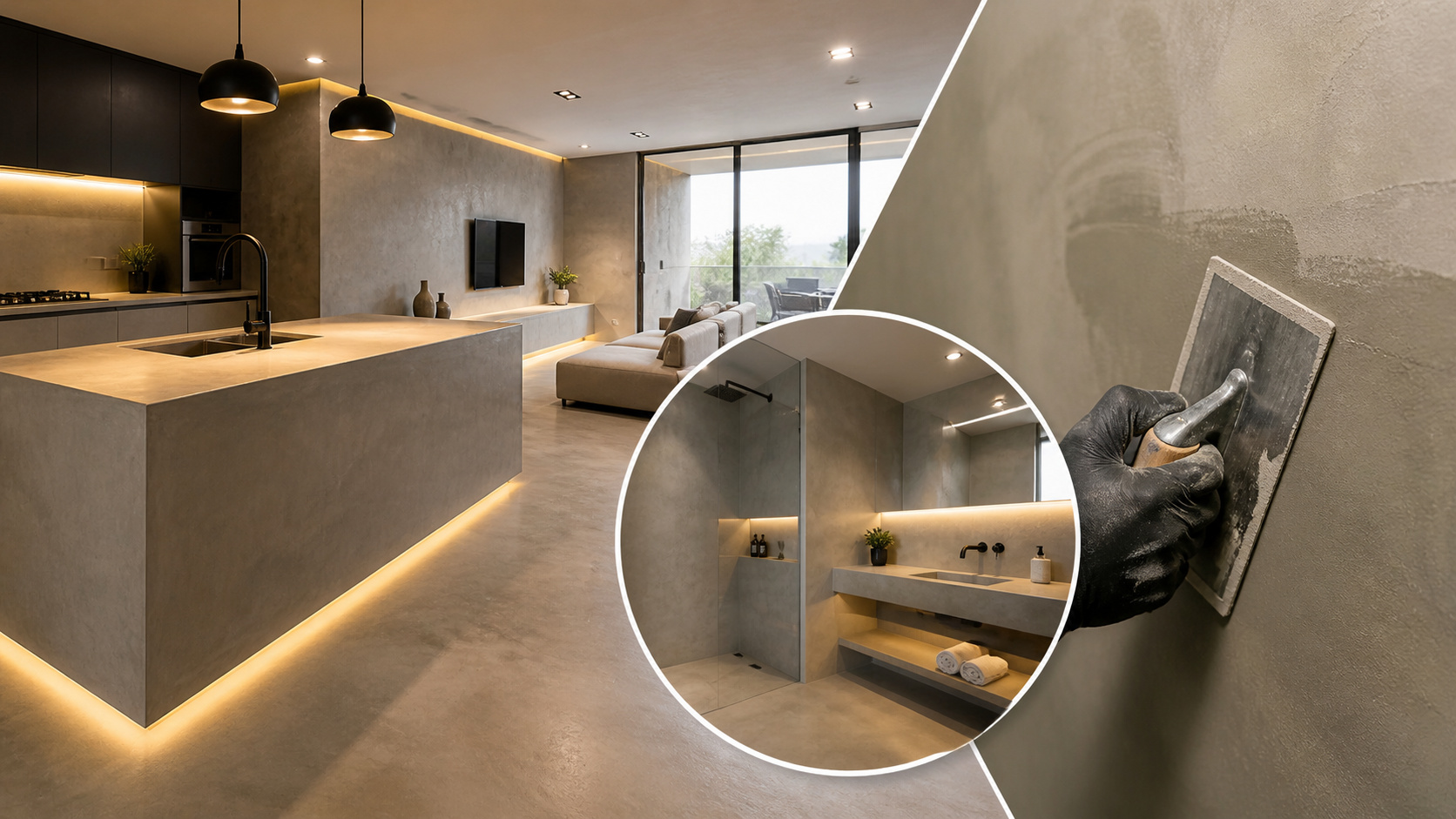
2 to 3 mm Microcement covers surfaces without demolition, eliminates grout, and gains space as an alternative to tiles.
In 2026, microcement ceased to be a finish restricted to high-end projects and began to appear more frequently in medium-sized residential renovations. The material, cited by specialized portals like Nivito in February 2026 and Auxiliadora Predial in January 2026, has been highlighted by architects and designers as one of the strongest trends of the year. The main reason lies in the combination of continuous aesthetics, direct application over existing surfaces, and significant reduction of debris.
The technical proposal is straightforward: a coating with a thickness between 2 and 3 millimeters capable of covering walls, floors, and countertops without the need to remove the old material. This completely changes the logic of renovation, which traditionally involves demolition, waste disposal, and long execution times.
At the same time, microcement eliminates grout, one of the main points of maintenance and dirt accumulation in environments such as kitchens and bathrooms.
-
Bolivian Female Construction Workers Form Association to Combat Discrimination and 38% Pay Gap in the Industry

-
Near Amsterdam, residents buy land and discover they must also build streets, manage drainage, handle waste, and grow food on half their plot.
-
Brazil’s WEG to Open New Factory in China by 2027, Expanding Production of Large Rotating Electric Machines and Low to Medium Voltage Motors in Rugao

-
Chinese Shipyard Secures $1 Billion in Orders for Low-Carbon Container Ships Amid Global Fleet Renewal Efforts


Microcement is applied in thin layers directly over existing cladding
Microcement is a cementitious coating modified with polymers, applied manually in thin layers over an existing base.
This means it can be used over:
- ceramic,
- porcelain,
- concrete,
- plaster.
The final thickness varies between 2 and 3 mm, which allows for a complete renovation of an environment’s appearance without significantly altering the floor level or wall structure. This point is one of the material’s main technical differentiators.
Application without demolition reduces debris and speeds up the renovation process
One of the biggest impacts of microcement is on project execution. Traditional renovations require the removal of old cladding, generation of debris, waste transportation, and base preparation before installing a new material.


With microcement, this process is reduced. The application occurs directly over the existing surface, provided it is properly leveled and prepared.
This reduces construction time and the volume of waste generated.
Absence of grout eliminates points of dirt and mold accumulation
Another important differentiator is the continuity of the surface. Since microcement is applied uniformly, it does not have visible joints like those found in tiles and porcelain.
This eliminates grout, which is often associated with the accumulation of dirt, moisture, and fungi, especially in wet areas. This characteristic has a strong functional appeal, in addition to a cleaner and more continuous aesthetic.
Despite its cementitious base, microcement relies on a sealing system to achieve high durability.
After application, specific layers of sealers and varnishes are used to make the surface impermeable and resistant.
When applied correctly, the material can exceed 20 years of useful life, according to industry professionals. This performance is directly linked to the quality of execution and the products used.
Material allows for continuous finish on floors, walls, and countertops
One of the most striking characteristics of microcement projects is visual continuity. The same material can be applied to different surfaces within the same environment, creating a uniform effect.
This includes:
- floors,
- walls,
- countertops,
- niches.
This integration reduces the visual fragmentation of the space, something highly valued in contemporary projects.
Microcement has moved beyond luxury projects and is starting to reach mid-range renovations
Historically, microcement was associated with high-end projects due to its cost and the specialized skill required for application.
However, the scenario is changing. The expansion of suppliers, greater dissemination of the technique, and increased demand have contributed to reducing access barriers.

The material is starting to appear in more accessible residential renovations, although it still requires skilled labor.
Application requires adequate base preparation and specialized labor
Despite its advantages, microcement is not a simple material to apply. The base needs to be level, clean, and free of infiltrations. Furthermore, the application is done manually, in stages, which requires technique and experience.
Errors in execution can compromise finish, adhesion, and durability, making the choice of specialized professionals a critical factor.
The resistance of microcement varies according to the system used. When well executed, it shows good resistance to wear, moderate impact, and humidity.
However, it is not indestructible. Surfaces can suffer scratches or wear over time, especially in high-traffic areas. Periodic maintenance of the sealer may be necessary to preserve performance.
Material enters the radar as an alternative, but does not replace all cases
Despite its growth, microcement does not completely eliminate other coatings. Each material has specific characteristics and more suitable applications.
In some cases, ceramic and porcelain may still be more indicated, especially in situations of high load or specific needs. Microcement emerges as a relevant alternative, not as an absolute replacement.
Now the direct question is: if a coating of just 3 millimeters can completely transform an environment without demolition and without debris, to what extent does the traditional renovation model based on demolition still make sense in the coming years?





Be the first to react!