






 Portuguese
  Spanish


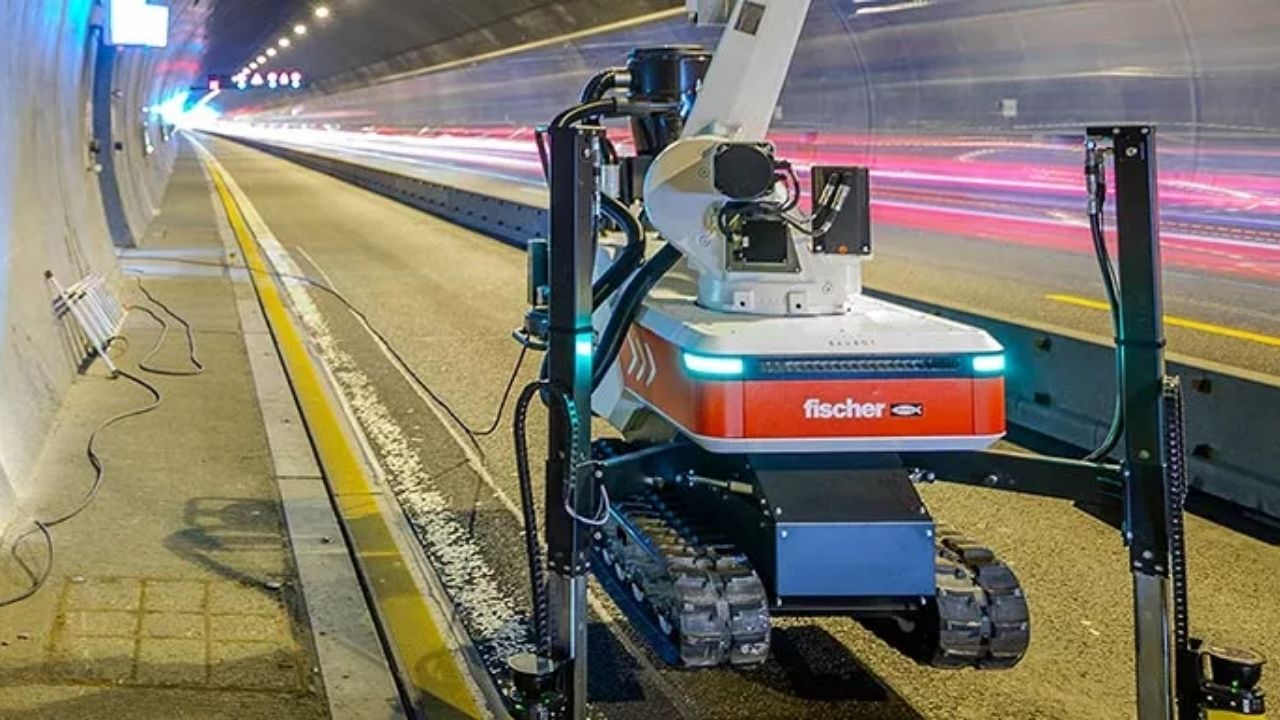


In the Engelberg tunnel in Germany, three fischer BauBot robots drilled more than 9,000 holes of 20 mm and 240 mm depth in concrete, up to 7.5 meters high, while the A81 renovation keeps traffic active and seeks to reinforce structures damaged by rock pressure expected for 2026.
The robots took the stage in the Engelberg tunnel, in Leonberg, Germany, to take on one of the most repetitive and heavy stages of the renovation: drilling more than 9,000 holes in concrete, in hard-to-reach areas and up to 7.5 meters high.
The intervention is part of the structural and operational modernization of the tunnel, located on the A81 highway, one of the busiest roads in southern Germany. The work began in April 2019 and is scheduled for completion in 2026, with traffic maintained during execution.
Robots take on heavy drilling in the Engelberg tunnel
The Engelberg tunnel renovation used three fischer BauBots to execute high-precision holes in concrete. According to the project profile, the equipment performed more than 9,000 holes with 20 mm diameter and 240 mm depth.
-
China’s Engineered Bamboo: The “Material of the Future” Stronger Than Steel and a Sustainable Wood Alternative

-
Egypt’s “New Nile”: 170 km Artificial River Aims to Turn Desert into Farmland, but Water Supply Concerns Loom
-
Unable to secure a mortgage as a self-employed single mother, she designed her own floating home from a 20-meter boat and now lives “off-grid” with her two children and solar panels on an English canal.
-
Man Transforms Rusty Shipping Container into Luxury Home with Insulated Walls, Large Windows, and Drywall Finish, Surprising Onlookers



The work was done fully automatically at elevated points, reaching up to 7.5 meters high. This type of task would be slower, repetitive, and physically demanding if it relied solely on manual drilling.
The technology was mainly applied in the preparation of anchoring points. In an underground construction, this type of step requires regularity, documentation, and precision so that the reinforcement elements are installed correctly.
With the robots, the operation gained efficiency and reduced the exposure of workers to repetitive activities at height. Human presence remained necessary but shifted to planning, supervision, operation, and control.
Tunnel undergoes renovation with 120,000 vehicles per day
The Engelberg tunnel is part of the A81 and crosses the Engelberg region, north of the Leonberg junction. The structure is one of the busiest in southern Germany, with about 120,000 vehicles per day.
The two galleries are 2,530 meters long each. Each tube has three lanes, as well as pedestrian crossings, connecting flows towards Karlsruhe, Munich, and Heilbronn.
The challenge is that the renovation occurs with traffic in operation. The lanes are maintained during most of the interventions, within a concept of a site planned to work in an extremely limited space.
Closures occur only during periods of lower traffic. This increases the complexity of the work because the safety of users and teams needs to be preserved while the structural renewal progresses.
Rock pressure damaged sections of the galleries

The need for renovation comes from damage caused by rock pressure over the years. The project reports that about 180 meters in the west tube and 170 meters in the east tube were affected.
The problem is linked to geological challenges involving anhydrite rock. When exposed to moisture, it can swell, deform the tunnel shells, and put the structure at risk.
Therefore, the work is not just an aesthetic or operational update. It involves structural reinforcement to preserve the safety and lifespan of the tunnel.
Among the planned measures are the installation of a reinforced concrete shell with steel beams to strengthen the vaults, the creation of a false ceiling, and the reinforcement of the road surface as an element of transverse stiffening.
Automatic drilling increases precision of fastening points
The robots were used to prepare fastening points in difficult areas of the tunnel. The technology allowed for drilling with controlled repetition, reducing common variations in extensive manual activities.
Fischer reported that the services included the creation of a digital construction plan, in which the exact drilling points were specified for the BauBots. This allowed the machine to follow previously defined coordinates.
Another important point was the automatic documentation. Each hole had relevant parameters recorded, such as depth, any contacts with reinforcements, and other process information.
With this, manual records were no longer necessary at this stage. In infrastructure works, this traceability helps in quality control and proof of execution according to the plan.
System reduces dust and improves work environment
Besides precision, BauBots feature integrated dust extraction. This feature helps keep the environment cleaner and healthier during drilling.
In tunnels, particle control is especially important. The space is enclosed, ventilation is limited, and drilling in concrete can generate a large volume of dust.
Extraction also contributes to the correct installation of fasteners, as clean holes favor application according to technical requirements.
The service package included drills, consumables, operators, and the availability of robots, end effectors, and additional teams for replacement in case of failure. The idea was to avoid stoppages and maintain productivity at the work front.
Project also renews safety and operation technology


The modernization of the Engelberg tunnel is not limited to structural reinforcement. The project also includes a complete renewal of operational and safety technology throughout its entire length.
This includes systems necessary to maintain the safe operation of the tunnel during and after the renovation. Even with ongoing construction, safety must be fully guaranteed.
The client of the project is the Federal Republic of Germany, represented by Autobahn GmbH, southwest branch. The execution is part of a broad intervention, initiated in 2019 and planned to end in 2026.
The company BauBot Services GmbH acted as the central contact point for planning, implementation, and support of robotic applications on-site, from digital planning to final documentation.
Robotic construction gains strength in complex projects
The case of the Engelberg tunnel shows how robotics is beginning to take on specific roles in heavy infrastructure projects. The technology does not replace the entire team but takes on repetitive, high, precise, and physically demanding tasks.
The main change is in the combination of physical site and digital planning. Drilling points are defined in a technical model, sent to the robots, and automatically recorded during execution.
In underground projects, where space, dust, height, and safety increase difficulty, this type of automation can reduce risks and improve standardization.
The trend is that construction robots will gain more space in stages such as drilling, fastening, measuring, documentation, and preparation of structures in areas with complicated access.
Reform shows the future of tunnel drilling
The robots used in the Engelberg tunnel show an important shift in heavy civil construction. More than 9,000 holes were drilled automatically, up to 7.5 meters high, in a project carried out with operational traffic and maximum safety requirements.
The case combines road infrastructure, difficult geology, structural reinforcement, and high-precision automation. Heavy manual drilling does not disappear from all projects, but it now shares space with machines capable of working consistently and recording each step.
For busy tunnels, this difference can mean less exposure for workers, greater technical control, and more efficient progress in critical areas.
And you, do you think robots in projects like this increase safety and precision, or do you still prefer to rely on traditional manual execution in infrastructure renovations? Share your opinion.







