






 Portuguese
  Spanish


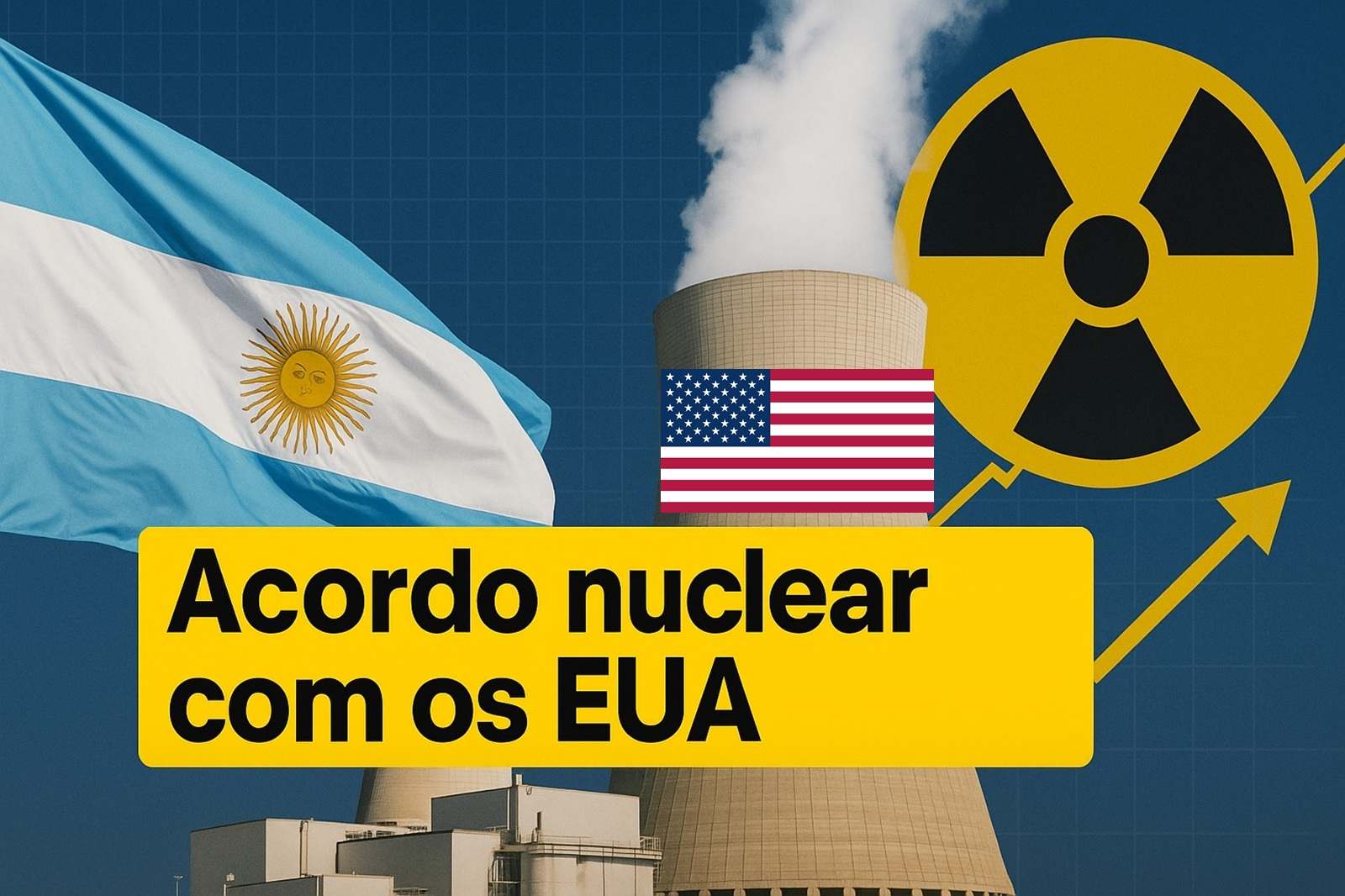


In a move that reinforces its regional leadership in the nuclear sector, Argentina took an unprecedented step by joining a U.S. program focused on clean energy, energy security, and applications related to artificial intelligence.
Argentina established itself on Friday, September 19, as the first country in Latin America to join a U.S. civil nuclear program.
The initiative focuses on the responsible use of Small Modular Reactors (SMRs), a technology that can boost strategic sectors such as the development of artificial intelligence.
The announcement came via a statement from the U.S. State Department, which celebrated Argentina’s participation in the Fundamental Infrastructure for the Responsible Use of Small Modular Reactor Technology (FIRST) program led by Washington.
-
China Develops Custom 140-Ton Electric Mining Truck with 770 kWh Swappable Battery, Deploys 290 Units in Xinjiang’s Largest Zinc Mine

-
Meta to Launch Arena, a New Prediction App Targeting 3.56 Billion Users, Competing with Polymarket and Kalshi

-
Scientist Challenges Famous Human Evolution Theory, Argues Homo Sapiens Evolved Gradually Over Thousands of Years
-
15-Year-Old American Builds Ocean Generator with PVC Pipe and 3D-Printed Propeller for $12, Wins National Prize, Presents at White House, and Makes Forbes 30 Under 30 List




The Importance of Argentina’s Membership
The U.S. Department of State, headed by Marco Rubio, emphasized the historic nature of Argentina’s move. “The United States welcomes Argentina’s decision to become the first Latin American country to join the U.S. FIRST program as a contributing partner,” it stated in an official note.
According to the Americans, the decision marks a milestone in strengthening the bilateral partnership in civil nuclear energy, expanding global energy security, and accelerating the deployment of advanced nuclear technologies in Latin America and other regions.
The Strategy of the Argentine Government
The presidential advisor for nuclear energy, Demian Reidel, had already anticipated that the goal is to build four SMRs in five years. These reactors, with a capacity of up to 300 megawatts — about one-third of traditional reactors — stand out for their modular construction.
In practice, in addition to meeting conventional energy demand, SMRs could be applied in cooling operations required by artificial intelligence systems, a rapidly expanding sector.
Reidel noted that Argentina maintains a pioneering project in the region. This is the CAREM 25, conceived in the 1990s and officially launched in 2006. The first unit will have an electrical capacity of 32 MW(e), and construction has already reached 62% completion.
Unique Conditions to Advance
The Argentine physicist and economist emphasized that the country has unique conditions to attract large data centers, vital infrastructure for global AI. He pointed to available land with simultaneous access to energy and water, a cool climate to facilitate cooling, and the absence of geological and military risks.
“These AI data centers require a power source with three characteristics: clean, stable, and scalable. And the answer is nuclear energy,” Reidel stated. In his words, the technology is “one of the cleanest in the world, if not the cleanest.”
The Role of FIRST in the Global Scenario
FIRST is led by the Bureau of Arms Control and Nonproliferation (ACN) of the State Department. The initiative was created to leverage the expertise of the nuclear industry, accelerating the responsible adoption of civil nuclear reactors.
Currently, the program involves over 50 countries across five continents. The focus is to ensure access to energy solutions that meet high standards of safety, protection, and nonproliferation, in accordance with the International Atomic Energy Agency (IAEA).
International Reference
With its membership, Argentina follows in the footsteps of Japan, South Korea, and Canada. These countries provide funding, technical expertise, and logistical support to FIRST. Now, Buenos Aires becomes a contributing partner, actively participating in global program activities.
This includes participation in regional projects, study trips, training programs, and initiatives aimed at facilitating the implementation of SMRs in interested countries.
Cooperation and Nuclear Leadership
In the view of the State Department, the partnership reinforces Argentina’s leadership in the nuclear sector and highlights the country’s willingness to foster international cooperation to address energy security challenges.
The U.S., in turn, emphasized that it intends to continue strengthening ties with Buenos Aires in the area of civil nuclear cooperation. The FIRST program presents itself, in this context, as the main platform to solidify this approach and promote concrete advancements in new nuclear technologies.







Que cada pais fique com o seu programa nuclear. Que cada pais monte a sua estrategia .
Onde energia nuclear é energia limpa?????
Se comparado com petróleo e hidroelétricas é sim energia limpa.
Energia nuclear o resultado fica com os Yankees, acelerar a IA; já o lixo atômico fica com os hermanos. Bela investida do Milei.