Portuguese
  Spanish


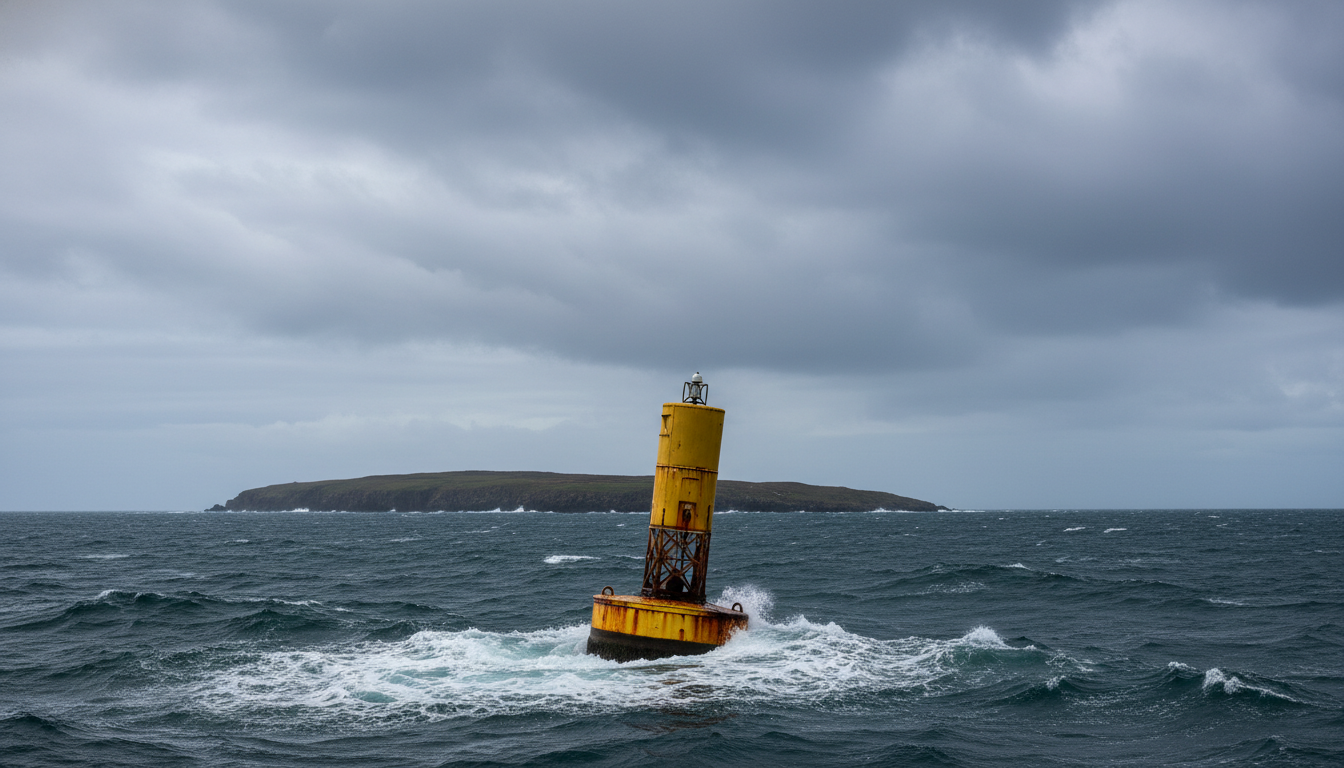

As Europe seeks alternatives to Russian gas and saturated solar energy, the Basque company IDOM connected a 42-meter-high vertical cylinder to the Spanish power grid this week, equivalent to a 14-story building, capable of generating 30 kW of clean electricity solely from the movement of the Cantabrian Sea waves, according to a report by NewAtlas.
The device is called MARMOK-A-5 and operates at the Biscay Marine Energy Platform (BiMEP), approximately 4 kilometers off the coast of Bizkaia, in the Basque Country.
Only 5 meters of the cylinder remain above the surface. The remaining 37 meters are submerged in water, at a total depth of 80 to 90 meters.
-
131-Ton Naval Propeller, Costing Up to $4 Million and Taking 4 Months to Manufacture, Powers the World’s Largest Cargo Ships Almost Invisibly

-
Brazil’s Maceió Port Joins Decarbonization Efforts with Study to Supply Clean Energy to Cruise Ships

-
Brazilian Port Expands Ship Capacity to 9.5 Meters, Boosting Cargo Transport and Reducing Logistics Costs
-
New Smart Radar Begins Issuing Fines to Solo Drivers in Carpool Lanes, Uses Cameras to Count Occupants, Changing Traffic Enforcement Rules on Busy European Roads



The technology is one of the most advanced versions of the “point absorber Oscillating Water Column” (OWC) concept. The system uses the vertical movement of the waves to compress and decompress air in internal chambers, and the flow drives a generating turbine.
How the 42-meter cylinder captures wave energy
The MARMOK-A-5 operates on a simple physical principle but demanding in engineering. According to IDOM, the cylinder floats semi-submerged. When the wave rises, the air inside the chamber is compressed and pushed to the turbine.
When the wave descends, the air re-enters.
The Wells turbine, patented in 1976 by Alan Wells of Queen’s University Belfast, is the key to the system. It generates energy in both directions of the air flow, eliminating valves.
The blades always rotate in the same direction, regardless of the direction of the wind inside the duct.
According to data from BiMEP, the Basque test platform has a 5.3 km² approved maritime area. It was inaugurated in 2015 by the Ente Vasco de la Energía (EVE) and has already received 8 wave energy prototypes from Spanish, French, and British companies.
In parallel, the MARMOK-A-5 is not the first vertical absorber in the Basque Country. In 2011, the Mutriku plant, embedded in the port’s breakwater, began operation with 296 kW.
It was the world’s first commercial wave power plant connected to the grid.
The numbers that distinguish the MARMOK-A-5 from previous prototypes
The 2026 device scales format and functionality. According to NewAtlas, the cylinder is 42 meters in total height and 5 meters in diameter. Only 5 meters emerge from the surface.
The nominal power is 30 kW, distributed in 2 generators of 15 kW each. This value is about 10 times less than the Mutriku plant, but the prototype serves to validate the “point absorber” concept in open sea, without needing a breakwater like Mutriku.
According to the EuropeWave program, the total budget of the European initiative reaches € 20 million (US$ 23 million).
The MARMOK-A-5 is one of 5 funded prototypes, alongside solutions from Mocean Energy (Scotland) and CorPower Ocean (Sweden).
Above all, IDOM, headquartered in Bilbao since 1957, is one of the oldest multidisciplinary engineering firms in Spain. The company operates in 7 main sectors: architecture, industrial engineering, energy, water, mining, defense, and information technology.
The global workforce in 2026 exceeds 4,500 employees.

Technical reveal: the Wells turbine and the bidirectional air cycle
In the background, the Wells turbine is the technical heart of the MARMOK-A-5. The turbine design allows operation with air flow in any direction, without the need for mechanical valves.
According to technical details of the project, the upper chamber of the cylinder has approximately 18 m³ of volume. When the wave rises, the internal water column compresses this air to up to 1.2 bar of overpressure.
When it descends, the air is pulled back by the same turbine.
The cycle repeats every 6 to 12 seconds in the Cantabrian Sea, depending on sea conditions. The conventional Wells turbine operates at rotations of 1,500 to 3,000 rpm, feeding the 2 synchronous generators of 15 kW.
In parallel, the conversion efficiency of the MARMOK-A-5 is about 20% to 30% according to EuropeWave tests. This value is higher than offshore wind farms in shallow waters (~15%) and slightly lower than modern photovoltaic solar panels (~22% cell efficiency).
What connected to the grid means in 2026
The connection to the Spanish power grid, announced in May 2026 by IDOM, is an operational milestone. According to NewAtlas, the cylinder was “installed and connected to the grid this week.”
The next step is to enter full operational service.
According to Red Eléctrica de España, Spain currently generates about 270 terawatt-hours (TWh) per year of electricity.
The contribution from waves is less than 0.01% of the mix. The MARMOK-A-5 produces about 70 to 100 MWh/year in full operation.
In parallel, the European goal is to install 1 gigawatt (GW) of wave energy capacity by 2030. The European Commission’s schedule includes commercial plants of 10 to 50 MW in the next decade.
The MARMOK-A-5 is the intermediate step.
Above all, the European Commission invested € 250 million in wave and tidal energy between 2014 and 2024 through Horizon 2020 and Horizon Europe programs.
The projected budget until 2030 reaches an additional € 400 million.

Human reveal: the Oceantec team and the IDOM spin-off
The human face of the project is the team from Oceantec Energías Marinas, an IDOM spin-off dedicated exclusively to wave and tidal energy.
The company was founded in Bilbao in 2008 with initial support from IDOM and Iberdrola.
According to Basque press coverage, the MARMOK-A-5 technical team consists of 15 engineers specialized in hydrodynamics, power electronics, and maritime materials.
The CEO of Oceantec is Pedro Mayorga, a naval engineer with 22 years of career in maritime energy.
In parallel, the project brings together 4 institutions besides IDOM. Tecnalia (Basque technology center), University of the Basque Country (UPV/EHU), Plocan (Canary Islands oceanographic laboratory), and Royal Belgian Institute of Natural Sciences.
The effort has been ongoing since 2015.
On the other hand, IDOM currently operates in more than 50 countries. In 2026, the engineering firm has active contracts in electrical transmission projects in Brazil with CCEE and EPE.
The entry into the wave energy market can scale internationally by 2030.
How the wave energy sector compares to offshore wind
The global wave energy market moved about US$ 2 billion in 2025 according to the International Energy Agency.
The number is only 2% of the offshore wind energy market, which reached US$ 95 billion in the same year.
On the other hand, the costs per MWh are still high. Wave energy costs between US$ 280 and US$ 400 per megawatt-hour.
Offshore wind has dropped to US$ 70 to US$ 85 per MWh, according to Bloomberg New Energy Finance data.
According to the International Energy Agency, the global technical potential of wave energy reaches 32,000 TWh/year.
This would be 116% of global electricity consumption in 2024. The main obstacle is technical: devices need to survive extreme storms.
In parallel, pioneering countries are the United Kingdom, Portugal, Spain, Norway, and Australia. Brazil has significant potential on the northeast and south coasts, but still no commercial plants.
The first national research was conducted by COPPE-UFRJ in Pecém in 2012, with 50 kW.

Future reveal: the next commercial phase in 2028
The next step planned by IDOM and Oceantec is the MARMOK-Commercial. The design foresees power of 250 kW to 500 kW per unit, scaled in farms of 10 to 40 cylinders.
In parallel, the company’s public schedule places commercial operation in 2028 or 2029. The preferred location is the northern coast of Spain, with possible expansion to Portugal, the United Kingdom, and France.
The initial cost of MARMOK-Commercial should be close to € 8 million per 500 kW unit.
According to the EuropeWave program, phase 2 of the European investment foresees functional commercial plants by 2030. The target is to demonstrate economic competitiveness with offshore wind by 2035.
It is worth remembering the coverage of comparable sector transformations in other sectors.
- Device: MARMOK-A-5 by IDOM (Bilbao)
- Total height: 42 meters (equivalent to 14 stories)
- Diameter: 5 meters
- Above the surface: only 5 meters
- Nominal power: 30 kW (2 generators of 15 kW)
- Technology: point absorber Oscillating Water Column with Wells turbine
- Location: BiMEP, 4 km off the coast of Bizkaia
- Program: EuropeWave (€ 20 million / 5 prototypes)

The points that still depend on operational proof
Despite the connection to the grid, 3 fronts still depend on operational proof. Survival in severe storms is the first. The Cantabrian Sea records waves up to 15 meters in harsh winters.
On the other hand, offshore maintenance is complex and expensive. Each intervention requires specialized vessels and a good weather window. Finally, integration with the grid in larger farms requires submarine cables and offshore substations, a cost that still makes immediate commercial projects unfeasible.