Portuguese
  Spanish


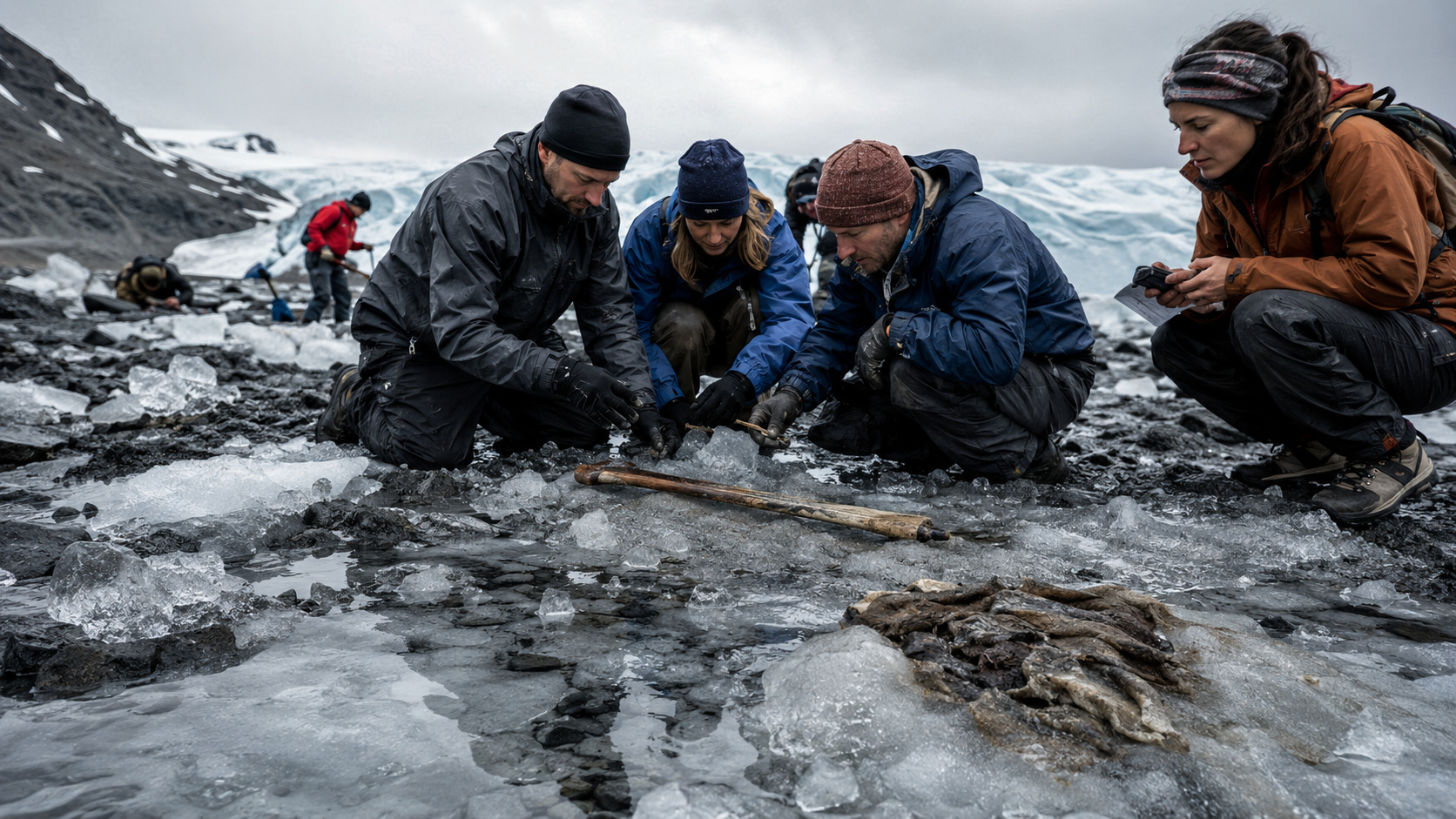

The retreat of ice reveals archaeological objects, human remains, and mineral areas, as researchers race to preserve materials exposed by global warming
For thousands of years, the ice functioned as a closed capsule. Now, however, this capsule is breaking apart in the face of advancing global thawing.
Consequently, tools, organic remains, and preserved bodies are reappearing in mountains and polar regions. Each discovery helps reconstruct ancient societies but also reveals the speed of climate change.
On January 10, 2025, UNESCO highlighted that the oldest artifact found in mountainous ice is over 10,000 years old.
-
Brazil Constructs First Japanese SABO Barrier in Nova Friburgo to Prevent Landslides, a $3 Million Concrete Trap for Rocks, Logs, and Mud

-
Brazilian Navy’s Technology Plays Strategic Role in Future of Small Modular Reactors, Boosting Nuclear Energy Capacity with Innovative Solutions for Power Generation and Industrial Applications

-
China Surpasses U.S. and Russia Combined in Submarine Production
-
Xiaomi Unveils Smart Glasses in Brazil with 12MP Camera, 4K Video, and AI Features, Challenging Ray-Ban Meta


It is a piece related to the launching of projectiles, found in the Rocky Mountains. Additionally, another similar object was located in the Yukon, Canada.
What the ice is returning to the surface
The ice retreats, and history appears.
Firstly, the extreme cold preserved wood, fabrics, tools, and organic materials that would likely disappear in other environments.
For this reason, previously inaccessible regions are being transformed into true open-air archaeological museums.
Among the main discovery sites are:
- Yukon Mountains, Canada;
- European glaciers and alpine areas;
- Remote Arctic regions.
However, preservation ends quickly when the object leaves the ice. After exposure, contact with air accelerates deterioration.
On December 4, 2024, the United States National Park Service explained that artifacts from different eras can emerge simultaneously in the same frozen area.

How glacial archaeology reconstructs the past
Each recovered tool functions as a clue.
Through the analysis of objects, experts can identify ancient routes, hunting techniques, and changes in human habits.
Additionally, dating the materials allows tracking technological transformations. In the case highlighted by UNESCO, the findings revealed the transition from dart throwers to the bow and arrow.
At the same time, mummies and preserved bodies provide information about diseases, clothing, and living conditions.
Thus, the ice does not only preserve objects. It conserves biological fragments capable of expanding knowledge about ancient societies.

The race to save the exposed artifacts
The greatest challenge begins precisely when the object appears.
As wood, leather, and fabrics can decompose quickly, researchers need to locate and retrieve the findings before they are lost forever.
Consequently, each expedition becomes a race against time. The more the ice recedes, the greater the number of materials that may be found.
On the other hand, the risk of disappearance before the archaeologists even arrive also increases.
The minerals that increase interest in the Arctic
Simultaneously, the retreat of frozen areas increases attention on mineral resources existing in northern regions.
The United States Geological Survey records potential for graphite, lithium, tin, tungsten, rare earths, and platinum group elements in Alaska.
However, the presence of these materials does not guarantee immediate exploration. After all, isolation, severe climate, and environmental risks make any project complex.
Therefore, the melting intensifies the debate between economic interest, environmental preservation, and regional development.
Why the Arctic is in the spotlight
On December 10, 2025, the National Oceanic and Atmospheric Administration of the United States, NOAA, published its 20th annual report on the Arctic.
According to the document, the region is warming much faster than the rest of the planet. Since 1980, the annual temperature has risen almost three times faster than the global average.
Consequently, the ice is diminishing, land areas are changing, and new navigation possibilities are emerging.
Even so, archaeological discoveries do not represent a benefit capable of compensating for environmental damage. On the contrary, they emerge as a direct consequence of a worrying transformation.
What the Melting Ice May Still Reveal
As warming progresses, new tools, mummies, and remnants may emerge.
Therefore, researchers will need to improve the methods of locating, removing, and preserving the materials.
In the end, the ice reveals how ancient peoples lived, moved, and survived. However, at the same time, it shows how major environmental changes continue to transform the planet.
And you, do you believe that science will be able to preserve these discoveries before they disappear after exposure? Tell us in the comments.