






 Portuguese
  Spanish


Unprecedented structure with Japanese technology will be installed in the Mountain Region of Rio to retain heavy materials in hillside areas and marks a new stage in debris containment works in the country.
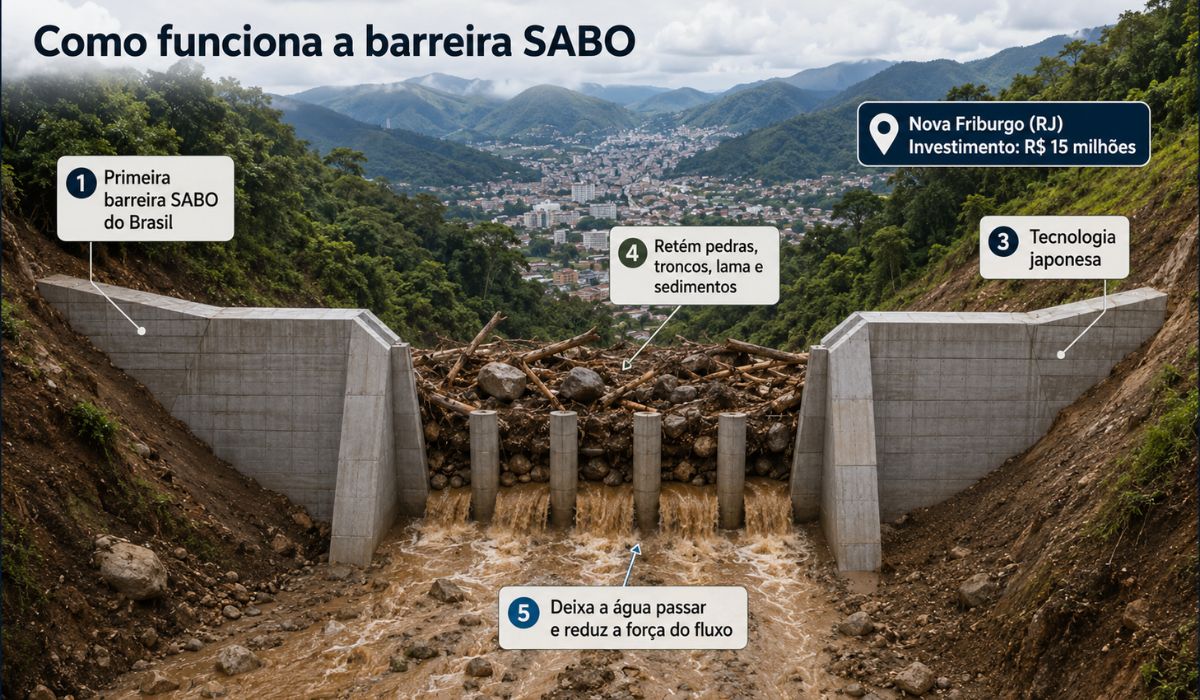
Brazil has started, in Nova Friburgo, in the Mountain Region of Rio de Janeiro, the execution of the country’s first SABO Barrier, a Japanese engineering structure designed to retain stones, logs, mud, and sediments before this material advances downhill.
The project will be implemented in the Duas Pedras neighborhood, near São Lucas Hospital, with a transfer of R$ 15 million from the Ministry of Cities within the New PAC.
The SABO technology is aimed at retaining the so-called debris flow, formed by solid materials carried by water in hillside areas.
-
Brazilian Navy’s Technology Plays Strategic Role in Future of Small Modular Reactors, Boosting Nuclear Energy Capacity with Innovative Solutions for Power Generation and Industrial Applications

-
China Surpasses U.S. and Russia Combined in Submarine Production
-
Xiaomi Unveils Smart Glasses in Brazil with 12MP Camera, 4K Video, and AI Features, Challenging Ray-Ban Meta

-
Volkswagen Unveils Bold Strategy to Compete with Chinese Automakers in Brazil, Featuring 5,000 Parts, 76% Localization, and a Surprising Turnaround


According to Caixa, this type of dam allows water to pass through and retains heavy materials, such as rocks, logs, and mud, reducing the volume and speed of the flow towards areas located below the hillside.
In the case of Nova Friburgo, the structure will be built in an area of the Duas Pedras neighborhood, a point indicated in the project’s official documents as the site for implementing debris flow retention works.
The proposal is to install the barrier in a natural passage area of this material, before it reaches urbanized sections.
How the SABO Barrier works in Nova Friburgo
The word SABO comes from the combination of Japanese terms associated with sediment and protection, as explained by Caixa.
In practice, the barrier is installed at strategic points on slopes or areas where water, soil, stones, and vegetation can descend in situations of intense flow.
The structure does not act as an impermeable wall.
According to Caixa, the technology allows water to pass through, while heavier materials are retained or have their movement reduced.
This characteristic differentiates the SABO Barrier from conventional works aimed only at containment or drainage.
In engineering terms, the main function is to control the movement of solid materials.
When water gains strength on the inclined terrain, it can carry soil, rock blocks, branches, and logs.
The barrier is designed to intercept this material at a point before reaching the areas below the hillside.
This logic explains the association made in the title with the idea of a concrete trap.
The expression figuratively describes the function of the structure: to retain part of the elements carried by the flow, without completely blocking the passage of water.
Project with Japanese technology integrates the New PAC
The project kickoff meeting was announced by the Ministry of Cities on April 18, 2026.
The meeting marked the technical and institutional alignment for the effective start of the work, with the definition of monitoring routines, inspections, execution deadlines, reporting methods, and operational procedures of the project.
Representatives from the Ministry of Cities, the Ministry of Integration and Regional Development, Caixa, the Government of the State of Rio de Janeiro, the City Hall of Nova Friburgo, COPPE/UFRJ, and companies involved in the execution and management of the project participated in the meeting.
The construction is part of the Disaster Prevention – Slope Containment axis of the New PAC.
The management is shared between the National Secretariat of Peripheries, linked to the Ministry of Cities, and the National Secretariat of Protection and Civil Defense, linked to the Ministry of Integration and Regional Development.
The project is also part of a technical cooperation between Brazil and Japan, with support from the Japan International Cooperation Agency, JICA.
According to the Ministry of Cities, the initiative combines knowledge transfer, training, and implementation of structural interventions.
Nova Friburgo will be the pilot case for SABO technology in Brazil
The ceremony to start the works took place on January 12, 2026, in Nova Friburgo, according to JICA.
The Japanese agency reported that the implementation in the municipality is treated as a pilot case and that the experience may support the application of SABO technology in other landslide risk areas in the state of Rio de Janeiro and other regions of the country.
Before the start of execution, the City Hall of Nova Friburgo reported that the municipality signed, on December 15, 2021, a commitment agreement to participate in the cooperation project between the governments of Brazil and Japan.
The municipal administration also recorded that studies and discussions on the implementation of the technology in the city began in 2013, within the scope of the Gides project, with the participation of JICA technicians.
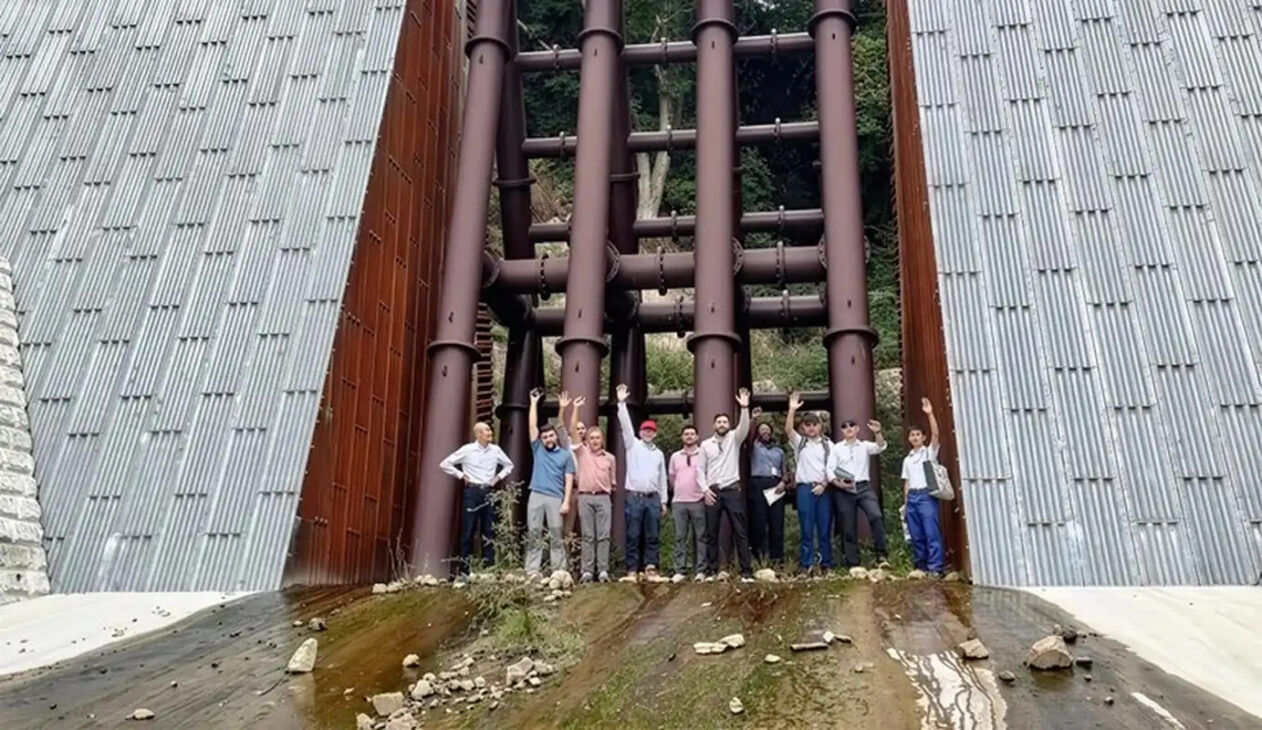
The choice of Nova Friburgo to receive the first SABO Barrier in Brazil appears in official sources associated with the implementation of a pilot project with Japanese technology for debris flow retention.
The text from the City Hall also mentions the project’s relation to previous technical cooperation actions and studies focused on mass movements in the city.
The Government of the State of Rio de Janeiro participated in the groundbreaking ceremony of the project, held at the Laercio Rangel Ventura Municipal Theater.
On the occasion, the State Department of Social Interest Housing informed that the intervention will be carried out on a hillside in the Duas Pedras neighborhood, on RJ-130, with an investment of R$ 15.2 million.
Official values of the SABO Barrier appear in different stages
The values associated with the project vary according to the administrative stage mentioned in official sources.
In June 2025, Caixa reported that the project had been approved with an investment of R$ 20.1 million from the New PAC, with funds from the General Budget of the Union transferred by the bank.
At the start meeting, in April 2026, the Ministry of Cities mentioned a transfer of R$ 15 million for the construction of the SABO Barrier in Nova Friburgo.
The Government of the State of Rio de Janeiro, in turn, reported an investment of R$ 15.2 million at the groundbreaking ceremony.
There is also a record of a higher value in the bidding notice nº 25/2025 of the State Department of Social Interest Housing.
The document indicated a total contract value of R$ 20,551,524.55 for the execution of debris flow retention works in the area known as Morro Duas Pedras, in the Duas Pedras neighborhood, in Nova Friburgo.
Therefore, the text maintains the value of R$ 15 million mentioned in the title and in the Ministry of Cities’ release, but notes that other official sources pointed out different values in previous or specific phases of the process.
Structure will retain stones, logs, mud, and sediments
The central point of the project is the retention of solid materials transported by debris flow.
In the Nova Friburgo project, the intervention was described in official documents as a debris flow retention work in the area called Morro Duas Pedras, in the Duas Pedras neighborhood.
This type of flow occurs when moving water carries soil, rocks, vegetation, and other materials across the terrain.
The SABO Barrier acts on this mixture, retaining some of the solid elements and reducing the energy of the displacement, according to the technical description released by Caixa.
The technology, therefore, is not limited to water control.
Its technical objective is to act on the material that descends with it.
On a slope, this set can include stones, mud, logs, and sediments, which are precisely the elements cited by official sources when explaining the functioning of the SABO barriers.
In the simplest formulation, the structure functions as a retention point for materials dragged down the slope.
The water follows the path planned by the project, while the heavy elements are retained or have their speed reduced by the barrier.
Teresópolis will also receive a SABO Barrier
Nova Friburgo will not be the only municipality in the Mountain Region to receive the technology.
The Ministry of Cities informed that another SABO Barrier will be built in Teresópolis, also with resources from the New PAC Slope Containment and technical support from Japanese consultants.
The implementation in more than one municipality indicates that the technology is being incorporated as an engineering solution in slope containment projects funded by the federal government.
In the case of Rio de Janeiro, the Mountain Region includes urban areas close to inclined terrains, making this type of intervention part of the structural works agenda.

The Nova Friburgo experience will be monitored by federal, state, municipal agencies, technical institutions, and companies contracted for execution and management.
The inspection and monitoring routines were defined at the kick-off meeting, according to the Ministry of Cities.
As the construction progresses, the execution and operation data should indicate how Brazil’s first SABO Barrier will be incorporated into the country’s debris containment engineering.


