Portuguese
  Spanish


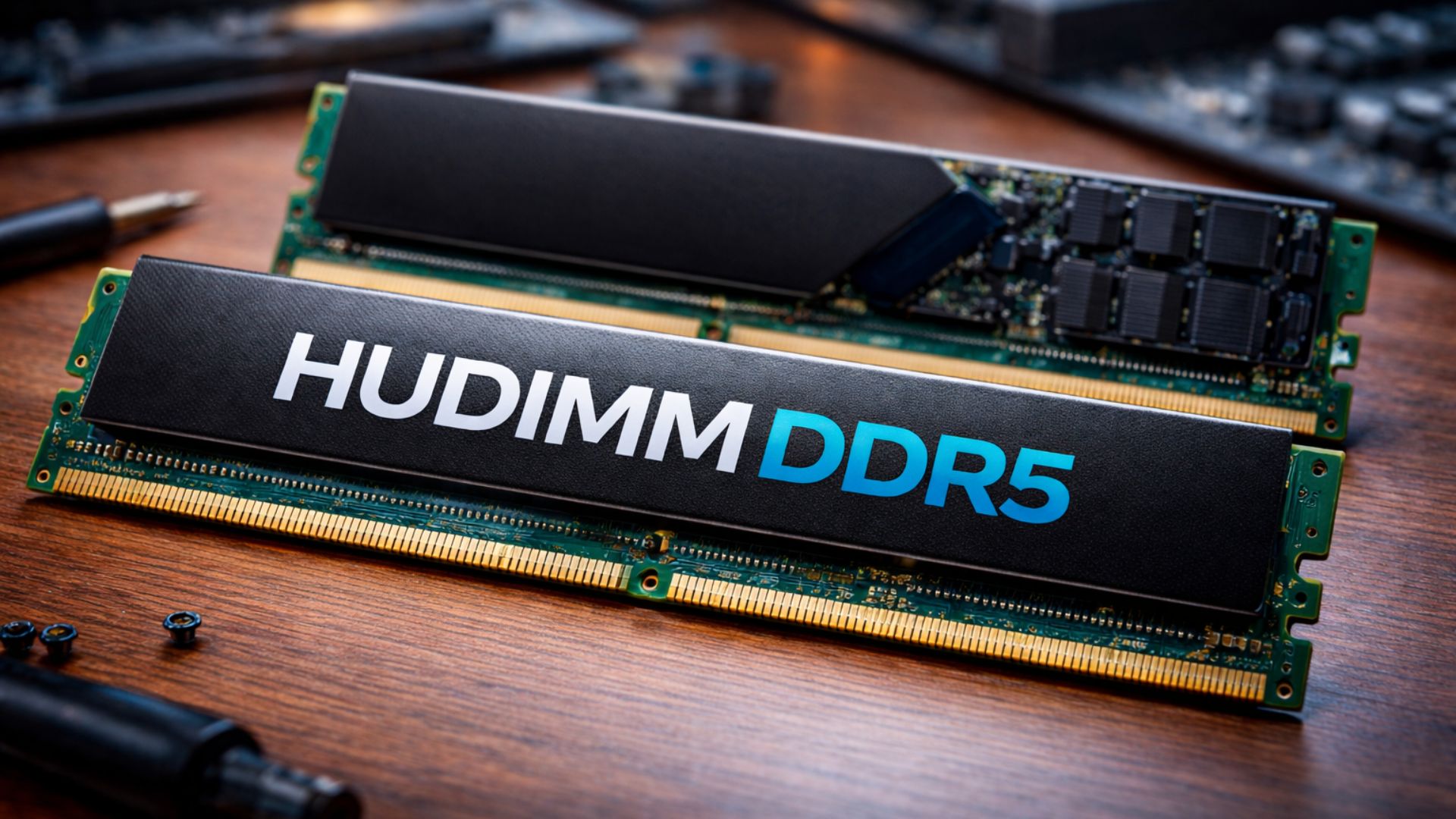

Understand how ASRock presents the HUDIMM standard, a new technology that can reduce costs and make DDR5 memory more accessible in entry-level PCs, and Intel has already declared support.
The search for more affordable hardware has gained a new chapter with the announcement of the HUDIMM standard, developed with support from Intel and implemented by ASRock. The proposal is clear: reduce the production cost of DDR5 memory and thus make it more viable for entry-level computers.
In a scenario where component prices remain globally pressured, this new technology emerges as a strategic alternative. By simplifying the structure of RAM memory, the model promises to directly impact consumers’ wallets and facilitate access to more modern systems.
The innovation already has significant support from the industry. Intel itself, through one of its technical representatives, Robert Hallock, highlighted the importance of this type of advancement to keep computing accessible. This reinforces that the movement is not isolated but part of a larger response to market changes.
-
Hurricane Katrina: Engineering Failures by U.S. Army Corps Led to 80% of New Orleans Flooding

-
Hisense Unveils 615-Liter PureView Fridge with Transparent Door, Smart Display, Voice Control, and UV Purification to Compete with LG and Samsung

-
Are Cleaning Staff in Large Buildings Becoming Obsolete? Autonomous Robots Now Clean Airports, Hospitals, and Shopping Centers for Hours, as Companies Invest in Automating Repetitive Tasks

-
Xiaomi Launches Compact Photo Printer with Bluetooth, Extra Black Ink, and Augmented Reality Photo Printing


HUDIMM from Intel and ASRock redefines the structure of DDR5 memory
The great differentiator of HUDIMM lies in its internal architecture. Unlike traditional DDR5 memory, which uses two 32-bit subchannels, the new standard works with only one 32-bit subchannel.
This change may seem small at first glance, but it has a direct impact on manufacturing. With half the traditional structure, ASRock can reduce the number of chips needed in each module. This simplifies the production process and opens up space for more competitive prices.
In practice, the conventional DDR5 standard was designed to offer greater bandwidth and performance. On the other hand, HUDIMM prioritizes cost-effectiveness. Intel supports this approach precisely because it understands that not all users need the maximum performance available.
This adaptation of the new technology shows how the sector is adjusting to meet different consumer profiles, especially at a time of technological transition.

Why reducing to a subchannel can lower RAM costs
The logic behind HUDIMM is simple: fewer components mean lower costs. By using only a 32-bit subchannel, the number of DRAM chips is nearly halved compared to traditional modules.
This model brings some clear advantages for production:
- Significant reduction in raw material usage
- Less complexity in module assembly
- Decreased logistical and industrial costs
- Possibility of more affordable final prices
This strategy from ASRock directly addresses the cost crisis affecting the sector in 2026. DDR5 memories, despite being more advanced, still face price barriers in many markets.
With this new technology, the trend is that more users will be able to migrate to newer standards without straining their budgets too much.
Focus on entry-level PCs boosts DDR5 memory adoption
The target audience for HUDIMM is quite specific: users looking to build or upgrade basic PCs. ASRock makes it clear that the modules were primarily designed for smaller capacities, such as 8 GB.
According to the company, in some scenarios, it may be more advantageous to combine an 8 GB HUDIMM module with a traditional 16 GB module, rather than using just a 24 GB memory. This approach creates new configuration possibilities.
Among the main benefits of this strategy are:
- Greater flexibility in system assembly
- Reduction in the initial upgrade cost
- Easier access to modern RAM memories
- Better balance between price and performance
Intel sees this movement as essential to expanding the user base for DDR5 memories, especially in emerging markets and more price-sensitive segments.
Real impacts on DDR5 memory performance with HUDIMM
However, not everything is a gain. The reduction to a single subchannel implies technical limitations that need to be considered. DDR5 memories with HUDIMM tend to offer lower bandwidth, which can impact more demanding applications.
This becomes more evident in situations such as:
- Modern games with high memory demands “`
- Editing and rendering software
- Intensive multitasking environments
- High-performance professional applications
On the other hand, for everyday use, such as browsing, studying, or media consumption, RAM based on this new technology should perform adequately without major issues.
The goal is not to compete with premium solutions, but rather to offer a viable alternative for those who need to save money without giving up a current platform.
ASRock brings HUDIMM to notebooks and mini PCs with HSODIMM
The strategy of ASRock is not limited to the desktop market. The company also announced compact versions of HUDIMM, known as HSODIMM, aimed at notebooks and mini PCs.
These modules already have a certain destination: they will be used in devices like the DeskMini B860, a compact PC that seeks to balance performance and cost. This shows that the new technology has potential for expansion into different formats.
The presence in smaller devices expands the reach of DDR5 memory, especially in scenarios where space and cost are critical factors.

Intel reinforces support for the standard and increases market confidence
The support from Intel is one of the most important pillars for the adoption of HUDIMM. The company confirmed compatibility with chipsets from the 600, 700, and 800 series, ensuring that the technology can be used across a wide base of systems.
Robert Hallock, the company’s technical representative, emphasized that solutions like this are essential for keeping the evolution of computing accessible, especially in light of the growing demand for memory.
This type of positioning reinforces market confidence and may encourage other manufacturers to explore similar approaches for RAM.
New technology may alleviate global pressure on hardware prices
The launch of HUDIMM comes at a sensitive time for the industry. The increase in demand for components, coupled with challenges in the supply chain, has driven up the prices of DDR5 memory in recent years.
In this context, initiatives that reduce production costs gain strategic relevance. ASRock, with support from Intel, is trying to offer a practical solution to this problem.
If the proposal proves efficient, the impacts may include:
- Gradual reduction in entry prices
- Greater competitiveness among manufacturers
- Expansion of the use of modern RAM
- Encouragement to upgrade old PCs
Still, everything will depend on how the market reacts to the new technology. Other initiatives in the sector are also emerging, like this one from Google:


What still needs to be proven about HUDIMM
Despite the potential, some questions remain open. The main one is the final price of the modules. Without this information, it is difficult to measure the real impact of the technology on consumers.
Other points also deserve attention:
- Practical performance difference in real tests
- Wide compatibility with different motherboards
- Acceptance by other manufacturers besides ASRock
- Future evolution of the standard within the industry
Intel has already given the green light in terms of support, but the consolidation of HUDIMM will depend on its acceptance in the market.
A new path for more accessible RAM
The emergence of HUDIMM shows that the industry is willing to rethink established standards to face current challenges. By reducing the complexity of DDR5 memories, ASRock, with support from Intel, creates an interesting alternative to broaden access to technology.
The new technology does not come to completely replace traditional models, but it can play an important role at the base of the market. For many users, especially those looking to build cheaper PCs, this could be the gateway to a new level of performance.
If prices are truly competitive, HUDIMM could mark a significant change in how RAM is produced and consumed in the coming years.
With information from Adrenaline.