






 Portuguese
  Spanish
  5 min of reading
  0 comments


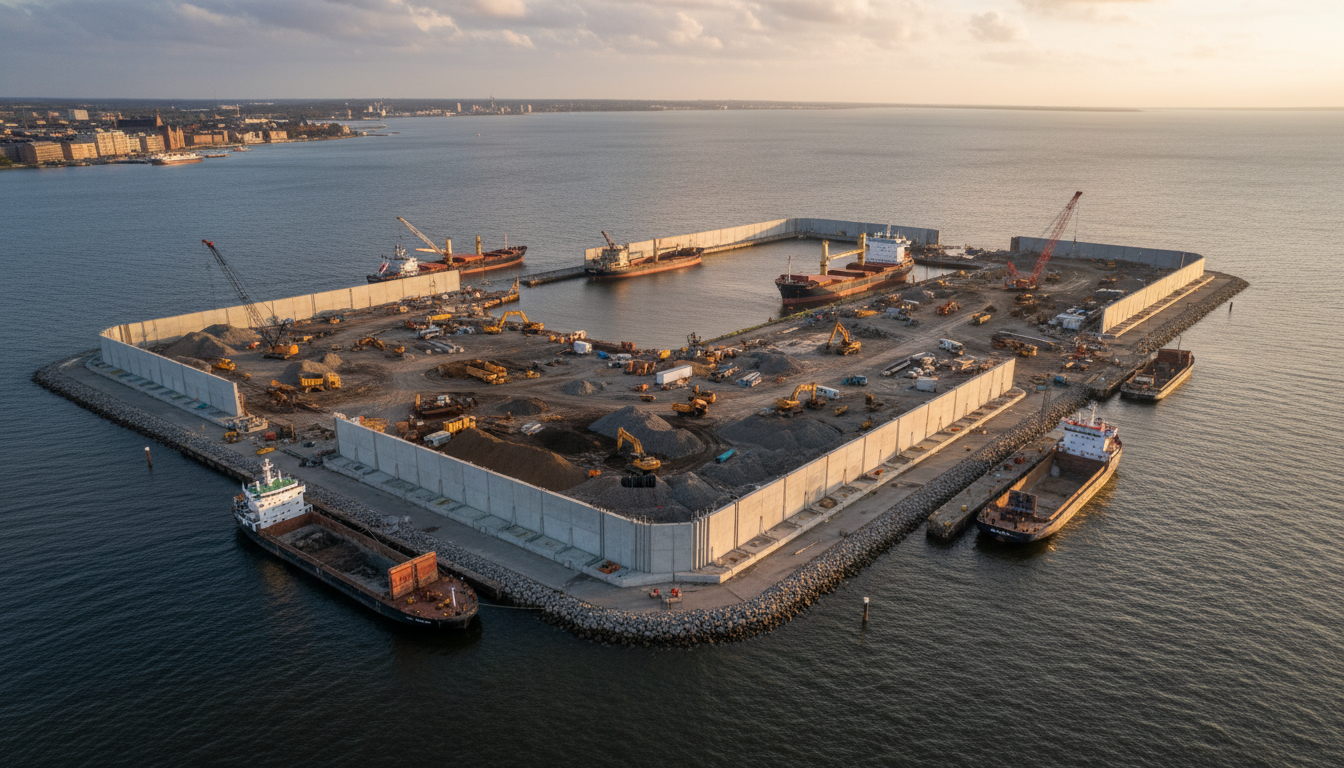
Phase 2 of the construction has already surpassed 50% and anticipates completion of soil filling by 2050
Denmark is sinking 80 million tons of soil into the Baltic Sea to build an artificial island in Lynetteholm Copenhagen. The project will house 35,000 residents when completed.
The construction also serves as a climate defense for the Danish capital. With rising sea levels, Copenhagen is increasingly exposed to storms.
The Danish Parliament approved the project in June 2021, with a vote of 85 in favor and 12 against. It was one of the country’s rare political consensuses.
-
Bolivian Female Construction Workers Form Association to Combat Discrimination and 38% Pay Gap in the Industry

-
Near Amsterdam, residents buy land and discover they must also build streets, manage drainage, handle waste, and grow food on half their plot.
-
Brazil’s WEG to Open New Factory in China by 2027, Expanding Production of Large Rotating Electric Machines and Low to Medium Voltage Motors in Rugao

-
Chinese Shipyard Secures $1 Billion in Orders for Low-Carbon Container Ships Amid Global Fleet Renewal Efforts


According to the technical documentation of the project, construction began in October 2022 with Phase 1. The first part was delivered in 2024.
Indeed, Phase 2 of the construction has already surpassed 50% in August 2025. 5.2 of the planned 8.6 km of stone dike have been delivered.
As reported by Time Magazine, the concept is simple but ambitious. Reuse soil from civil works in the region to create 275 hectares of new land.

How the Lynetteholm Copenhagen project works
The Lynetteholm Copenhagen project is executed by By & Havn, a public company of the Port of Copenhagen. The main contractor is Per Aarsleff A/S.
As reported by Dezeen, the total investment reaches 20 billion Danish kroner. That’s about 2.7 billion euros.
The financing is self-sustaining. Therefore, By & Havn will sell plots on the island when it is ready to recover the investment.
In parallel, the material used is locally sourced soil. According to an analysis by Architect’s Newspaper, 80 million tons of soil are excavated from other civil works in Copenhagen.
Thus, the logistics involve about 350 trucks per day crossing the city. The flow generates criticism from residents of impacted neighborhoods.
Indeed, the pace of dumping is so intense that it will last almost 30 years. The total soil filling will only be completed in 2050.

Why Lynetteholm Copenhagen serves as climate defense
The dual function is what differentiates Lynetteholm Copenhagen from other land reclamation projects. In addition to housing, the island protects against sea level rise.
According to an analysis by CNN Style, Denmark faces increasing risks of storm surges. The Baltic Sea level has risen 17 cm since 1900.
Therefore, the artificial peninsula will function as a natural barrier. It will hold back floods before they reach the old neighborhoods of the capital.
In parallel, former Prime Minister Lars Løkke Rasmussen announced the project in October 2018. “The capital is developing rapidly. Copenhagen will run out of available land,” said Rasmussen.
Thus, Lynetteholm solves two problems at once: scarce land and climate protection. This rare package ensured cross-support.
According to details from Travel Tomorrow, former mayor Frank Jensen also supported the plan. It was a rare alignment between national and municipal governments.

The technical data of Denmark’s largest urban construction
The Lynetteholm Copenhagen project has impressive dimensions. The total area will be 275 hectares, equivalent to 385 official football fields.
According to data from The Civil Engineer, the defense perimeter will have 7 km of stone dikes.
Indeed, the urban integration includes the extension of the Copenhagen metro line. It also has a port tunnel connecting the districts of Nordhavn and Refshaleøen.
In parallel, the architectural project is by the offices COWI, Arkitema, and Tredje Natur. The island will have 35,000 jobs in addition to the 35,000 residences.
- Total area: 275 hectares (385 football fields)
- Total soil: 80 million tons
- Stone dikes: 8.6 km (Phase 2)
- Investment: 20 billion DKK (2.7 billion EUR)
- Planned residents: 35,000
- Jobs: 35,000
- Approval: June 2021 (85×12 votes)
- Conclusion soil filling: 2050
Environmental controversy with the Baltic in Lynetteholm Copenhagen
Despite internal political support, Lynetteholm Copenhagen faces international criticism. The Coalition Clean Baltic published a manifesto against the project in September 2023.
According to the coalition, the artificial peninsula could block the flow of salty and oxygenated water to the Baltic. The estimated reduction reaches 0.5% of the total influx.
On the other hand, percentage-wise it seems small. In parallel, the Baltic is a closed sea and any reduction in flow can affect the entire regional ecology.
Thus, Sweden maintains formal objections to the project. There is a dispute over the Espoo agreement on transboundary environmental impact.
According to Bloomberg, critics accuse Denmark of “greenwashing”. The argument is prioritizing local defense over regional ecosystem health.
In May 2023, a supplementary EIA stated that the bathing water quality of Copenhagen’s coast would be maintained. But the opinion is still contested.
For a comparative case of European mega-engineering, it’s worth reading the coverage by Click Petróleo e Gás on Arctic infrastructure.
What Lynetteholm means for Brazilian port cities
The Lynetteholm Copenhagen project offers a reference for Brazil. Cities like Santos, Vitória, and Salvador face similar climate risks.
According to an analysis by economists from the University of Copenhagen in 2024, the welfare gain from the project reaches 136 billion DKK. That’s about 18 billion euros in added value.
Therefore, Brazilian models of Public-Private Partnership could replicate the logic. Financing capacity exists, but institutional engineering is lacking.
In parallel, the Danish model is a reference for the European oil and gas sector. Resilient ports ensure operational continuity of logistics chains.
Indeed, Denmark is a critical hub for Baltic offshore energy. The local floating wind farms depend on operational ports like Copenhagen.
For more on European mega-projects, it’s worth checking the coverage by Click Petróleo e Gás on the Yamal LNG terminal.
It’s worth noting that the Lynetteholm project still faces risks. Supplementary hydrological studies may force environmental redesign in the coming years.
Despite this, the schedule remains firm. By 2050, Copenhagen will have a new 275-hectare neighborhood in what is now open sea.





-

1 person reacted to this.