






 Portuguese


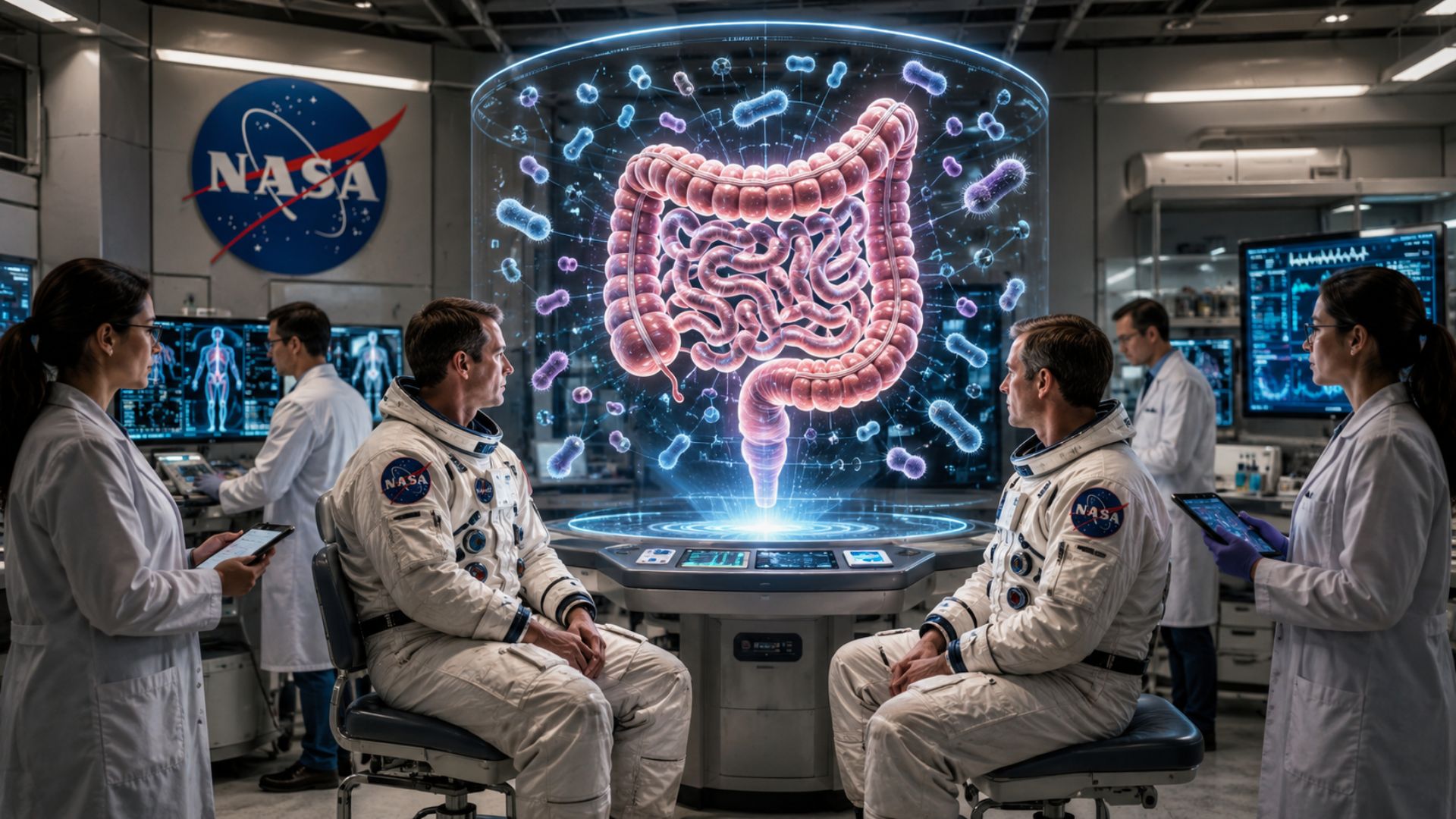

Invisible changes in astronauts’ intestines reveal how prolonged spaceflight can affect essential systems of the human body, increasing attention on biological risks that need to be understood before long-duration journeys to Mars.
Astronauts who spend long periods in space may return to Earth with changes in an invisible part of the human body: the gut microbiome, a community formed by microorganisms linked to digestion, metabolism, immunity, and the balance of different body systems.
This alteration was observed in the set of studies known as the NASA Twins Study, which monitored the effects of nearly a year of stay on the International Space Station on Scott Kelly, while his twin brother, Mark Kelly, remained on Earth.
The discovery is noteworthy because the gut hosts a complex network of bacteria, viruses, and fungi that participate in essential functions, many of them silent, but directly related to the body’s ability to respond to extreme environments.
-
São Paulo to Convert Historic Downtown Building into Affordable Housing for Low-Income Families

-
Electrolux Unveils Smart Washing Machine Line with 12kg Capacity, 45-Minute Cycle, Automatic Dosing, Dirt Sensors, Sanitizing Steam, App Control, and User-Guiding Display
-
Realme Launches Affordable 16x 5G Phone with Military Certification, 6,600 mAh Battery, 50 MP Camera, and 6.8-Inch Screen Starting at $320

-
Amazonian Fruit Bacuri: A Nutrient Powerhouse with Antioxidants, Vitamins, and Bioactive Compounds, Ideal for Sweets and Beverages



Although the observed change reversed after returning to Earth, the result brought the microorganisms accompanying astronauts to the forefront of medical discussions about prolonged space travel.
Gut microbiome entered the radar of space medicine
The alert was released by the Northwestern University Feinberg School of Medicine, responsible for analyzing the microbiome within the NASA twins study, one of the most well-known investigations on the effects of space on the human body.
According to the institution, prolonged spaceflight affected the human gut microbiome by altering the ratio between two major groups of bacteria present in the digestive tract: Firmicutes and Bacteroidetes.
During Scott Kelly’s stay on the International Space Station, scientists recorded a relative increase in Firmicutes and a reduction in Bacteroidetes, a change that indicated a temporary remodeling of the microbial community in orbit.
However, the overall diversity of bacteria did not decrease during the flight, a fact considered positive by researchers, as microbial variety is often associated with an important component of gut health.
The most sensitive point is the fact that space does not only alter structures easily associated with life outside Earth, such as muscles, bones, vision, and circulation.
By revealing that a microscopic ecosystem within the body also responds to the space environment, the research expanded the list of biological systems that need to be monitored before planned missions beyond Earth’s low orbit.
Samples revealed changes during the stay in orbit
The comparison made by scientists was based on samples collected before, during, and after the space flight, allowing them to track how the intestinal composition changed throughout the mission and how it reacted after returning to the planet.
In Scott Kelly’s case, researchers analyzed two fecal samples before the mission, four during the period in orbit, and three after the return, a sequence that helped identify the dynamics of the observed changes.
The relevance of the microbiome goes beyond the intestine, as the Northwestern University Feinberg School of Medicine highlights its relationship with digestion, metabolism, and immunity, as well as studied connections with bones, muscles, and the brain.
This connection makes the topic especially important for space medicine, as a temporary alteration can be monitored on the ground in short missions, but would require a different type of control during long-duration journeys.
On a manned journey to Mars, any significant biological disorganization would need to be understood and monitored during the trip itself, in a scenario of limited medical resources and no possibility of a quick return.
Space factors can influence body bacteria
The study does not claim that the observed change in Scott Kelly’s microbiome caused illness, and the researchers themselves avoided classifying the alteration as positive or negative.
Even so, the remodeling of the microbial community during the flight reinforced the need to understand how the human body and its microorganisms react to the space environment over prolonged periods.
Among the factors that can influence this change are microgravity, increased radiation, changes in circadian rhythm, reduced sleep time, limited air circulation, stress of living in a closed environment, and modified diet.
In the context of space missions, these elements work together and create a biological routine very different from that experienced on the Earth’s surface, where gravity, natural light, food, and environment follow patterns more familiar to the organism.
Diet received special attention from scientists because astronauts largely consume pre-packaged, irradiated, or freeze-dried foods, a standard that could affect the diversity of the intestinal microbiome during the stay in orbit.
The data released by the university indicated, however, that bacterial diversity did not decrease during Scott Kelly’s stay in space, despite the unusual conditions of diet and environment.
Microgravity gained strength as a possible relevant factor
The hypothesis considered most likely by Northwestern researchers is that microgravity plays a relevant role in the observed alteration, especially because previous studies with mice also recorded changes in the microbiome after spaceflights.
This assessment gained strength because the animals were subjected to the same diet under different conditions, allowing for the comparison of groups that were in space with others kept on Earth.
The International Space Station offers a unique laboratory for this type of investigation, as it keeps humans in orbit for prolonged periods under conditions that cannot be fully reproduced on the ground.
Still, the station’s environment is within Earth’s low orbit, a region more protected than deep space, where a mission to Mars would face different levels of exposure.
For this reason, the discussion about the microbiome has become part of a larger category of medical challenges, alongside more well-known issues involving bones, muscles, vision, circulation, and radiation.
Human travel to Mars does not depend solely on rockets, supplies, space suits, and landing systems, but also on the preservation of silent biological functions sustained by trillions of microorganisms in the body.
Travel to Mars requires preserving invisible systems
The very logic of space exploration changes when considering that astronauts do not travel alone from a biological standpoint, as each crew member carries with them a microbial community essential for internal processes.
This community participates in important functions and can be affected by isolation, diet, sleep, altered gravity, and exposure to a completely different environment from Earth during prolonged missions.
In the study released by Northwestern University Feinberg School of Medicine, Scott Kelly’s microorganisms returned to a normal pattern after returning to Earth, which reduced the reading of immediate risk.
Even so, the result does not eliminate the operational importance of the discovery, because a trip to Mars would require many months of staying off-planet before any recovery on the ground would be possible.
From this concern, the challenge becomes understanding how to protect the microbiome during increasingly longer periods, with strategies that help preserve microbial communities in prolonged missions.
The university cites possible paths involving prebiotics, probiotics, and postbiotics, resources studied to support gut health and reduce impacts on microorganisms associated with the functioning of the human body.
Space medicine already monitors bone loss, muscle reduction, vision changes, cardiovascular changes, and radiation effects, but the inclusion of the microbiome in this list adds a less visible layer to the debate.
By showing that human adaptation to space also depends on systems that do not appear in simple exams or in impressive images of orbital routine, the research reinforces the importance of silent functions in the stability of the organism.
For future missions, the question is no longer just how to take astronauts to Mars and bring them back, as the challenge involves keeping an entire organism balanced during one of the most extreme journeys ever planned.
If space can alter even the bacteria living inside astronauts, what other invisible effects might still appear before a human mission to Mars?


