Portuguese
  Spanish


Asteroids2029 brings together specialists and agencies to transform the safe passage of the Apophis asteroid into a global action of science and planetary defense.
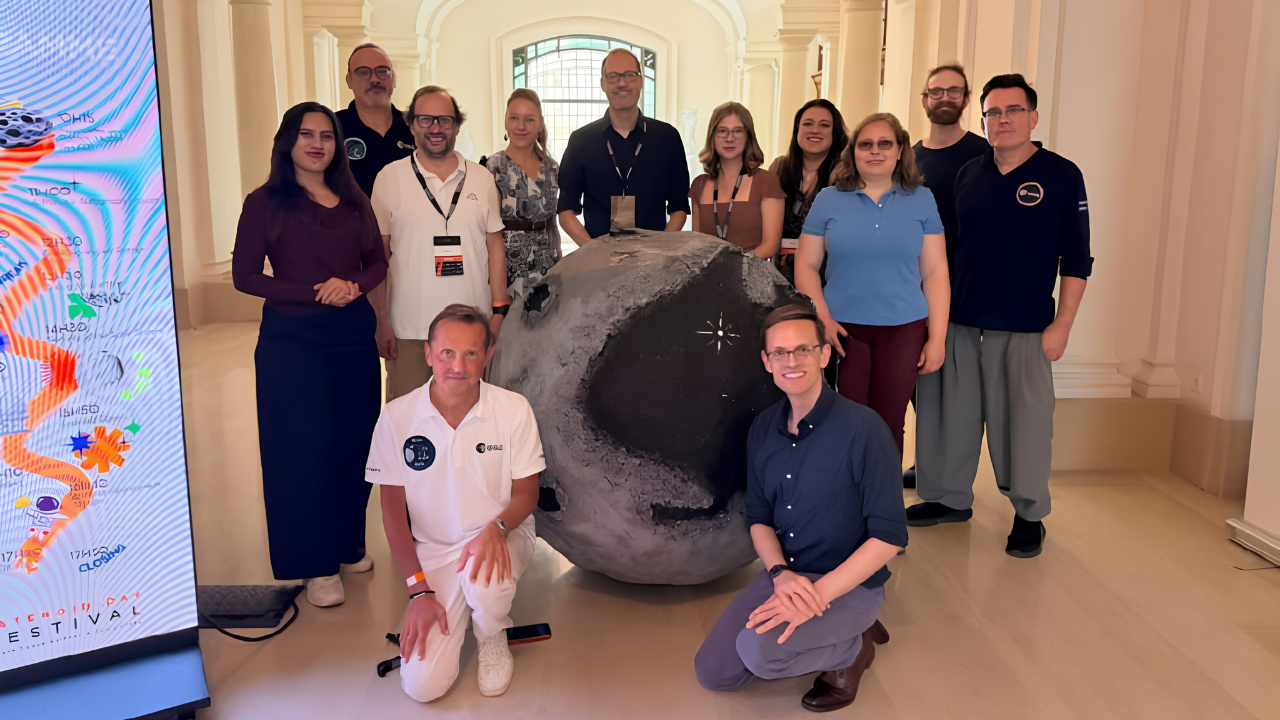
A group of more than 70 professionals from scientific institutions, space agencies, and educational entities presented on Tuesday (30) the Asteroids2029, a global project aimed at expanding public understanding of asteroids and planet protection strategies. The mobilization will have as its central moment the passage of the asteroid (99942) Apophis, which will approach Earth on April 13, 2029, without posing a collision risk.
The celestial body will cross the planet’s vicinity at a distance less than the orbit of some satellites. The approach will be sufficient for Apophis to be observed without equipment by billions of people during the night, turning the phenomenon into an unusual opportunity to bring the population closer to astronomy.
The announcement took place during Asteroid Day and is part of the actions related to the International Year of Asteroid Awareness and Planetary Defense, declared by the United Nations General Assembly.
-
Cut Plastic Bottles Become Electricity-Free Air Conditioners in Bangladesh, Cooling Metal Homes During Extreme Heat

-
Brazil’s Santa Catarina Dumps 800,000 Tons of Sand in $53 Million Coastal Project, But Seawater Returns in Less Than Two Months

-
Japanese Manufacturer Dominates Global Bicycle Gear and Brake Market, Supplying 70% of Mid to High-End Bikes, Including Tour de France Winners

-
German Startup Raises €8 Million to Build Robot for 24/7 Harvesting of Tomatoes, Cucumbers, and Peppers Without Human Labor




Asteroid can be seen without a telescope
Apophis is expected to provide one of the most remarkable astronomical events of the coming years. Instead of remaining visible only to observatories and specialized equipment, the asteroid can be directly observed in the sky by a significant portion of the world’s population.
The proximity, however, should not be interpreted as a sign of emergency. According to the statement released by Asteroids2029, the object poses no danger to Earth during the passage scheduled for April 2029.
The encounter will be used as a great scientific outreach experience. The intention is to explain how asteroids move, how they are monitored, and what technologies already exist to assess possible future threats.

Asteroids2029 brings together science, education, and communication
The new initiative adopts the motto “Observe. Explore. Protect.” and aims to connect different sectors involved in space studies. Governments, researchers, educators, communicators, and space institutions will participate in actions focused on both knowledge production and public awareness.
The program also seeks to show that asteroids have two important aspects. They are valuable sources of information about the Solar System, but some of them also need to be monitored due to the possibility of dangerous approaches.
Among the initiatives announced by Asteroids2029 are:
- creation of national centers to coordinate activities in different countries;
- development of long-term scientific projects;
- organization of international debates on planetary safety;
- production of communication campaigns for the public;
- development of educational programs;
- citizen participation in asteroid observations.
Planetary defense attempts to anticipate space risks
Planetary defense encompasses the necessary work to locate and track objects passing close to Earth.
This effort includes the discovery of asteroids and comets, calculating their trajectories, studying their characteristics, and developing strategies to prevent a collision if a real risk is identified.
Astronomy and engineering are part of this process, but no institution or country can perform all the work in isolation. Data exchange and coordination between different nations are fundamental elements for tracking objects moving through space.
The initiative highlights planetary defense as a field where a natural risk can be recognized many years in advance. This interval would allow the study of the object and the evaluation of possible measures before a dangerous approach.
Brian May participates in the launch of the mobilization
Queen guitarist Sir Brian May, who is also a co-founder of Asteroid Day, participated in the project’s presentation. For May, the approach of Apophis offers an opportunity to spark the interest of people who do not usually follow space research.
The musician and science communicator emphasized that the 2029 observation can help the public understand that planet protection depends on knowledge and cooperation. “The powerful message of Asteroids2029 is that we all share the same Earth and the same Sky,” stated Sir Brian May.
According to him, the encounter with the asteroid could stimulate people from various countries to value science and understand why planetary defense is important for the future of life on Earth.
Safe passage will serve as a scientific exercise
Although Apophis poses no threat, its approach will allow tracking a large space object under unusual conditions. Scientists will be able to use the event to expand observations, test tracking methods, and provide information to the public in real-time.
The passage also creates a favorable situation to explain how specialists calculate orbits and rule out impact risks. Thus, Asteroids2029 aims to replace the fear often associated with asteroids with a vision based on research, preparation, and knowledge.
The phenomenon will be treated as a demonstration that continuous monitoring allows distinguishing a safe approach from a situation that would require attention.
Citizens will be able to participate in the observations
The project will not be restricted to professional scientists and space agencies.
One of the proposals is to create opportunities for ordinary people to participate in asteroid observation. The activities could bring students, teachers, and astronomy enthusiasts closer to the work carried out by specialized institutions.
Public participation could also help expand the reach of educational campaigns planned until 2029. By placing billions of people before the same event in the sky, the passage of Apophis offers an opportunity to transform an astronomical event into a collective learning experience.
Site will gather information and activities until 2029
As part of the launch, Asteroids2029 presented an official platform that will function as the central point of the initiative. The space will gather content about planetary defense, asteroids, scientific events, and activities planned for the coming years.
The proposal is to keep governments, educators, researchers, communicators, and citizens connected to the actions developed until the passage of Apophis. The site should also support national hubs and facilitate access to observation projects and educational materials.
Apophis turns approach into global opportunity
The event of April 13, 2029, will have significance far beyond observing a bright spot in the sky.
The safe passage of the asteroid will allow the public to be presented with the ongoing work to protect the planet, as well as encourage scientific education on an international scale.
With the support of dozens of experts and institutions, Asteroids2029 aims to use the coming years to expand the dialogue on space monitoring and preparation against possible impacts.
With information from Olhar Digital