Portuguese
  Spanish


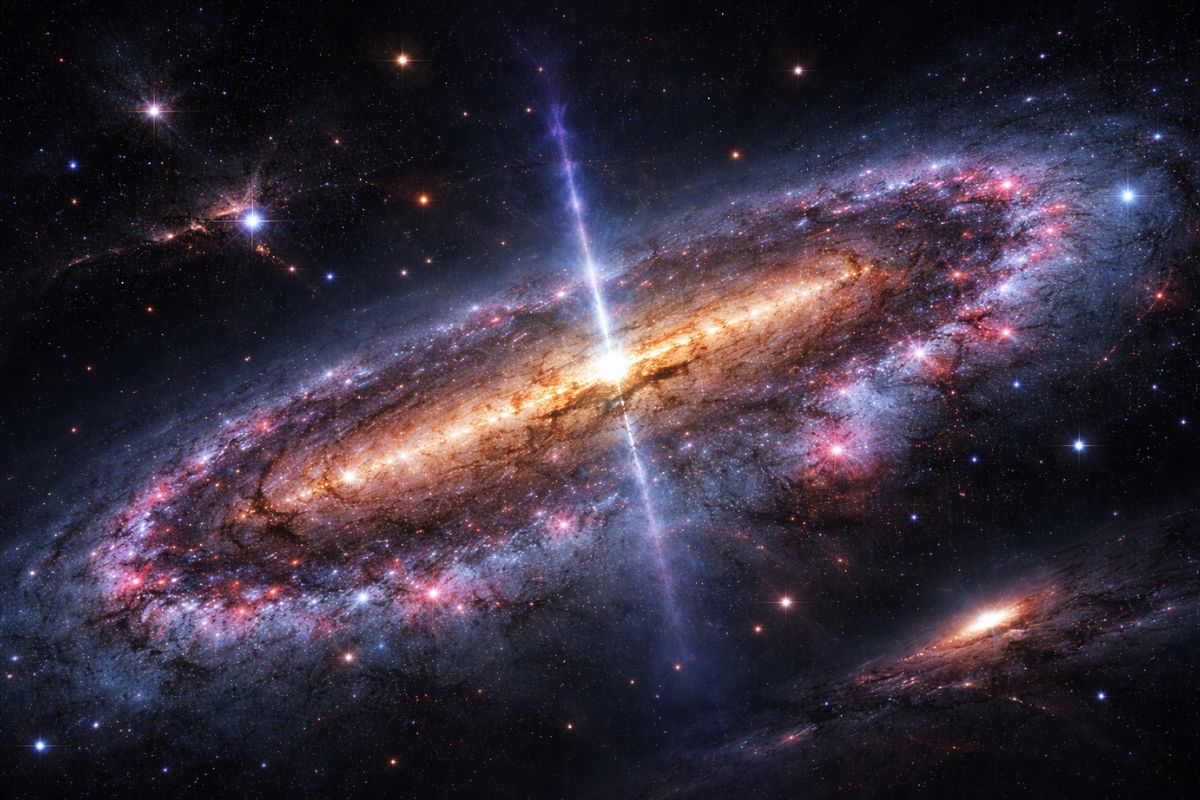


COSMOS-74706, Seen as Existing About 11.5 Billion Years Ago, Displays a Stellar Bar That Channels Gas and May Influence Black Holes and Star Formation. The Discovery Led by Daniel Ivanov Is the Largest Redshift Without a Lens Confirmed Spectroscopically with Data from James Webb.
A barred galaxy surprisingly mature was already forming when the Universe was only 2 billion years old, and this changes the way we view how certain internal structures can organize so early. The target, named COSMOS-74706, appears to be a strong candidate for one of the oldest barred spirals ever identified with this level of observational certainty.
The team led by Daniel Ivanov, a graduate student in physics and astronomy at the Kenneth P. Dietrich School of Arts and Sciences at the University of Pittsburgh, presented the result at the 247th meeting of the American Astronomical Society. The focal point is not just to “see” a beautiful shape, but to measure distance and time with confidence to slot the galaxy into the timeline of the Universe.
A Barred Galaxy When the Universe Was Still Young
Calling COSMOS-74706 “old” is not a figure of speech: it appears to have existed about 11.5 billion years ago, a span that places its light coming from a very early phase of cosmic history.
-
Humanoid Robots Begin Replacing Workers in Repetitive Roles as Companies Accelerate Industrial Automation

-
Humanoid Robots Begin Replacing Factory Workers in China, Working 64-Hour Shifts and Driving Industrial Automation Forward

-
Miniature Nuclear Reactor to Be Installed in South Wales, Powering 20,000 Homes and Reviving UK’s Nuclear Industry After Nearly 50 Years
-
San Andreas Fault Reaches “Highest Tension in 1,000 Years,” Raising Fears of the “Big One,” but New Study Identifies Key Zone Near Los Angeles Influencing Earthquake Impact





In other words, when it is said that this galaxy was developing bars 2 billion years after the Big Bang, it is referring to a period when many internal structures were still considered unlikely, or at least rare.
This rarity is part of the impact: finding a barred spiral at this time does not mean that “all were like this,” but suggests that some evolutionary paths may have been faster than previously thought.
And when such an object is precisely placed on the Universe’s chronology, it becomes a kind of “milestone” to test hypotheses about when stellar bars began to appear.
What Is a Stellar Bar and Why Does It Change the Fate of a Galaxy
A stellar bar is a straight, elongated structure that extends through the central region of a spiral galaxy. It is not a “unique object”: it is a dense alignment of stars and gas that, seen from above or below the disk, creates the appearance of a bright line cutting through the center.
The important detail is functional, not just visual. Stellar bars can channel gas from the outer regions inward, changing the rate of growth and transformation of the galaxy over time.
This internal flow can feed the supermassive black hole at the core and, at the same time, reduce star formation in parts of the surrounding disk—a type of internal reconfiguration that helps explain why two galaxies that appear “similar” on the outside may follow very different stories “on the inside.”
How the Light from COSMOS-74706 Was Used to Place the Galaxy in Cosmic History
To assert that a galaxy existed at a specific time, it is not enough to have an image that looks “old”: it is necessary to connect the observed light to a distance and, consequently, to a moment in the Universe.
It was this temporal alignment that allowed researchers to state that COSMOS-74706 was already developing bars 2 billion years after the birth of the Universe.
Ivanov highlighted this directly by commenting that the galaxy was developing bars “2 billion years after the Big Bang.”
This phrase, in itself, serves as a physical constraint: if the bar already exists that early, then the processes that organize stars and gas in the center can start and consolidate earlier than many scenarios assumed as “normal.”
Why Confirmation by Spectroscopy Changes the Weight of the Discovery
Other teams had already reported possible barred galaxies even further away, but there was a recurring problem: less precise redshift measurements.
The difference here lies in the type of confirmation. COSMOS-74706 was confirmed by spectroscopy, a method that provides more reliable distance data than less direct estimates.
Furthermore, there is a “shortcut” that sometimes complicates interpretation: gravitational lensing. In some previous cases, the light from the galaxy was distorted by a close pass by a massive object, which can amplify and deform the image.
COSMOS-74706 stands out as a barred spiral galaxy without gravitational lensing with the highest redshift, confirmed spectroscopically, according to the summary description by Ivanov, meaning that the observed shape has less chance of being a “mirror effect” of the light’s pathway to the telescopes.
What This Suggests About When Bars Began to Appear and Why They May Be Rare
Even with the impact, the discovery did not come as “impossible” for those following theoretical models. Computational simulations suggest that stellar bars may have begun to form around redshift 5, or approximately 12.5 billion years ago.
What COSMOS-74706 does is provide firmer observational evidence to calibrate these time scales.
Still, Ivanov himself noted that not many objects of this type are expected to be found in that phase of cosmic history. This point is crucial: when something is predicted as possible, but rare, each well-confirmed example weighs more than “just another detection.”
It helps narrow the range in which bars become viable and discuss what conditions of gas, internal dynamics, and star formation allow a galaxy to organize a bar so early.
The Role of James Webb and the Path of Data to Analysis
The research relied on observations from the James Webb Space Telescope, a project associated with NASA/ESA/CSA. The data were obtained through the Space Telescope Science Institute, operated by the Association of Universities for Research in Astronomy, Inc., under NASA contract NAS 5-03127, with support from NASA itself.
This “ecosystem” of observation, operation, and processing is part of the reason why such delicate results can be discussed with greater confidence.
The study also received support from the Brinson Foundation, and this helps remind us that such discoveries do not arise from a single click of the telescope.
They depend on observation time, infrastructure, teams that master techniques such as spectroscopy, and, most importantly, a well-framed scientific question: at what moment in the history of the Universe did stellar bars really begin to appear measurably in a galaxy?
COSMOS-74706 places a concrete piece in an ancient puzzle: how does a galaxy manage to build a stellar bar when the Universe was still relatively young, only 2 billion years after the Big Bang?
With confirmation by spectroscopy and without relying on gravitational lensing, the discovery reinforces that certain internal structures may form early but probably not commonly, and therefore become references to test simulations and expectations about the onset of barred spiral galaxies.
If you could “travel back in time” and observe the sky from that period of the Universe, would you expect to see more galaxies already organized into spiral bars, or do you imagine that this would be a rare exception?
And, looking at the Milky Way itself with its central bar, which scenario seems more convincing to you: bars emerging early in a few special cases, or taking longer, but appearing widely later?