Portuguese
  Spanish


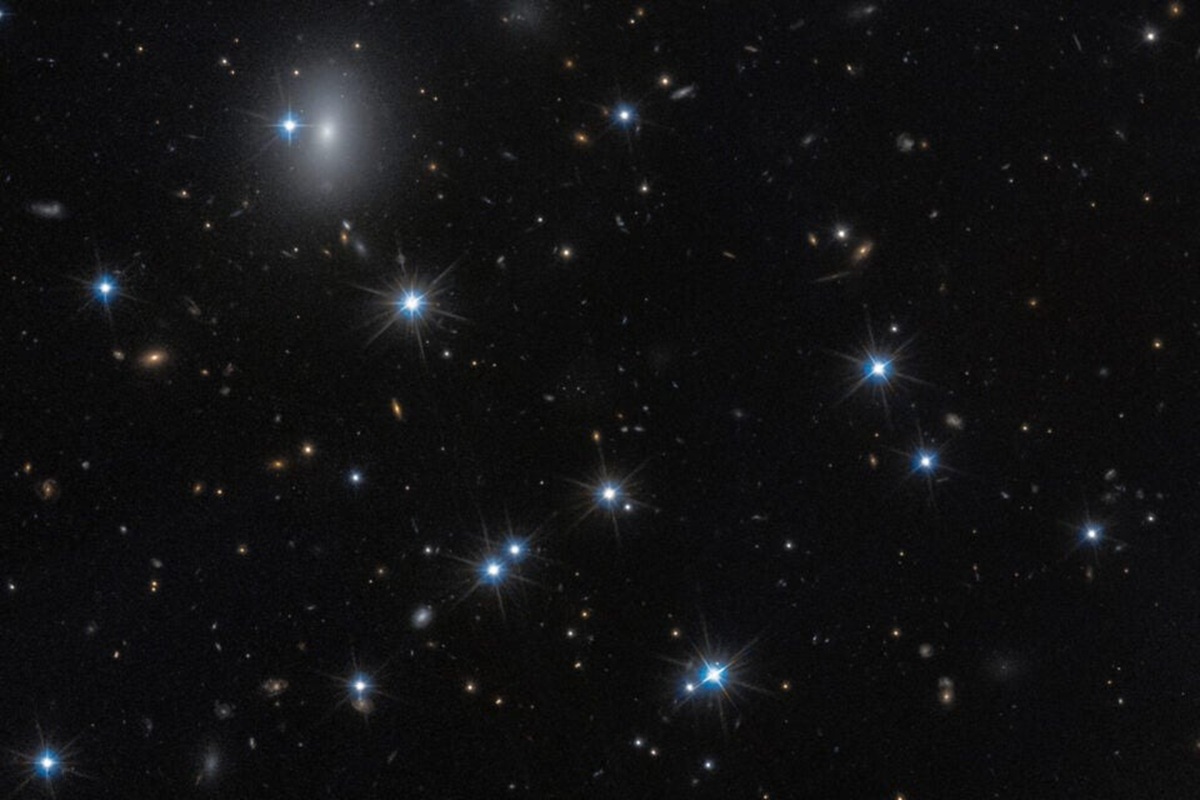


The Galaxy CDG-2, Located in the Perseus Cluster, Is Composed of 99% Dark Matter and Has a Very Low Surface Brightness, Offering New Insights into the Mysteries of the Cosmos
The Galaxy CDG-2, discovered in the Perseus Cluster, has 99% dark matter and low surface brightness. This discovery may shed new light on the properties and mysteries of dark matter in the universe.
The Invisible Galaxy: 99% Dark Matter
The Galaxy CDG-2, identified in the Perseus Cluster, is composed of 99% dark matter and is almost invisible, with an extremely low surface brightness.
Although dark matter does not directly interact with light, its presence is inferred by the gravitational influence it exerts on other objects.
-
Humanoid Robots Begin Replacing Workers in Repetitive Roles as Companies Accelerate Industrial Automation

-
Humanoid Robots Begin Replacing Factory Workers in China, Working 64-Hour Shifts and Driving Industrial Automation Forward

-
Miniature Nuclear Reactor to Be Installed in South Wales, Powering 20,000 Homes and Reviving UK’s Nuclear Industry After Nearly 50 Years
-
San Andreas Fault Reaches “Highest Tension in 1,000 Years,” Raising Fears of the “Big One,” but New Study Identifies Key Zone Near Los Angeles Influencing Earthquake Impact





Scientists believe that this galaxy is one of the richest in dark matter ever discovered. This research is important because dark matter makes up 85% of the universe’s mass and may be crucial for understanding various cosmic mysteries.
What Is Dark Matter?
Dark matter is a mysterious substance that neither emits, reflects, nor absorbs light, making it invisible to conventional telescopes. However, it has a significant impact on how galaxies move and interact gravitationally.
Without the presence of dark matter, the models used to understand the movement of galaxies would not hold validity.
Although scientists have yet to directly detect dark matter, it remains the consensus among astronomers, due to the indirect evidence supporting its existence.
CDG-2: A Galaxy with Globular Clusters
The Galaxy CDG-2 is located in the Perseus Cluster, a region of the universe known for its rich population of globular clusters. These clusters are dense units of millions of stars. The discovery of CDG-2 was made possible through the analysis of various observations conducted by the Hubble Telescope, ESA’s Euclid, and the Subaru Telescope. Through these observations, astronomers noticed a faint glow and began to suspect that the region was, in fact, a dark galaxy. This hypothesis was confirmed after a detailed statistical analysis revealed that the four globular clusters found are part of a single galaxy.
The Peculiarity of CDG-2
CDG-2 has a luminosity equivalent to about 6 million stars like the Sun, with 16% of this luminosity originating from the globular clusters. However, in terms of mass, 99% of the galaxy is composed of dark matter. This discovery reinforces the hypothesis that the galaxy has lost a significant portion of its “normal” matter, such as hydrogen gas, due to interactions with other galaxies in the Perseus Cluster. Even with this peculiarity, CDG-2 represents an excellent opportunity to study star formation and test theories about the evolution of galaxies and clusters.
Implications of the Discovery
The detection of CDG-2 is significant because it marks the first time a galaxy has been identified solely through its population of globular clusters.
This discovery may help resolve fundamental questions about galaxy formation and the presence of dark matter.
If the theory about dark matter is confirmed, it could provide answers to many questions that astronomers have had for decades.
The Galaxy CDG-2 is not only a fascinating discovery but also a key to understanding the mysteries of the universe, such as the role of dark matter and its relationship with star and galaxy formation. Research on dark galaxies continues to expand and may lead to significant advances in physics and cosmology.