Portuguese
  Spanish


Experiment in the Amazon simulates an atmosphere with more CO₂ to observe reactions of the forest in real scale, while scientists seek data on carbon, water, soil, and climate before COP30.
Scientists have installed a structure in the Amazon to test how the forest may react to an atmosphere with more carbon dioxide, a condition predicted in climate scenarios for the coming decades.
The experiment, called AmazonFACE, exposes adult trees to elevated concentrations of CO₂ to observe, in an open environment, changes in carbon absorption, water loss through leaves, plant growth, and soil functioning.
The research takes place in a mature forest area near Manaus, in Amazonas, and seeks to answer a central question for climate science: how does a large tropical forest behave when it begins to receive, in a controlled manner, a greater amount of CO₂ in the air?
-
Teen Inventors Win $50,000 for Pen-Sized Device Using Ultrasound to Remove 94% of Microplastics from Water

-
Ultra-Black Car Paint Absorbs 99.9% of Light, Making Vehicles Look Like “Black Holes” on Wheels

-
Ancient Maya City Discovered in Remote Mexican Area with 12-Meter Pyramid, Palaces, Canals, and 14 Preserved Monuments
-
Indigenous 8-Year-Old Girl Wins National Science Award for Solar-Powered Water Heater Invention Using Recycled Materials


The discussion is also related to the COP30, the UN climate conference held in Belém, Pará.
According to UN Brazil, the conference addressed topics related to adaptation, climate financing, mitigation, technology, capacity building, transparency, and global balance, in an edition held in the Amazon and accompanied by debates on the behavior of the forest in scenarios of global warming and changes in atmospheric composition.
AmazonFACE simulates future atmosphere in the Amazon forest
In AmazonFACE, six large metal rings have been erected above and around the vegetation.
Each structure encompasses dozens of adult trees and allows for the comparison of two scenarios within the same forest area: in part of the rings, the CO₂ concentration will be elevated; in the others, the environment will remain exposed to natural conditions, serving as a reference for researchers.
The structure is located about 80 kilometers from Manaus and consists of six rings of 30 meters in diameter, made up of metal towers 35 meters high.

According to information released by the federal government, the proposal is to simulate a 50% increase in carbon dioxide concentration compared to current levels, using FACE technology, which stands for Free-Air CO₂ Enrichment.
This technology allows the forest to remain in its own environment, without being transferred to a laboratory.
In this way, trees, roots, vines, microorganisms, soil, water, and light continue to interact under natural conditions, while sensors and field measurements monitor the ecosystem’s responses to the increase in gas.
“We are trying to create the atmosphere of the future,” said Carlos Quesada, a researcher affiliated with the National Institute for Amazon Research, explaining the goal of the experiment.
The project is conducted by teams from Inpa and State University of Campinas, with support from the Brazilian government and cooperation from the United Kingdom.
What scientists are investigating about CO₂ and the Amazon
The research measures whether the increase in CO₂ interferes with plant growth, carbon absorption, leaf transpiration, and soil dynamics.
In studies on photosynthesis, carbon dioxide is one of the elements used by plants to produce energy; however, according to researchers from AmazonFACE, the response of a tropical forest also depends on temperature, rainfall, water availability, nutrients, and characteristics of each species.
In the Amazon, one of the questions being investigated involves the availability of nutrients in the soil, especially in areas where elements like phosphorus may limit plant growth.
For this reason, the study does not focus solely on the tree canopies.
The teams also analyze leaves, trunks, roots, fungi, microorganisms, and cycles of water and nutrients.
Sensors installed in the area record environmental variations at frequent intervals and monitor the vegetation’s response to rain, sun, storms, and changes in humidity.
According to Reuters, the equipment records the forest’s response every 10 minutes, including how foliage absorbs carbon dioxide and releases oxygen and water vapor under different weather conditions.
The CO₂ air enrichment stage will allow for the comparison of similar areas under different atmospheres.
With this methodology, scientists aim to produce field data for climate models that currently still have uncertainties about the reaction of tropical forests to increased concentrations of greenhouse gases.
Unprecedented experiment in mature tropical forest
Experiments with CO₂ enrichment have already been carried out in other countries and on other types of vegetation.
In the case of AmazonFACE, the differential highlighted by those responsible for the project is the chosen environment: a mature tropical forest, with adult trees and complex ecological interactions.
According to institutional material from the federal government, it is the first time that this technology will be applied in a tropical forest.
Forest engineer Gustavo Carvalho defined the study as “the first experiment in a natural forest of this size in the tropics.”
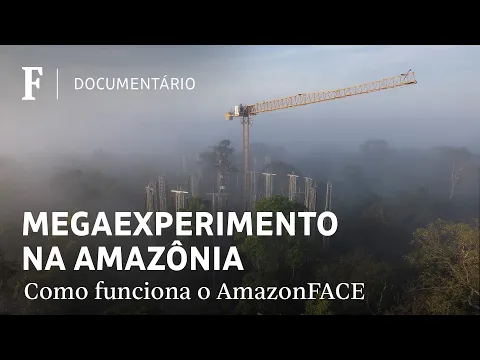

The observation refers to the scale of the installation and the fact that the experiment takes place in an area of standing forest, without isolating trees in a laboratory or restricting the analysis to seedlings.
For researchers, the scale of the experiment is relevant because the Amazon does not depend solely on the individual behavior of each tree.
The functioning of the biome involves interactions between vegetation, atmosphere, soil, water, biodiversity, and regional climate, factors that can influence the forest’s ability to store carbon and regulate humidity.
In addition to carbon, the project monitors the water cycle, biodiversity, nutrients, and aspects related to forest populations and food security.
The second phase of AmazonFACE, planned for the period of 2025 to 2030, was presented in project documents as the implementation and operation stage of the experiment in a mature forest.
COP30 in Belém broadens attention on climate and the Amazon
The holding of COP30 in Belém placed the Amazon at the center of the international climate agenda.
In the scientific field, AmazonFACE contributes to a specific discussion: what field data can reduce uncertainties about the forest’s response to an environment with more CO₂, higher temperatures, and greater climate variability?
According to climate scientists, the preservation of tropical forests is associated with the ability to store carbon and influence rainfall regimes.
Even so, the continuation of this role depends on factors such as reduced deforestation, control of wildfires, rainfall stability, and the physiological limits of species in the face of environmental changes.
AmazonFACE has an experimental purpose and does not replace public conservation policies.
Its function is to produce real-scale measurements to feed climate models, guide research, and broaden understanding of forest behavior under atmospheric conditions different from current ones.
In practice, the metallic rings installed in the forest allow for observing a portion of the Amazon under the air predicted by future climate scenarios.