






 Portuguese
  Spanish


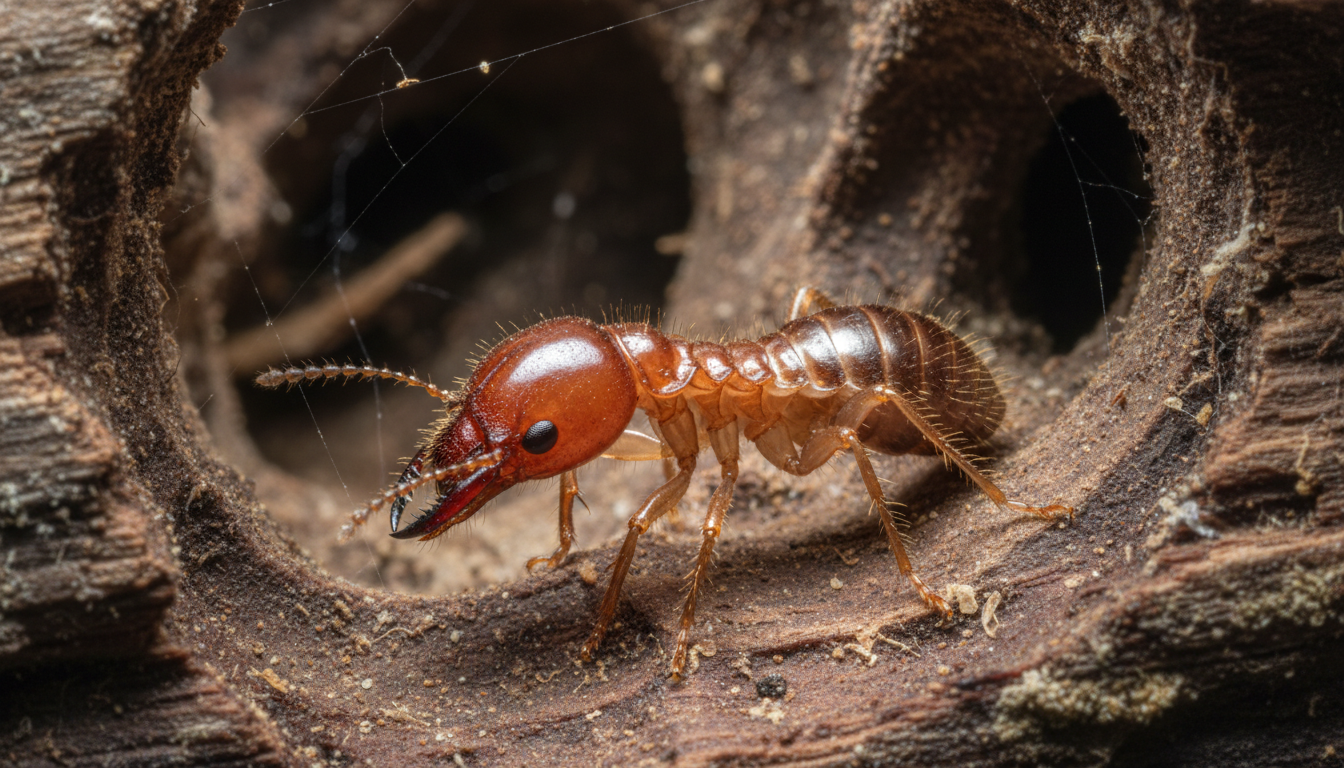

At the top of trees in South America, scientists found a termite so strange that its head looks like a miniature sperm whale — and it was named Moby Dick
Of the thousands of insect species that live in the canopies of tropical forests, one has just received a name that no entomologist expected to give. The Cryptotermes mobydicki is a soldier termite whose robust and elongated head resembles a miniature sperm whale.
According to a report from R7, the new species was described in a study published in the scientific journal ZooKeys on April 5, 2026.
The name is not a coincidence. The visual similarity between the insect’s head and the profile of a sperm whale is so strong that researchers turned to the classic work of Herman Melville to name it.
-
Viking Textile Factory Unearthed in Denmark Reveals Ancient International Trade Links

-
Bruno Guimarães, 28, Misses Crucial Penalty Against Norway in World Cup After Replacing Vinicius Jr.

-
Pennsylvania Mine Creates Ice in Summer Heat and Melts in Winter, Turning a Mountain Crevice into a Reverse Natural Refrigerator
-
China Accelerates Global Expansion of Robotics: From Smart Vacuums to Industrial and Humanoid Machines, Millions Exported to Over 150 Markets




However, the surprise goes beyond appearance. The whale termite exemplifies a rare phenomenon called evolutionary convergence — when species that have no relation develop similar forms independently.

The head that blocks invaders: why a termite needs to look like a whale
The function of the elongated head is not aesthetic. The Cryptotermes mobydicki is a soldier termite — its mission is to defend the colony.
The robust head acts as a physical barrier. The soldier positions itself at the entrance of the wooden galleries and literally plugs the hole with its own head, preventing the entry of predators like ants.
The jaws are reduced and barely visible, creating the smooth and rounded silhouette that resembles the profile of a sperm whale. Sensory structures arranged similarly reinforce the resemblance.
In this way, an insect just a few millimeters long and a whale 18 meters long have arrived at similar forms through completely different evolutionary paths — each solving distinct problems in opposite environments.
Life in the heights: the whale termite only exists in the canopies of tropical forests
The Cryptotermes mobydicki lives exclusively in dead wood in the canopies of South American tropical trees. It is not found in the soil or in human structures.
Therefore, unlike urban termites that destroy furniture and houses, this termite contributes to the decomposition cycle and nutrient recycling in the forest ecosystem.
The genus Cryptotermes includes insects specialized in dry wood, with distribution connected to the Caribbean and northern South America. Of the approximately 3,000 termite species known globally, the whale termite expands the documented diversity of this group in the region.
Recent discoveries in Brazil, such as the new species of rhinoceros with a parrot-like beak, reinforce that South American biodiversity still hides unimaginable surprises.

The pattern of recent discoveries: surprising insects emerge from Brazilian forests
The whale termite is not an isolated case. In recent years, scientific exploration of South American tropical forests has revealed increasingly surprising insects.
In 2016, the Trichadenotecnum ufla — an insect only 2 mm long with a white head — was discovered on the campus of the Federal University of Lavras in Minas Gerais, 3,400 km from its known distribution.
In March 2026, the Hydrometra perobas — a semi-aquatic bug that walks on water — was identified in the Biological Reserve of Perobas in Paraná.
These findings indicate that the canopy of tropical trees remains undersampled. Possibly thousands of species await scientific description.
In the more visible fauna, rare species like the colobus monkey, whose infant is born white and turns black, show that nature continues to defy expectations.
Limitations: little information available and resemblance may be exaggerated
On the other hand, information about the Cryptotermes mobydicki is still limited. There are no exact size measurements (in mm), detailed public photos, or data about the authors and collection methods in the original ZooKeys article.
The resemblance to a whale is visual and anatomical, but does not imply a direct evolutionary relationship. There may be some journalistic exaggeration to attract attention to an entomological discovery.
The species does not pose a risk to human structures — it lives exclusively in dead wood in natural environments.
Still, each new species described in the canopies of tropical forests is a reminder that we know only a fraction of the life that inhabits this ecosystem. The termite that looks like a whale may be strange — but it is nature saying that its solutions are infinite.





