Portuguese
  Spanish




Aurora’s autonomous trucks already operate without drivers in Texas and reignite debate on automation, logistics, and the future of truck drivers.
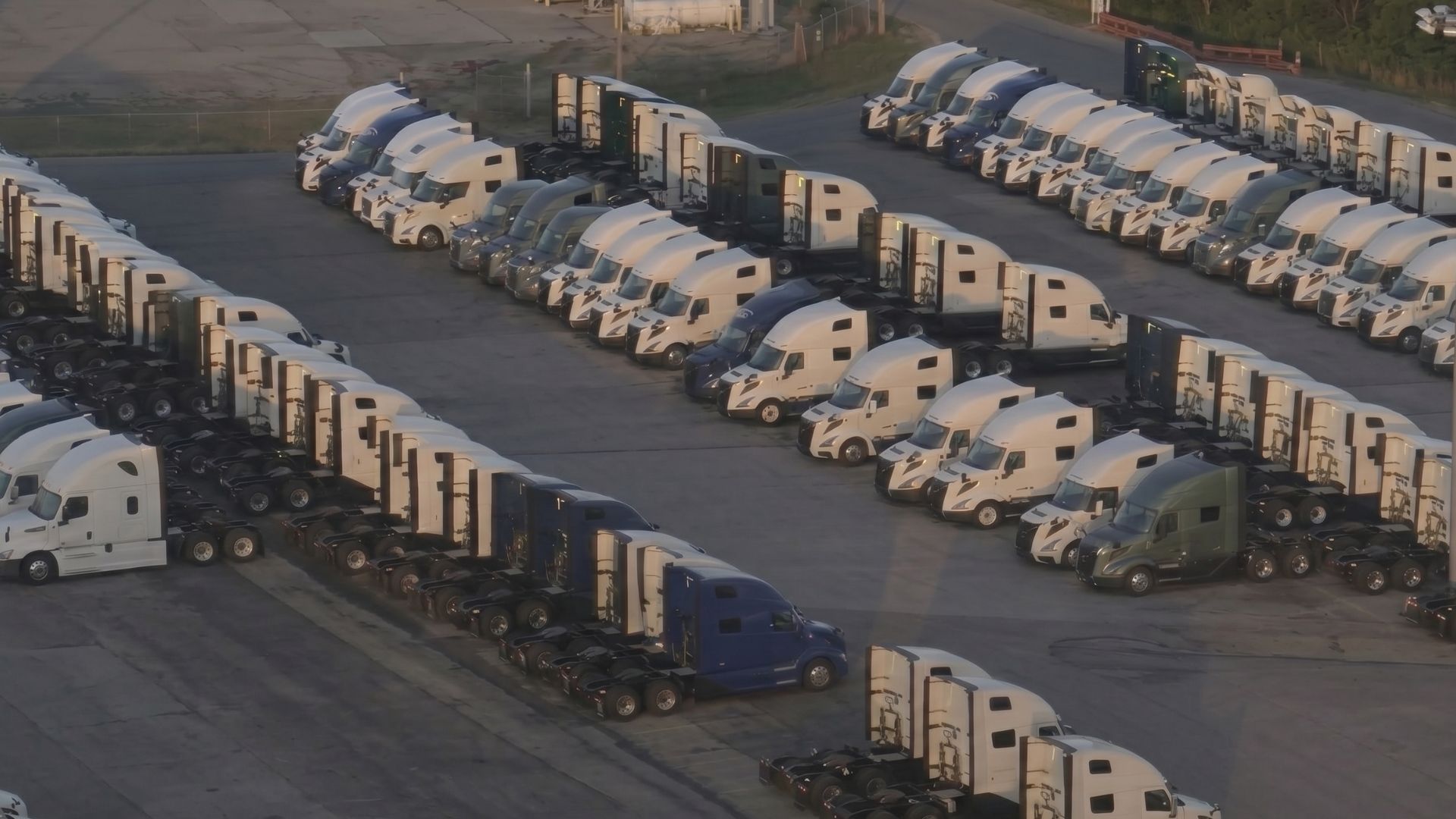
Autonomous trucks are no longer a distant promise in the United States. Aurora Innovation began commercial operations in 2025 with Class 8 trucks without a safety driver in the cabin, transporting real cargo between Dallas and Houston, Texas, in one of the country’s most important logistics corridors. The company claims to have launched the first commercial Class 8 autonomous truck service in the United States, using the Aurora Driver system for paid deliveries. The model is concerning because it is not limited to selling trucks: Aurora wants to operate transportation as a service, charging per mile traveled.
Aurora deployed Class 8 trucks without drivers to transport real cargo between Dallas and Houston
The operation officially began in May 2025, after the company announced regular commercial deliveries without a human driver on the route between Dallas and Houston. The service uses heavy trucks equipped with sensors, cameras, radar, lidar, and Level 4 autonomous driving software.


In practice, this means that the truck can operate on its own within specific conditions and routes, without requiring a person to hold the steering wheel as a supervisor. Aurora reported that it started the service with clients like Uber Freight and Hirschbach Motor Lines.
-
NASA Rover Captures “Tired Face” on Mars, Highlighting Human Brain’s Tendency to See Faces in Rock Formations

-
Ancient Stone City in the Desert, Once Home to 30,000, Puzzles Scientists with Nabateans’ Water Mastery 2,000 Years Ago

-
Ancient Creature Thought Extinct Since Dinosaur Era Reappears, Baffling Scientists
-
India Deploys Giant Fabric Tubes Filled with Sand to Combat Coastal Erosion and Rebuild Disappearing Beaches





The Texas corridor is strategic because it involves long distances, a large flow of cargo, and highways favorable for automation. For the logistics sector, this type of route is exactly where technology can have the greatest economic impact.
The business model does not sell the truck, it sells the trip per mile traveled
The most sensitive point of the operation is not just the technology, but the business model. Aurora’s documents show that the company operates with the logic of “autonomous freight as a service,” charging a fee per mile traveled.
This changes the traditional transportation relationship. Instead of a carrier simply buying the truck and hiring drivers, it can hire an autonomous operation managed by software, fleet, maintenance, remote support, and usage-based billing.
This model resembles digital platforms because it transforms travel into a scalable service. For truck drivers, the warning is clear: if automation reduces cost per mile and increases operating hours, the pressure on human labor may quickly increase.
Autonomous trucks can run more hours than human drivers and change the transportation equation
Truck drivers need to work shifts, rest, sleep, and respect physical and legal limits. An autonomous system, when approved to operate, can keep the truck running for much longer periods, depending on maintenance, refueling, and logistical planning.

This difference hits the economic heart of road transport. The more hours a truck is in motion, the greater the vehicle’s utilization and the lower the proportional cost per trip. This is exactly where automation shifts from a technological curiosity to a structural threat to the labor market.
Aurora has already signaled expansion plans for new routes in the so-called American Sun Belt, including corridors in Texas, Arizona, and other regions. If the scale grows, the impact could cease to be local and become a national change in freight transport.
The technology still has limits, but it has already moved beyond the demonstration phase
Aurora’s operation does not mean that all trucks in the United States will suddenly be driverless. The system operates within defined routes and conditions, with specific operational domain and technical monitoring.
Even so, the advancement is significant because it left the testing phase with a safety driver and entered the commercial phase without a person in the cabin. This leap is what makes the case a milestone for the industry.
The company has also released safety reports and has been trying to show that the technology can handle real road traffic. There are still regulatory debates, union concerns, and questions about data transparency, but commercial operation has already begun.
Texas has become the showcase for the race for driverless trucks
Texas has become one of the main laboratories for autonomous trucks because it combines extensive highways, a large volume of cargo, relatively favorable weather, and a regulatory environment more open to innovation.
Companies in the sector see the state as a starting point to prove that the technology works on a commercial scale. The route between Dallas and Houston has become a symbol of this new phase because it combines significant distance, real logistical demand, and adequate infrastructure.

If the experiment progresses with safety and competitive cost, other highway corridors may follow the same path. This is the point that makes the issue so concerning: the model does not need to dominate all roads to start affecting human work.
The revolution of autonomous vehicles may start with trucks before passenger cars
For years, the public debate on autonomous vehicles has focused on driverless taxis and private cars. But freight transport may be the field where automation advances faster.
Highways are more predictable environments than urban centers. Logistic routes are repetitive. Companies calculate cost per mile with precision. And any cost reduction can generate an immediate competitive advantage.
That’s why the case of Aurora in Texas is not just a technological curiosity. It’s a sign that automation may first hit a historic, essential, and numerous profession, even before autonomous cars become common in cities.
The direct question remains: if driverless trucks start running cheaper, for more hours, and on increasingly larger routes, how much longer will truck drivers remain indispensable on long roads?