






 5 min of reading
  0 comments


Danielle left traditional housing behind after college, renovated a minibus for three and a half years, and started living on wheels to reduce fixed costs, gain mobility, and escape the monthly pressure of rent
Danielle’s decision, a 26-year-old living in the United States, began with a common concern among many recent graduates, moving out without being tied to high rent. After graduating in May 2021, she was still living with her mother and decided to look for a more flexible alternative.
Danielle bought a school minibus in September 2021 and began a renovation that lasted three and a half years. The project was completed in March 2025, when she started living in the vehicle adapted as a home.
The transformation cost between US$ 25,000 and US$ 35,000, including the price of the bus. More than an aesthetic choice, the project was born as an attempt to escape the fixed cost of traditional housing and fulfill an old dream of living nomadically.
-
Survivor of 1966 SS Daniel J. Morrell Shipwreck in Lake Huron Recounts 38-Hour Ordeal in Extreme Cold

-
The Greatest Hoax in World Cup History? The Film That Denied Brazil’s 1958 Victory and Exposed How Fake Evidence Can Seem Convincing on TV
-
Fake South Korean Online Stores Offer Shopping Thrill Without Spending Money or Receiving Products
-
The War of Jenkins’ Ear: How a Severed Ear Sparked One of the 18th Century’s Most Unusual Conflicts


The story draws attention because it mixes economy, adventure, and a radical change of routine. But it also shows that life in a converted bus requires planning, constant maintenance, and a willingness to deal with tasks that a regular house usually hides.
The choice for the short bus was not by chance
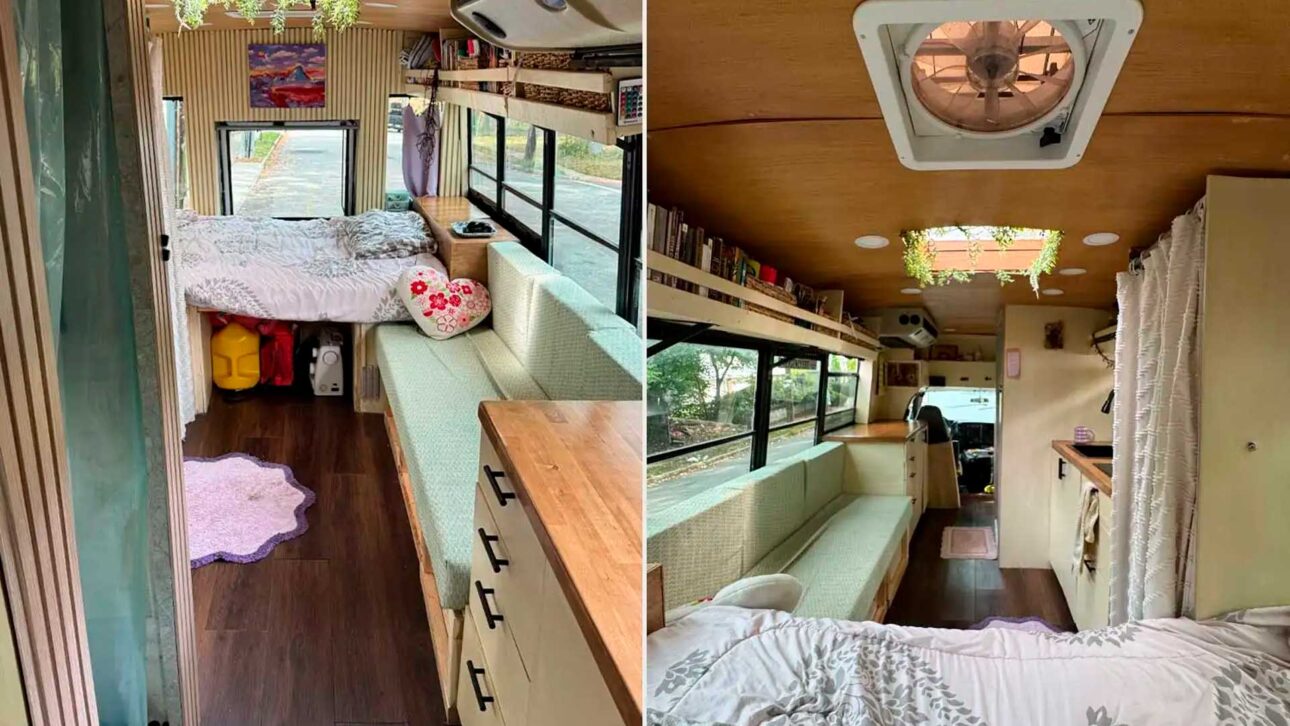
Danielle didn’t want just any vehicle. She was looking for a smaller school bus, with less than 200,000 miles and a flat roof, because this would facilitate the internal construction and make driving less complicated.
The reduced size would also help control the budget. Instead of opting for a large, more expensive, and difficult-to-renovate bus, she chose a short model, with enough space to live in, but still viable for driving and parking during trips.
The choice was also related to comfort. For Danielle, a bus offered more freedom of customization than a van and more space than many vehicles adapted for travel.
This difference weighed on the project. The goal was not just to have a bed on wheels, but to create a functional mobile home, with energy, insulation, kitchen, bathroom, and living areas.
The renovation took three and a half years and most of it was done by herself
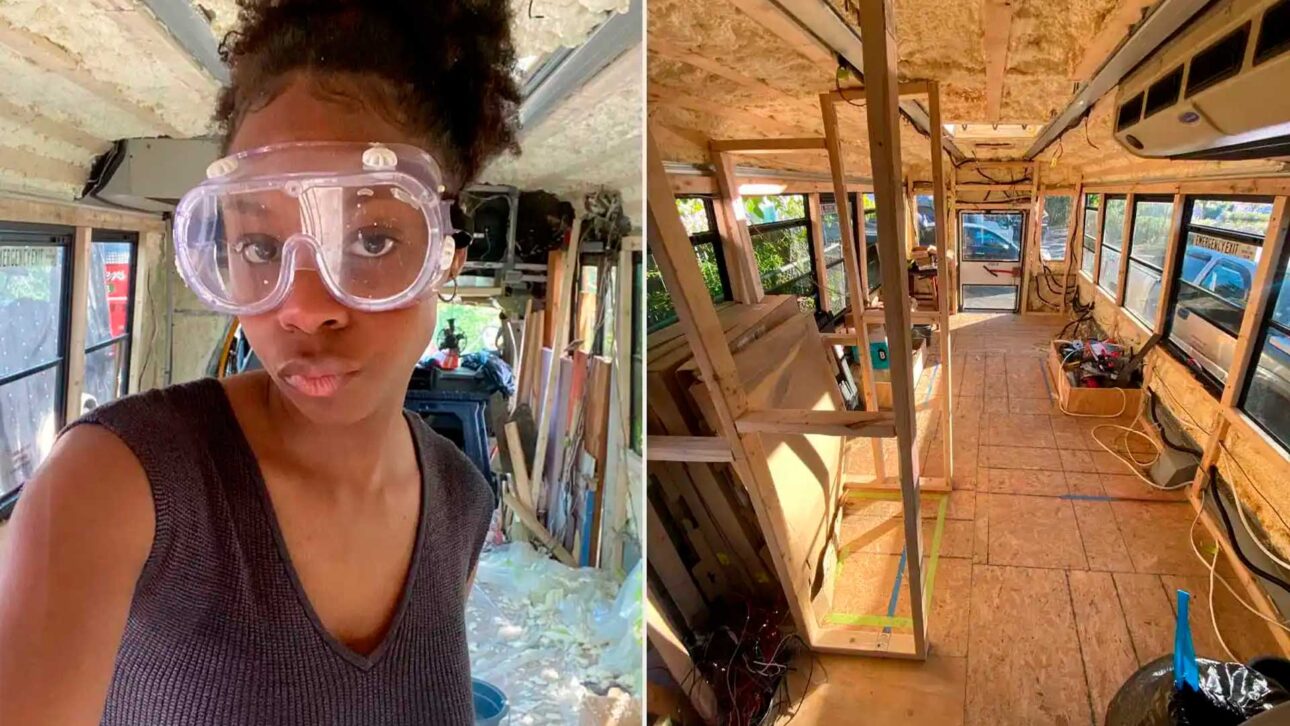
The conversion began in September 2021 and progressed gradually. Danielle estimates she did about 85% of the work herself, learning during the process and hiring help only for tasks that required more safety or technical knowledge.
Among the services where she sought support were the removal of seats and the installation of more complex components. A friend helped with parts of the demolition, and a handyman named Marco was called for stages like the solar panels and moments when the young woman felt exhausted.
Solar energy was one of the most expensive parts of the adaptation. The system cost almost US$ 3,000, including materials and installation, and became essential to ensure electricity during life on the road.
Another significant expense was the polyurethane foam insulation, which cost about US$ 900. This step is crucial in adapted vehicles because it helps control the internal temperature, reduce thermal discomfort, and make the space more livable in different climates.
The bus became a home, but the routine doesn’t have the same luxuries as a traditional property
After completing the renovation in March 2025, Danielle began living on the bus full-time. She reports that she has already taken trips with friends and that her family, initially skeptical, has come to be proud of the choice, although they still have concerns about safety.
The vehicle was designed to be comfortable, but it doesn’t eliminate all challenges. Those who live in a house on wheels need to deal with water supply, proper waste disposal, choosing places to park, and maintaining the vehicle itself.
Danielle often stops at truck rest areas, retail chain parking lots, national parks, and campgrounds. This routine allows her to reduce rental costs but requires flexibility, research, and attention to the rules of each location.
She also acknowledges that the bus works better in cold climates. During warmer periods, she tends to move to regions with milder temperatures, showing that mobility is part of the solution but also part of the routine.
The story grows amid an increasingly burdensome rental scenario
Danielle’s choice did not happen in isolation from a larger economic context. According to the Joint Center for Housing Studies at Harvard University, the United States reached a record of 22.7 million renter households spending more than 30% of their income on rent and basic bills in 2024.
The same survey indicates that 12.1 million of these families were in an even more burdensome situation, spending more than half of their income on housing. This scenario helps explain why alternative solutions, such as vans, trailers, and adapted buses, have started to attract young adults and workers with greater mobility.
The RV Industry Association also identified a shift in the profile of those seeking recreational vehicles in the United States. The 2025 report showed that the audience is younger and that remote work has started to influence part of this interest in mobile lifestyles.
In Danielle’s case, the goal is precisely to secure a remote job to sustain the freedom to travel. Until then, she lives off savings and temporary jobs, keeping the bus as her home and main living structure.
The romanticized part exists, but reality demands preparation
Although the story seems inspiring, Danielle makes a point of highlighting that living in a bus is not for everyone. The nomadic life requires accepting changes, unforeseen events, and a less predictable routine than that of a conventional home.
She warns that people tend to see the prettier version of this lifestyle on social media, but they don’t always see the behind-the-scenes. Finding water, managing waste disposal, dealing with heat, cold, parking, and maintenance are inevitable parts of the experience.
At the same time, the young woman states that she learned what was necessary during the process. The bus renovation did not start with complete technical mastery, but with a willingness to research, make mistakes, correct them, and move forward step by step.
The result is a small, mobile, and personalized home, created as a response to rent and the desire to live with more freedom. For Danielle, the project was not just a vehicle renovation but a way to redesign her own life with less dependence on a fixed address.
Would you have the courage to trade a house or apartment for an adapted bus to escape rent and live on the road? Leave your opinion in the comments and tell us if this freedom would outweigh the daily challenges.


Be the first to react!