






 Portuguese
  Spanish
  5 min of reading
  0 comments


As the housing crisis pushes more people onto the streets, a project in Cambridge uses compact houses, privacy, and social support to try to break the cycle between street, shelter, and unstable housing
The city of Cambridge, England, has become a reference in a practical response to one of the most difficult urban problems to solve, getting people off the streets without just transferring them to temporary shelters. The approach was to install small, individual, self-sufficient modular homes on well-utilized land, with close social support.
The project is led by the Jimmy’s Cambridge institution, in partnership with local organizations, the municipal public authority, and construction sector companies. The proposal does not treat the house as an isolated solution, but as a transitional stage for those who need to rebuild routine, health, relationships, and autonomy.
According to information from Jimmy’s Cambridge itself, the initiative began in 2019 and today totals 22 modular homes distributed across four locations in Cambridge. The units are aimed at people who have slept on the streets and who benefit from individual housing, with support from professional staff.
-
Facing high costs and limited expertise in Brazil, couple builds 27 m² tiny home on wheels for $36,000 using online resources.

-
Tired of High Rent in Portland, Newlyweds Buy 37m² Tiny House with 36 Cabinets, King-Size Bed, and Loft Office, Paving Way to Financial Freedom
-
In Sweden’s Jukkasjärvi, Artists Transform the Frozen Torne River into the Icehotel, a Seasonal Ice Structure That Melts Back into Nature

-
Innovative Heat Storage Tower in Finland Uses 2,000 Tons of Crushed Soapstone to Warm Cities


The issue gained even more relevance because England has once again recorded high numbers of people sleeping rough. According to the British government, the autumn 2025 survey estimated 4,793 people sleeping on the streets in a single night, the highest number in the official series.
The small house does not function as a collective shelter, and this detail changes the experience of those who have lived on the streets
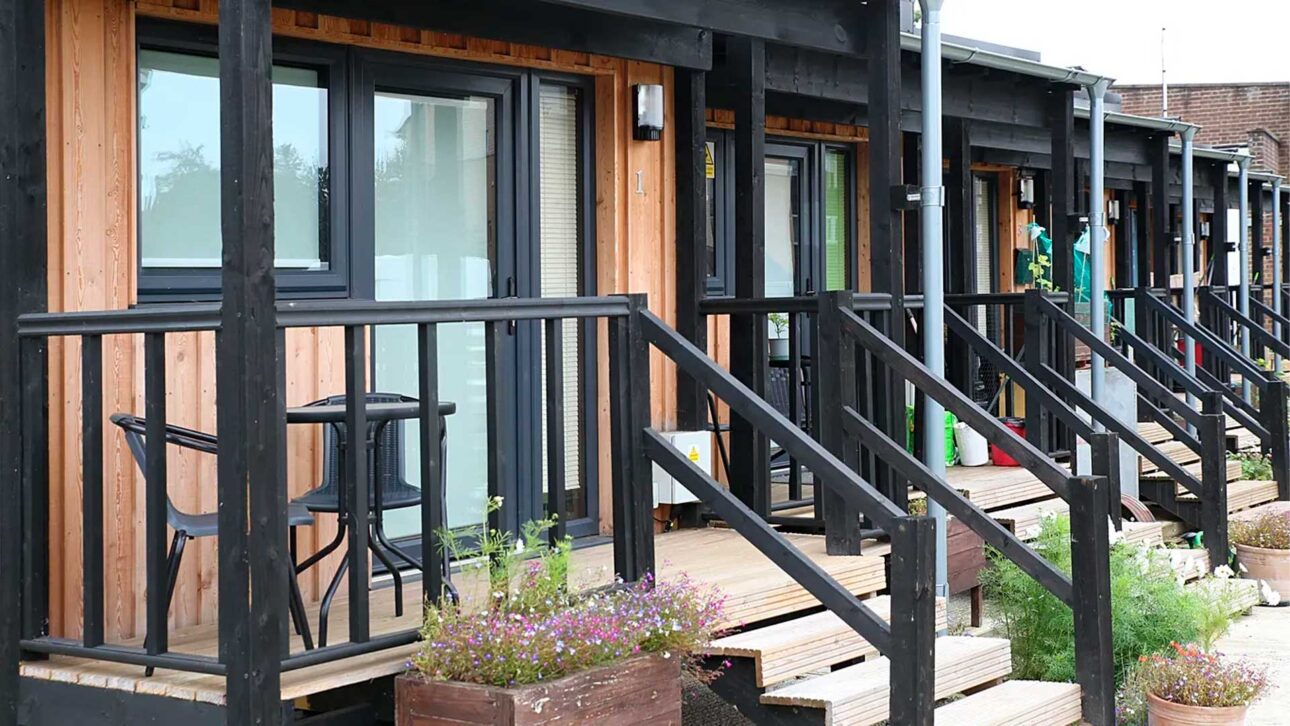
The central point of the Cambridge model is the idea of offering a door of one’s own. For those who have experienced street life, hostels, shared rooms, or unstable accommodations, this detail can mean security, silence, privacy, and control over their own routine.
The modular units are compact but include the basic elements of an individual dwelling: living area with kitchen, bathroom, separate bedroom, and, in some cases, a small balcony and garden. In practice, the resident no longer depends on collective spaces for simple day-to-day tasks.
This difference is important because many people experiencing homelessness also carry health problems, broken family ties, substance dependency, a history of violence, or difficulty adapting to conventional shelters. Housing, in this case, functions as a point of stability, not as a magic solution.
Cambridge used small plots to create mini-communities instead of large isolated complexes
One of the most important decisions of the project was to avoid very large complexes. The houses were distributed in small clusters, with four to six units in some locations, forming low-scale mini-communities.
This choice reduces the feeling of confinement and facilitates monitoring of the residents. It also allows for the use of plots that would hardly receive conventional developments, such as smaller areas, underutilized public spaces, or land donated by local partners.
According to Euronews, the modular houses were presented as a lower-cost and faster construction alternative compared to traditional affordable housing models. The report also highlighted that, in Cambridge, each unit was about 25 m², a small size but sufficient for a person to live with privacy.
The modular format helps because part of the construction can be done off-site. Then, the unit is transported and connected to the site’s infrastructure, which can reduce time, heavy construction, and initial cost.
Social support is what separates housing from a simple box installed on the land
The Cambridge experience shows that it’s not enough to place small houses on an empty plot. Social support is part of the project’s structure and aims to help residents deal with health, documents, money, routine, employment, and preparation for permanent housing.
As reported by Homeless Link, the Cambridge model serves people with medium to high support needs and does not intend to replace all shelters. It functions as an alternative for those who do not adapt well to hostels, collective accommodations, or emergency solutions.
This detail is decisive. A person who has lived on the street for a long time may manage to enter a modular unit but still need guidance to maintain bills, appointments, social habits, and plans to move to permanent housing.
Therefore, the project is more like a bridge than a final destination. The house offers stability, but the goal is to prepare the resident for a more autonomous and secure life.
The idea spread because it addresses a problem that grows faster than traditional construction
Interest in modular homes has increased because many cities face the same combination of problems: high rent, lack of social housing, overcrowded shelters, and difficulty finding land for large projects.
The Centre for Homelessness Impact identified, in a study on the United Kingdom, 33 modular housing schemes or adapted containers in 22 local authorities, totaling 808 units. The survey showed that most of these initiatives are temporary and depend on partnerships between the public sector, social entities, and private suppliers.
The construction company Hill, for example, created the Foundation 200 initiative, with the promise of providing 200 modular homes for homeless people over five years. The SoloHaus units were designed with a focus on safety, dignity, and independence.
This type of project draws attention because it tries to occupy an intermediate space between emergency shelter and permanent social housing. Instead of waiting years for an ideal solution, the city creates a stabilization stage for those most vulnerable.
But the model itself makes it clear that modular housing does not solve the housing crisis alone
Despite the positive results, the case of Cambridge also reveals limitations. The units are small, generally temporary, and depend on available land, constant maintenance, and skilled teams.
The Cambridge Centre for Housing and Planning Research pointed out that modular housing can bring positive results but works best when combined with support. The study also indicates that the bigger challenge remains the lack of long-term affordable housing.
This is the most sensitive point. Modular housing can take someone off the streets, provide privacy, and allow a life restart. But if there is no permanent housing afterward, the person risks being stuck in an intermediate stage.
Therefore, experts treat the model as part of the housing policy, not as a substitute for it. It can be quick, flexible, and cheaper, but it needs to be connected to a larger network of health, social assistance, employment, and affordable rent.
Do you think small modular homes, with social support, could work in Brazilian cities to take people off the streets? Leave your opinion in the comments and tell us if this model would be a viable solution or just a temporary response to a bigger problem.





Be the first to react!