Portuguese
  Spanish


Korean Researchers Eliminate The Dendrite Problem And Create Lithium-Metal Battery That Guarantees 800 Km Of Range And Recharges In Just 12 Minutes.
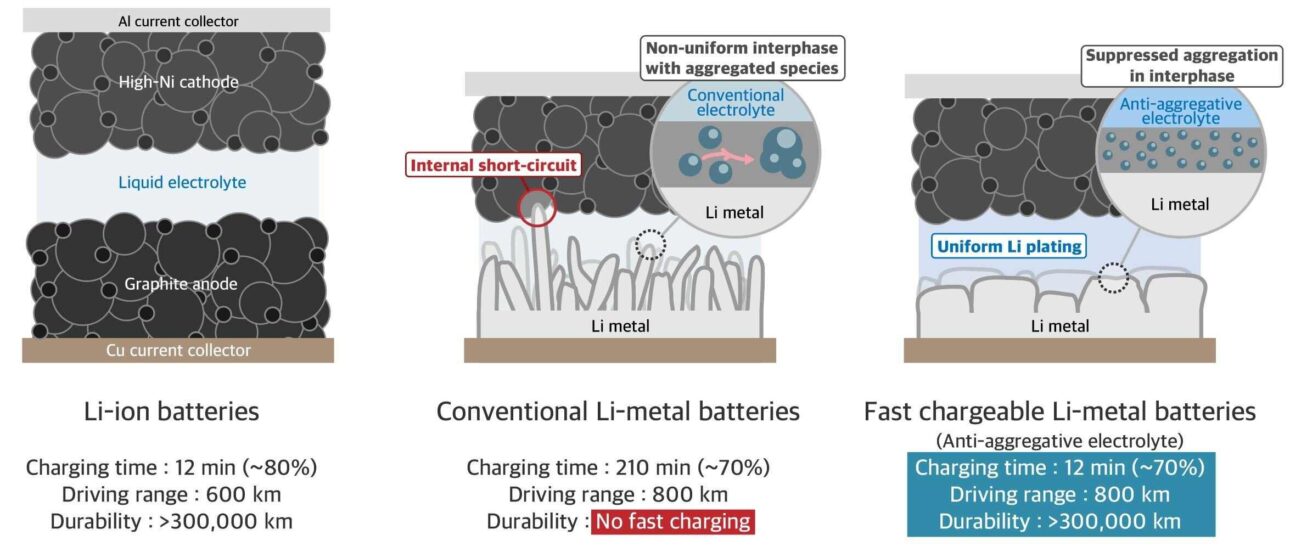
Korean researchers have developed a lithium-metal battery capable of overcoming the limits of current technologies. The result is a range of 800 km on a single charge and a recharging time of 12 minutes.
This advancement was made possible because the team solved the long-standing dendrite problem, which compromised the performance and safety of lithium-metal batteries.
Comparison With Conventional Batteries
Lithium-ion batteries, used today in most electric vehicles, reach a maximum range of 600 km. In contrast, the new battery maintains superior performance, with an estimated lifespan of over 300,000 km.
-
Giant Phantom Halo Appears Around Remote Pacific Islands, NASA Reveals It’s Created by Tiny Marine Organisms

-
Scientists Develop Method to Store Wind and Solar Energy by Liquefying Air for On-Demand Power Generation

-
Brazilian Engineer Who Grew Up Without Electricity Develops Software, Expands AltoQi to 67,000 Clients, Aiming for $21 Million by Digitizing Brazil’s Construction Industry

-
Spain Launches World’s Largest Floating Dry Dock: 56-Meter Giant Produces Massive Concrete Structures in A Coruña Using Technology Proven in Brazil



Additionally, it solves the limitation of low charging speed, one of the main obstacles for the automotive sector.
The Role Of Joint Research
The achievement is the result of work conducted at the Frontier Research Laboratory (FRL), which includes Professor Hee Tak Kim from KAIST and LG Energy Solution. The study was published in the journal Nature Energy.
The innovation lies in the creation of a “new cohesive-inhibiting liquid electrolyte,” responsible for stabilizing the lithium metal interface during charging.
How The Solution Works
The electrolyte uses an anionic structure with weak binding affinity to lithium ions. This configuration reduces the non-uniformity on the anode surface, preventing the formation of dendrite crystals.
Therefore, even under fast charging conditions, the growth of these crystals is suppressed, ensuring stability and performance.
Importance For The Market
The result means that electric vehicles can travel further, recharge in just a few minutes, and maintain operational safety. This opens the door for large-scale application of this technology.
According to Je-Young Kim, CTO of LG Energy Solution, the four years of collaboration with KAIST are yielding significant advancements. He stated that the company will continue to strengthen the partnership between industry and academia.
View Of The Researchers
For Professor Hee Tak Kim, the research creates a solid foundation to overcome the technical challenges of lithium-metal batteries. According to him, the most difficult barrier to introducing this model in electric vehicles has been overcome.
This result marks a decisive step toward the next generation of batteries, which could change the global electric mobility market.